The recent update of a royal burial on the Caracol site, in Bélize, brings new elements to the origins of the Maya monarchical power. In January 2025, archaeologists from the University of Houston discovered the presumed tomb of Te K’ab Chaak, considered as the founder of the Caracol dynasty, one of the main urban centers in the Mayan world. Dated approximately 350 AD. AD, the burial was located in the northeast acropolis of the site.
The excavation delivered remarkable funeral furniture: a mosaic mortuary mask of jadeite, jade jewelry, engraved bone tubes, eleven ceramic vases decorated with ritual scenes, as well as spondyle shells from the Pacific. These objects testify to extensive exchange networks and the high status of the deceased. The state of conservation of the remains indicates that it was a man of around 1.70 meters, wereyed, probably elderly, which supports the hypothesis of an individual belonging to the Mayan elite.
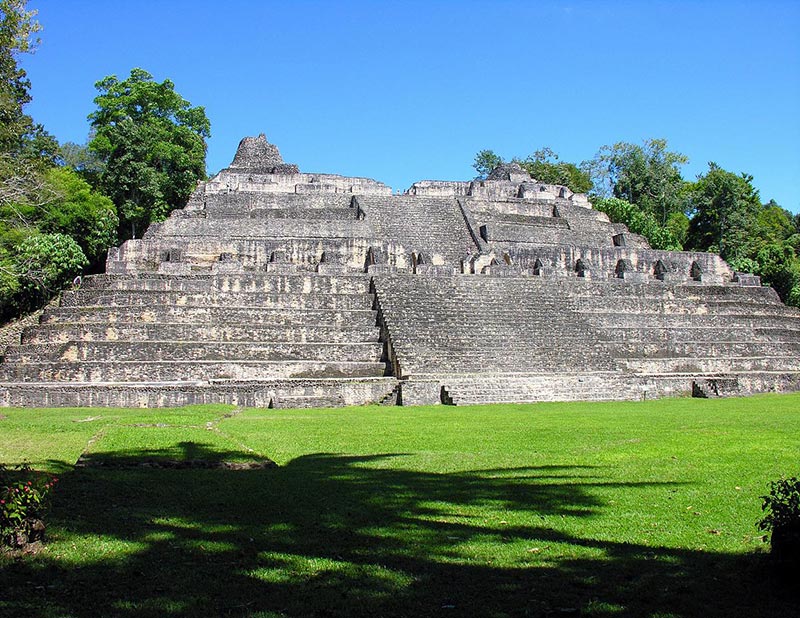
The research program in Caracol has been directed since 1985 by Arlen and Diane Chase, respectively professor and vice-president of the University of Houston, in partnership with the Bélizian heritage authorities. These works have made it possible to document the extent of the city, the monumental nucleus of which covers nearly 200 km², with in particular the Caana pyramid (43 m), several ceremonial places and fifty sculpted steles.
Among the major contributions of this discovery is the presence of symbols and objects of foreign origin, accrediting the existence of old diplomatic relations between Caracol and Teotihuacan, the main urban center of the Mexico Valley, located more than 1,200 kilometers. The analysis of funeral furniture suggests the existence of political, economic and religious exchanges prior to thetraded From 378, a military intervention by Teotihuacan in Tikal mentioned in the epigraphic sources, which has permanently modified the regional balance.
The Mesoamician context of the 4th and 5th centuries is marked by the emergence of cities-states, the consolidation of major centers such as Teotihuacan, and the multiplication of alliances networks. L’traded Introduced dynasties linked to Teotihuacan to Tikal. In Caracol, archaeological data suggest a distinct chronology and call to reassess the scheme of direct military domination for the benefit of a model based on the circulation of practices, people and resources between regional powers.
Since its rediscovery in 1937, and more intensively since the 1950s, Caracol has asserted itself as a reference site for the study of classic Mayan civilization. The excavations made it possible to release residential sets, astronomical monuments and older tombs, confirming the political importance of the site in the Mayan cultural area.
The next steps of the project include ancient DNA analyzes, isotopic studies and the restoration of the jadeite mask. The first results will be presented during an international conference organized in Santa Fe in August 2025. The artefacts were preserved by the Bélize Archeology Institute and will be the subject of reinforced conservation protocols for a public presentation on a national scale.