Twenty-seven years after seeing a few pieces of wood and amphorae under two meters of water, two Sicilian divers could finally be rewarded for having unearthed a Roman wreck. By judgment no. 660 of September 29, 2026, the Council of Administrative Justice for the Sicilian Region (CGARS the equivalent in France of an administrative court of appeal) required the regional services to complete the procedure initiated to specify the conditions for the discovery of the two divers in order to determine their right to a reward.
On August 11, 1999, off the coast of Marausa in Sicily, Fabio di Bono and Dario d’Amico spotted a wooden structure surrounded by amphora fragments on the bottom of the Trapani Sea while snorkeling. The next day, they reported their discovery to the customs police and the Superintendence of the Sea, in order to assert their right to the price of the discovery (First prize) provided for in the Italian code of cultural goods and which regulates the reward mechanisms for “fortuitous” discoveries.
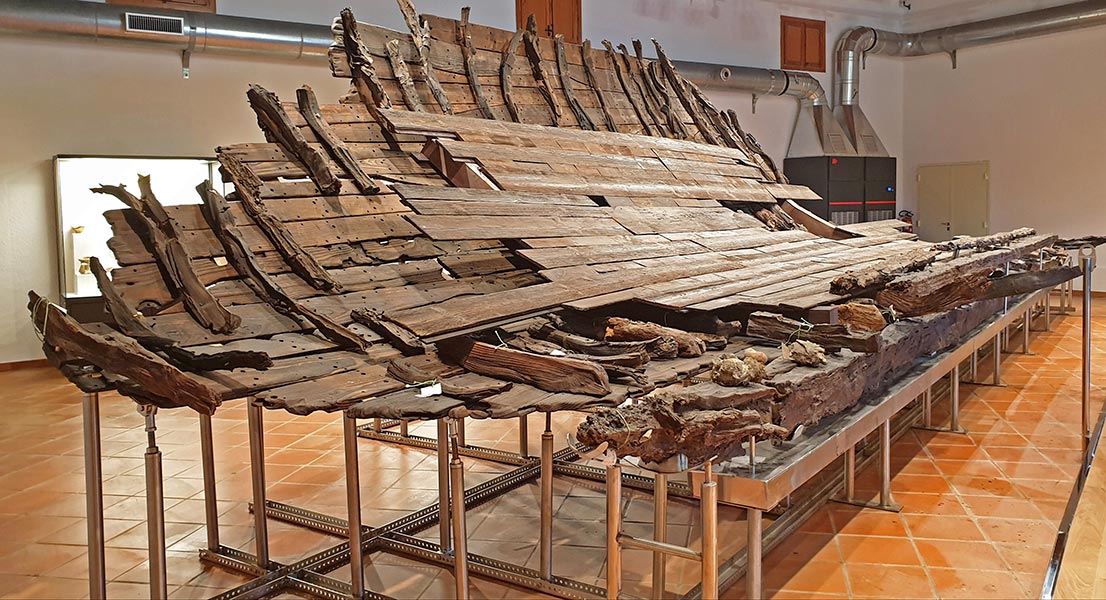
Seen just 2 meters deep, the wooden structure was identified as the wreck of a Roman merchant ship dating from the 3rd century AD. The wreck was pulled from the water in 2011, and the boat was then restored in Salerno, before being transferred to the Baglio Anselmi Archaeological Museum in Marsala (Sicily), where it has been on permanent display since April 13, 2019.
The administrative procedure aimed at setting the amount of the reward was unsuccessful, and the divers then appealed to the Regional Administrative Court (TAR) demanding 500,000 euros. Their request rejected, they appealed to the CGARS which overturned the court’s decision and obliged the Region to continue its efforts, without however ruling on the nature of the discovery or setting a sum to be paid, other than 6,000 euros in compensation for the plaintiffs’ legal costs. It is now up to the Sicilian Region to determine whether or not the discovery was fortuitous – a necessary condition for obtaining a reward.
The uncertainty of the case was due to the fact that the subsequent commitment of di Bono and d’Amico in the protection of the site of their discovery, and in the archaeological research of which it was the subject, had raised suspicions of the existence of a scientific motivation behind their dive, which would have made the discovery intentional and, if necessary, ineligible for a reward.
The CGARS, however, clarified that the subsequent involvement of the two men in research around the Marausa wreck is not enough to rule out the fortuitous nature of the discovery. On the other hand, the Region has not received any directive relating to a possible reward, and remains competent to quantify the amount which, in accordance with the law, cannot exceed a quarter of the value of the goods. The CGARS, however, specified that this amount should be calculated by considering all the archaeological discoveries following the divers’ report – and not just the strict subject of their report –, under the principle of causal, topographical and archaeological continuity.
In France, maritime cultural property is subject to a special regime. The Code distinguishes between property whose owner is not likely to be found, which immediately belongs to the State, and those whose owner has not been found three years after the publication of the discovery, which then becomes property of the State. Any vestige or wreck of archaeological, historical or prehistoric interest located in the public maritime domain is considered maritime cultural property. A reward is provided for the discoverers, which can take the form of a lump sum compensation or an interest in the operating results for thirty years. In this second case, the amount of the profit-sharing cannot exceed 25% of the operating profit.