
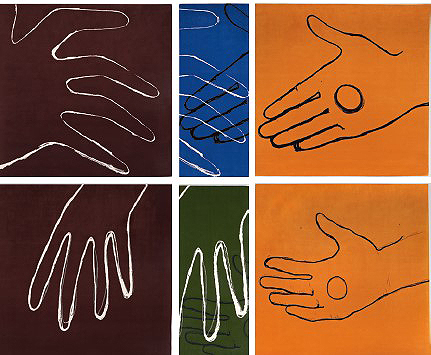
Those who were able to know Anni Albers personally said that the German artist maintained a relationship with the very diverse materials she used that could be defined as intimate: inspired by the pre-Columbian art that she was able to see first-hand in Latin America and also by industrial aesthetics, like so many in the Bauhaus, she constantly explored the capacity of fabric to generate its own motifs and fulfill new functions. Without ceasing to combine his creative work with the pedagogical and the theoretical, he was able to exhibit his hangings and pictorial textiles in several American museums, including the MoMA – it was the early fifties – until in engravings he found the ideal method to propose compositional patterns susceptible to multiple variations – triangles and rhombuses or labyrinthine curved lines that connect with his previous tapestries predominate.
Your essay The Pliable Planedated precisely in 1957, gives the title to the exhibition with which the Bank of Spain presents, until next March, the crafted pieces that are part of its funds, and also some from other public and private collections. In that text, this pioneer in combining traditional creative practices and modern graphic language defined fabrics in art as an active and flexible surface that could modify spaces, filter light, absorb sound and transform our experience of architecture.
In this exhibition, curated by Yolanda Romero, curator of this institution, this textile support is not addressed as an ornamental element, but as a multifunctional device, capable of protecting those who inhabit spaces, delimiting areas, telling stories or representing certain visions of power. Those that occupy the center of the route, belonging precisely to the Bank, were conceived to integrate into the architecture of the headquarters of this entity, serving hierarchical and representative purposes and enhancing the solemnity of the rooms.
Around these pieces, contemporary works will come our way that in recent decades have renewed and expanded the possibilities of this discipline, while, at the same time, they remember that this continues to be a valid and current technique when transmitting knowledge and memories or reflecting on the value of the artisanal connotations of these compositions or on their weight when it comes to relating to spaces and architecture itself; that, according to Albers herself, is our third skin, the tissue being, from that perspective, the mediator between the human body and its environment.
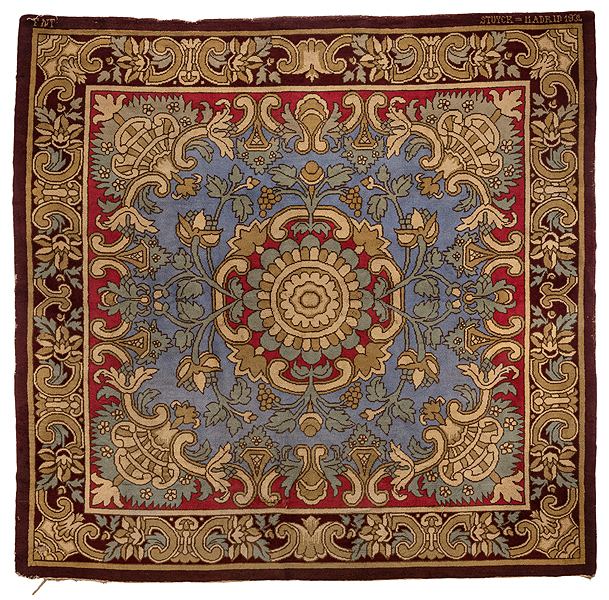
National Tapestry Factory. Carpet, 1934. Bank of Spain Collection
“The flexible plane” thus consists of tapestries, carpets, paintings, photographs, videos, documents and coins, dated between the 17th and 21st centuries, which are structured into four thematic sections dedicated to the act of sewing, to the many crises that threaten artisanal trades and their survival strategies, to the role of these works in interiors – their most common habitat – and, finally, to their relationship with the creation of value in the context of the building in which we are located.
The exhibition begins by claiming that the needle can be to three dimensions what the pencil is to two, and its stitches are strokes: sewing draws, writes and builds and, beyond the domestic sphere, is part of stories, identities, forms of work and uses of power. This section includes compositions by contemporary artists who have associated threading with historical demands for women’s rights (Elo Vega), with domestic work during the Franco era (Isabel Oliver), with the memory of employees in the textile industry (Victoria Gil) or with what sewing has to claim for slowness in times of acceleration and consumption (Carole Frances Lung).
In addition, we will see proposals by Narelle Jubelin – a reinterpretation of The Víznar Gapby José Guerrero, in which the needle would sew wounds after the death of García Lorca-; from the performer Esther Ferrer, who has claimed that the thread can raise its own minimal architectures; or Elena del Rivero, who time and again has used fragile materials, and also sewing, to allude to absences, memories and wounds.
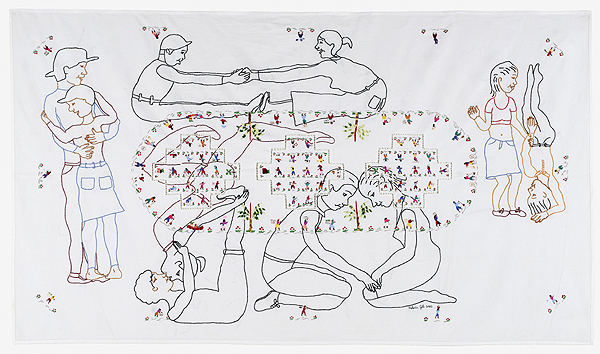
Victoria Gil. The locals work 3. Bank of Spain Collection
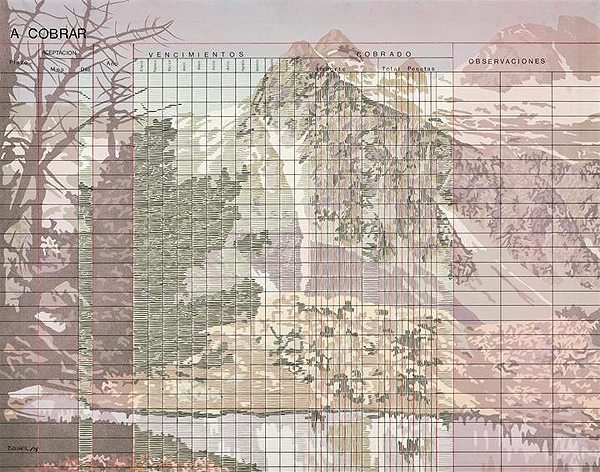
Elizabeth Oliver. No.34. Series The commercialization of art1975. Bank of Spain Collection
The chapter dedicated to the decline and survival of craftsmanship is titled, significantly, Defeated minoritiesin reference to another mention by Anni Albers of lost manual tasks.
Here await us are those works designed to prove that rampant industrialization has not managed to stop textiles from being a learning space and has added a resistance exercise component to it. From their different generations, the Catalans Teresa Lanceta and Aurèlia Muñoz have praised the cultural transmission carried out by the communities of anonymous and popular weavers; The French Yto Barrada has taken as a starting point the traditional dyeing and fiber handling processes of Morocco to approach, by critical comparison, the functioning of today’s textile industry and its ecological and political effects; and Antonio Pichillá, a Mayan author tz’utujilhas used fibers and wool to recover indigenous ways of understanding time. Both of them attest that there is not only nostalgia in the tapestry.
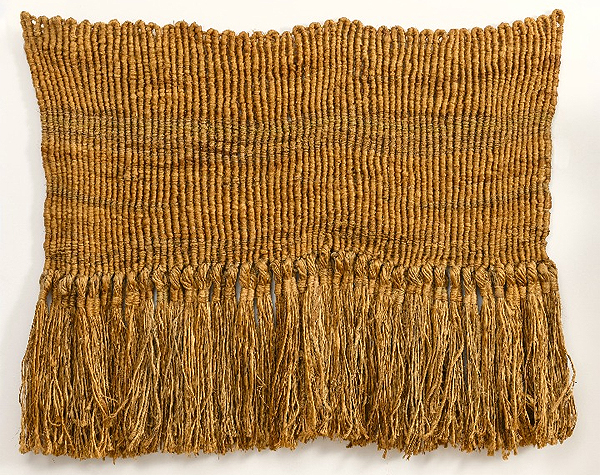
Aurelia Muñoz. Mantle1973. Bank of Spain Collection
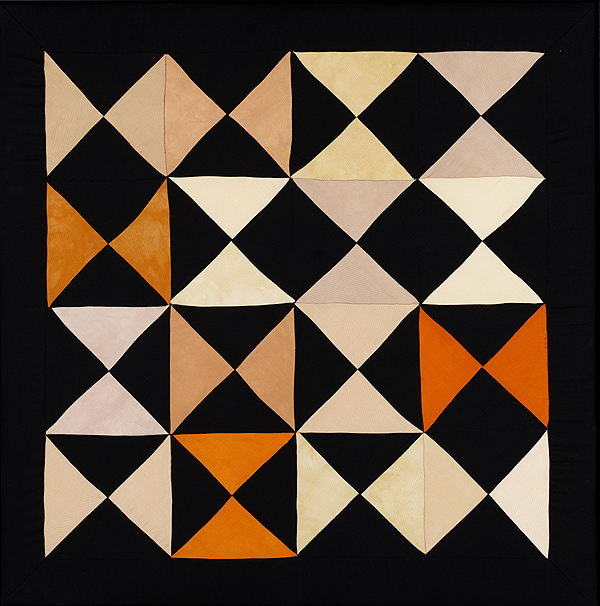
Yto Barrada. Hourglass II2023. Bank of Spain Collection
Yes, again, Albers spoke of an indoor existence and emphasized the role that fabrics played in the distribution of interior spaces, in terms of comfort and dampening sound and cold, the third section of the exhibition has works designed to differentiate or organize rooms and make them more comfortable. They are linked to the history of the Bank of Spain itself, which has demanded this type of creations since its inception.
We are referring to carpets commissioned from the Royal Tapestry Factory in the second half of the 19th century or to half a dozen Flemish tapestries by Geraert Peemans that represent the months of the year and the signs of the zodiac and that Juan de Zavala integrated into his project to improve the acoustics and that they became part of the same construction.
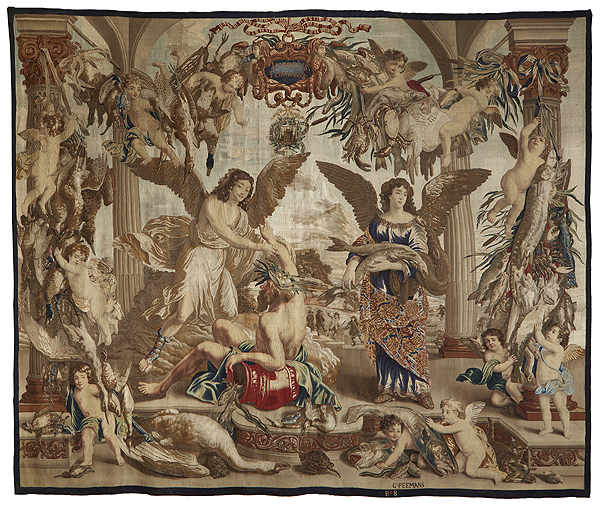
Gerard Peemans, after design by David Teniers III. Series The monthsaround 1679. Bank of Spain Collection
Finally, textiles become a center of exchange, an object of value and a means of telling stories.
The Bank has commissioned Dora García to tapestries for its Collectors’ Hall in which this artist links the creation of economic value with interpersonal relationships, and here we will also learn about projects by Andreas Maria Fohr, Mercedes Azpilicueta, Patricia Esquivias and Manuel Chavajay. The first has used a safe, a photograph, a ceramic key and several embroidered textiles to allude to promissory notes, that is, promises of future payment with value in the present; and the last three share with the former their desire to connect other times with this one and to measure and remember from cloths that weave much more than threads.
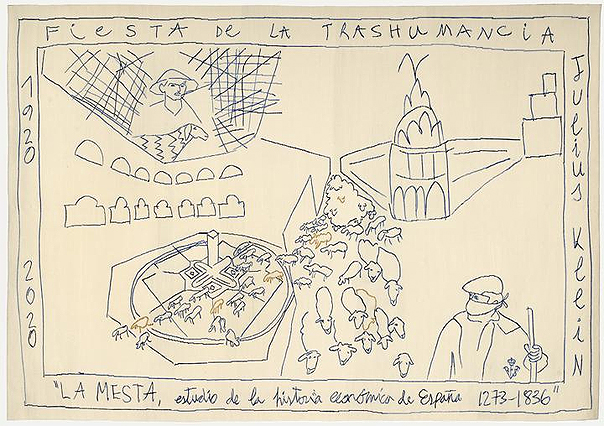
Patricia Esquivias. Transhumance festival2020. Bank of Spain Collection
«The flexible plane. The textile collection of the Bank of Spain»
BANK OF SPAIN ROOM
C/ Alcalá, 48
Madrid
From September 28, 2026 to March 28, 2027


