Despite budgetary difficulties, London museums manage to find funds to grow or modernize like the British Museum or the National Gallery. The Britain Tate is not to be outdone with a more modest project. The initiative called “The Clore Garden” consists in giving a facelift to the green spaces adjoining the entrance.
The origin of the project dates back to February 2024, when the Tate announced the selection of the Tom Stuart-Smith studio to design a new garden in front of the museum. In March 2025, public consultations were organized. The first projects were presented in May 2025, before examination by the Council soon.
The Duffield Foundation fence finances the project as part of a donation of 30 million pounds (€ 34 million) announced in 2024 to celebrate its 60th anniversary. The Tom Stuart-Smith studio, led by a renowned landscaper, ensures the design, in collaboration with Feilden Fowles for infrastructure. The Royal Horticultural Society brings its technical expertise for the choice of plant species.
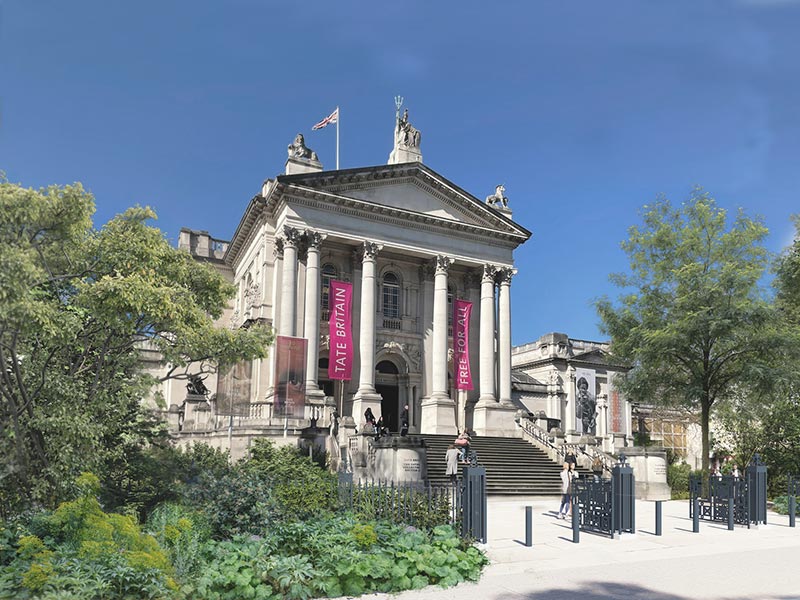
The Garden Clore will therefore replace the existing green spaces with a layout including a garden of Mediterranean inspiration in the south and a space inspired by the woods of Asia from East to North, with a fauna pond. Sixty new trees belonging to different species will be planted. An autonomous wooden and stone garden classroom, a coffee terrace and a space intended for the public, designed by Feilden Fowles, will complete the whole, connected by trails made from recycled materials. Sculptures from the Tate collection, including works by Nathan Coley, Henry Moore and Barbara Hepworth, will be integrated into the site. The redevelopment also plans to modify the implantation and restore the current (protected) grids as well as the displacement of the taxi stop.
3D projection of the project The Clore Garden around the Britain tate.
© Tom Stuart-Smith
The work will start in the fall of 2025 for an opening in 2026. The site must take place in two phases: the first will concern landscaping and the garden classroom, the second road facilities.
Critics come mainly from heritage defense organizations. Victorian Society denounces a “Unacceptable damage” to the architectural framework, believing that the extent of the plantations risks “Compromise architectural integrity” by “excessive foliage”. Historic Buildings and Places opposes the planting of a walnut in front of the facade, deemed disturbing for symmetry. These organizations highlight a risk for heritage readability and historical perspective, while recognizing the overall interest of the project.
The Westminster Municipal Council, Historic England and Transport for London are among the institutional supports. According to them, the proposals “would bring significant public advantages without causing excessive prejudice to the site”. Supporters highlight the creation of a green space associating art and nature, the improvement of urban biodiversity and educational interest. Roland Rudd, president of the tate thus justified the need for the project: “Currently, let’s be honest, when you go to the Britain tate, it’s awful. You have these rows of bushes (at the front), and they look very old, they seem to be moldy. People tend to relieve themselves behind them ”.
This initiative comes after the renovation of 45 million pounds (€ 52 million) carried out between 2010 and 2013 by Caruso St John Architects, which had reopened the main entrance on the Thames (Millbank), created a spiral staircase under the rotunda to access the basement, restored the circular balcony closed since the 1920s and rebuilt nine galleries.