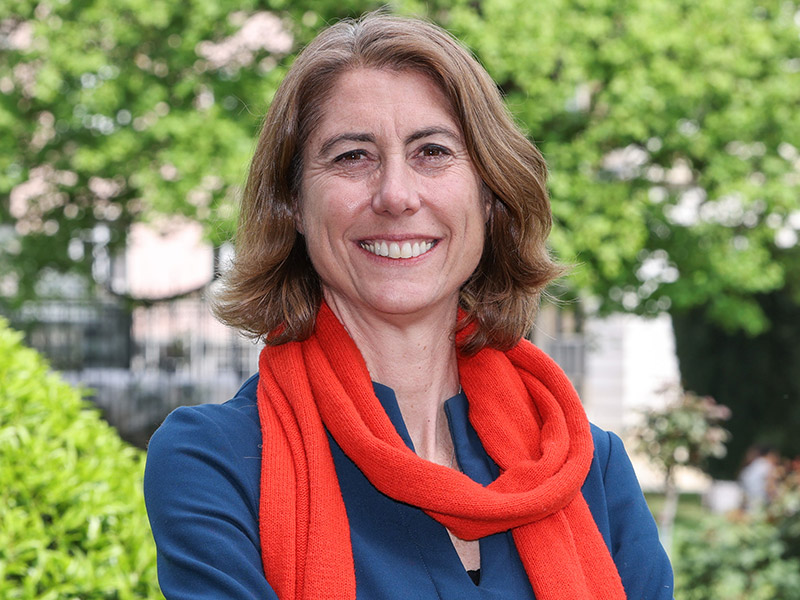
A figure in the cooperative world, Laurence Ruffin is a French social entrepreneur. A graduate of the Essec business school, in 2009 she became president and CEO of Scop Alma, a cooperative company specializing in the publishing of software and digital services. She remains there until 2026. She is the sister of MP François Ruffin.
You promised to change mayors and methods without changing course. On culture, which decision from the mandate of Éric Piolle (the previous mayor, environmentalist) are you abandoning?
Already, we want to keep what works like culture in public space, free and accessible. But it is true that we want to abandon major construction projects to rehabilitate existing buildings and work in a different way with cultural actors. For example, we want to resize the Tiles Festival (in reference to the Tiles Day of June 7, 1788, editor’s note) and give it a political tone on the question of resistance. We could even change its name and location.
Where do you place the limit between the political message carried by the City and the creative freedom that you defend at the Théâtre municipal de Grenoble (TMG)?
Structures like the TMG retain their artistic freedom. The City intervenes on premises, investments, accessibility and the main directions of public service, not on artistic choices. We also don’t want private financiers to dictate programming.
The cost of the Tiles Festival today amounts to 250,000 euros. How much will the 2027 version cost?
We are considering lowering its cost to 200,000 euros, but nothing has been decided because we want to keep an important event which attracts different audiences.
Isn’t the objective to preserve small structures?
We are committed not to reduce their subsidies this year. To save money, we first seek to make better use of equipment and avoid degrading public service. If budgetary constraints worsen, we will be able to review the rhythm of certain events such as the Biennial of Cities in Transition, the format of which is now being re-examined.
La Bobine (cultural venue) has closed, the National Contemporary Art Store-Center has experienced strikes, and actors are denouncing reductions in subsidies. Is it not necessary to renew dialogue with the cultural sector?
Absolutely. We were expected on this issue and we are working for reconciliation with the stakeholders, but the City will not be able to do everything and even less compensate for the disengagements of the State and the Region (Auvergne-Rhône-Alpes). However, we want to continue to support artistic and cultural creation, dissemination and education.
You announce a cultural budget of more than 30 million euros for 2027. How much are you really guaranteeing?
We are already protecting the 3.5 million euros directly paid to cultural actors. And as for the cultural budget, it exceeds 30 million euros with 28.9 million in operation and 2.8 million in investment. The objective is to maintain culture as the City’s third budgetary item after education and social services. And even if national finances force us to make choices, we seek to preserve the commitment of 174 euros of cultural spending per inhabitant.
Which gives no guarantee on the maintenance of these 30 million euros…
Our firm commitment firstly concerns the 3.5 million euros intended for the actors. For the rest, we are building a budget that allows us to preserve public service as well as a high level of cultural investment.
You say you want to avoid the financialization of culture while seeking new funding. How do you reconcile the two?
I don’t want privatization of the city! We refuse to let financial interests decide on artistic activity because culture is a common good. We need to be more imaginative, especially when it comes to financing. The renovation of the Perret Tower benefited from the patronage of citizens and businesses, while for the old painting museum we are working on a cooperative fund which would make it possible to diversify funding and move forward in stages.
In fact, the renovation of the old Painting Museum is estimated at 20 million euros. Do you confirm this amount?
We are well within this order of magnitude for a complete renovation, but we will not be able to do everything at once. The priority is to secure the building before gradually committing a few million euros.
Are you going to apply the same strategy for the transformation of the city of Rabot?
Yes, we are considering putting between 1 and 2 million euros each year to spread out funding still under negotiation, with, I would say, 10% as a contribution for the City. We will see more clearly at the end of the year but our ambition is first and foremost heritage.
Has the “Grande Bibliothèque” project been abandoned?
No way ! It is the construction of a new building which is abandoned, it will be housed in the premises of the tourist office. The objective is to open it before the end of the mandate, it is one of our main investments still under study in which the State must participate up to 40%.
Will it be enough to reach audiences far removed from culture?
No. There remains a gap of 20% between managers and workers in attendance at cultural places. Free access is not enough because we also need to reach out to the public. At the conservatory, registrations are free for families whose quotient is less than 400 euros, and they benefit from scholarships for instruments. We also want to strengthen the work in priority schools and neighborhoods.
You make the fight against drug trafficking a priority. What role can culture play?
Our objective is to strengthen the cultural presence in priority neighborhoods with structures such as the Espace 600 (theater for young audiences located in the Villeneuve district), the Prunier Sauvage (live performance hall) which we finance to the tune of 500,000 euros, or the Théâtre Sainte-Marie-d’en-Bas. Hoche sector, we want associations, families and artists to regain their place in public space. We must prevent drug traffickers from becoming neighborhood leaders because the mafia is already an important cultural force among young people. Culture won’t solve everything, but it can open doors and provide other perspectives.