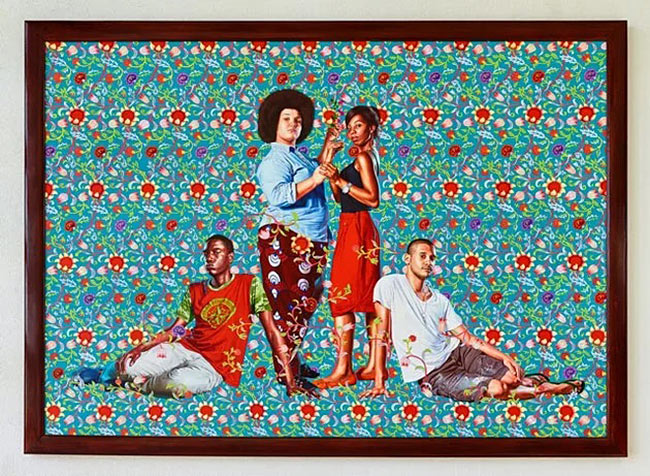
New assault on “wokist ideology” in the United States of Donald Trump. The State Department (equivalent in the United States to the Department of Foreign Affairs) announced that it wished to sell the work Young Artists After Siamesas 1960painted by artist Kehinde Wiley following a federal commission placed as part of the diplomatic program Art in Embassies in 2013. The painting has already been removed from the U.S. Embassy office in the Dominican Republic, but the State Department is still determining whether it can legally sell it.
Invoked as an argument for this hostility, the word: “woke”. Originally, the State Department offered more specific reasons, citing Kehinde Wiley’s accusations of sexual assault (which he denied), as well as a comment made about one of his works reinterpreting Judith and Holofernes, which he described as playing with the idea of“end with white people”. But the adjective woke ultimately appeared as a sufficient justification capable of hiding the real reason: Kehinde Wiley is the author of the official portrait of Barak Obama.
The work was commissioned in 2013, during President Obama’s first term. In 2015, the Department awarded Kehinde Wiley the Medal of Art for her contributions to cultural diplomacy. At the time, he was described as an artist reappropriating the tradition of Western portraiture to honor figures who had been historically and systematically excluded. A practice shared by other artists belonging to underrepresented communities, such as the African-American painter Henry Taylor, currently on display at the Musée Picasso-Paris.
The painting in question, Young Artists After Siamesas 1960results from extensive research conducted by Wiley on Dominican artists Gilberto Hernández Ortega – painter of the work Siamesasafter which Wiley composed his painting – and Celeste Woss y Gil. The four people depicted in front of the flowered background represent young Dominican artists who had posed for the artist.
Before the canvas was removed, the team at the United States Embassy in the Dominican Republic took the initiative of covering the painting with the Star-Spangled Banner. A choice which seems, in fact, more in line with the aesthetic criteria of Erin Scavino, director of the program Art in Embassies since Trump’s second term. Last month, she organized an evocative exhibition in Washington, “Passport to Patriotism: 250 Years of Diplomacy”, presenting 70 versions of the American flag.
As Virginia Shore, director of acquisitions for Art in Embassies between 2000 and 2017, recalled, there is no precedent for the sale of a work from the embassy’s collections. However, the Foreign Affairs Manual provides a procedure that would allow a work of art to be disposed of, explicitly considering its sale, subject to obtaining authorization from the Office Overseas Buildings Operations (OBO) department responsible for cultural heritage and works of art. For now, the outcome remains uncertain.