Crowdfunding. Remember, ten years ago: almost all museums organized very popular exhibitions crowdfunding (“crowdfunding”). Today these campaigns are in sharp decline. With the exception of the Louvre, large establishments have almost all abandoned this practice. “The Musée d’Orsay has only done it once, in 2014 for the restoration of Courbet’s Workshop (1854-1855). Then we didn’t follow up because we don’t have a dedicated team. Which means that this type of campaign requires a lot of time and energy to raise amounts that are not extremely high”summarizes Guillaume Roux, director of development of the public establishment. The Lyon Museum of Fine Arts, after several very effective campaigns (Ingres, Corneille), has also abandoned this practice. “We liked this because these actions allowed us to democratize the still elitist image of patronage. This helped us reach a lot of people, explains Isabelle Duflos, head of philanthropy at the Museum of Fine Arts in Lyon. We also really liked the novelty effect and the experimental side. But once it became commonplace, it was less stimulating. »
The time-consuming nature and logistics inherent in these operations have even discouraged certain museums, such as that of Bordeaux. “I think we are one of the rare major museums to have never offered participatory sponsorship! , smiles Sophie Barthélémy, its director. We thought about it because it is a good communication tool, but we did not find the suitable work. » However, some continue to bet on these jackpots. “For big museums, it’s not interesting and even a little counterproductive in terms of image. We know that they have significant resources, so giving the impression that we are doing the collecting can be frowned upon, slips a curator who is a fan of crowdfunding. But for small museums, it is crucial to involve our public and send a message to our guardianship. It’s a way of showing them that we don’t wait for money to fall from the sky. »
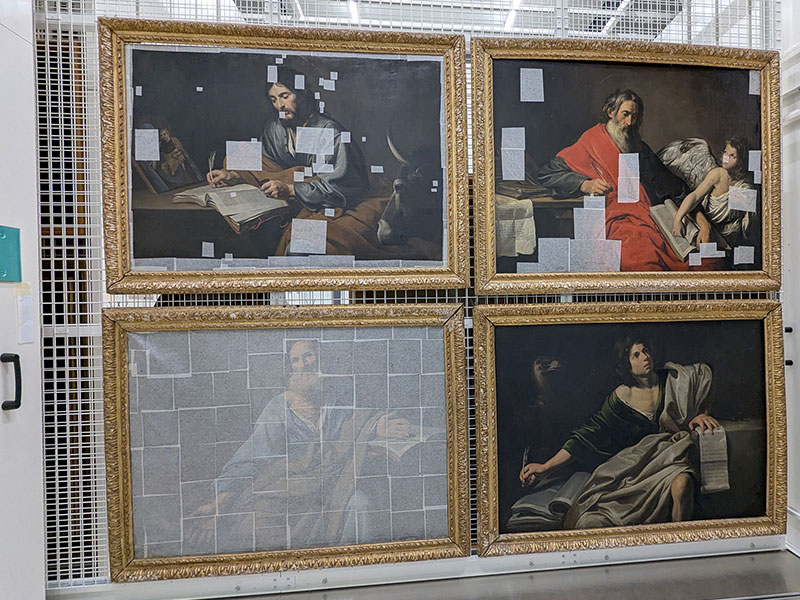
In this contrasting panorama, the example of the Museum of Fine Arts in Tours appears almost against the grain. “The first campaign was launched in 2023, when other museums had generally disengaged from this sectornotes Florian Sarrebeyroux, head of the sponsorship mission. Honestly, I didn’t really believe in acquiring an Italian primitive in the middle of an economic crisis. But the operation worked very well, including among young people thanks to an offbeat media campaign. » Building on this success, the museum is trying its luck again today and is seeking to collect 60,000 euros to restore eight major paintings from the 17th century, linked to the history of the museum but kept in reserve for a long time. And, against all expectations, for the moment the campaign is working well. “Despite the gloomy economic context, art lovers still want to support the institutions that are close to their hearts. One of the keys to its success is that patronage is apolitical and that it constitutes a sort of empowerment in the face of growing constrained spending. »