She is an artist, but also a writer, poet and editor and there are few works in which her concerns in all these facets are not appreciated. Laura Lío, born in the sixties in Buenos Aires and resident in Madrid for nearly thirty years, is now offering her first institutional exhibition in the capital at CentroCentro, under the curation of Nerea Ubieto: “Sobre/salto” brings together works dated since 2010 and some projects made specifically for the occasion. They respond to different languages (those of sculpture, graphic work, drawing and installation) and, thematically, to his fundamental look at life in all its forms: a biocentrism that has led him to explore the various ways of inhabiting the world, not just human, and to map the changes that have taken place in them and that have generated many others – social, environmental, communication – and the sensation that gives the title to this presentation. Their proposals speak to us again and again about links between species and interdependence in a very broad sense, between beings, formats or between citizens and power.
The assembly, on the fourth floor of the Cibeles Palace, transits between heaven and earth and often formulates visual connections between one piece and another. The first are two collages inspired by tree roots, in one case from the growth of a seed and the equation of sap and blood; in the other, nourishing itself with words: those contributed by participants in workshops, which articulate a kind of vegetal and emotional map with urban echoes.
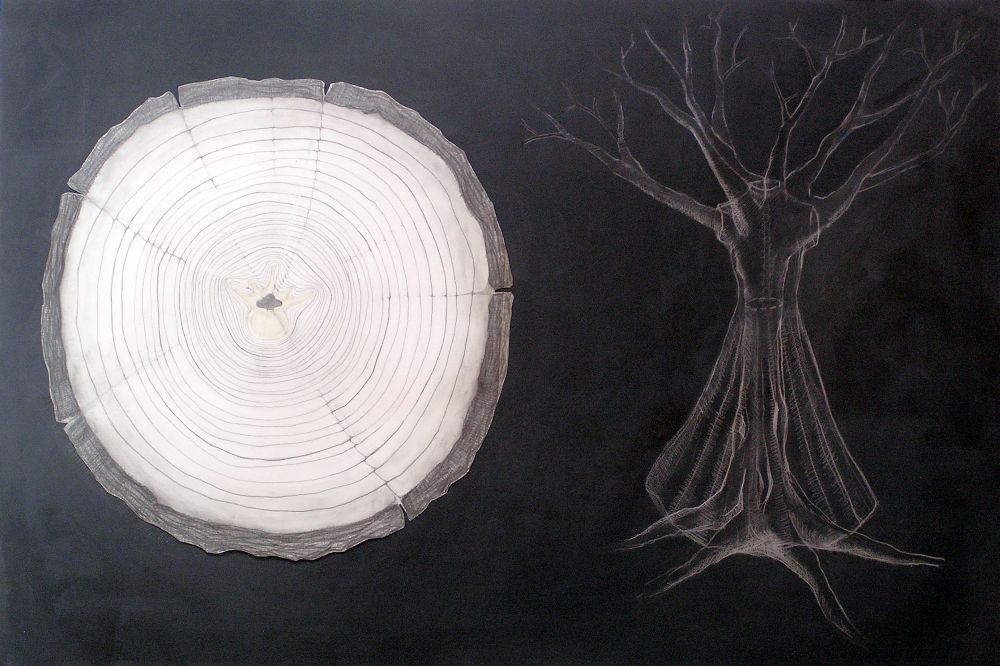
Laura Lío. Untitled, 2011. © Laura Lio. VEGAP, Madrid, 2026
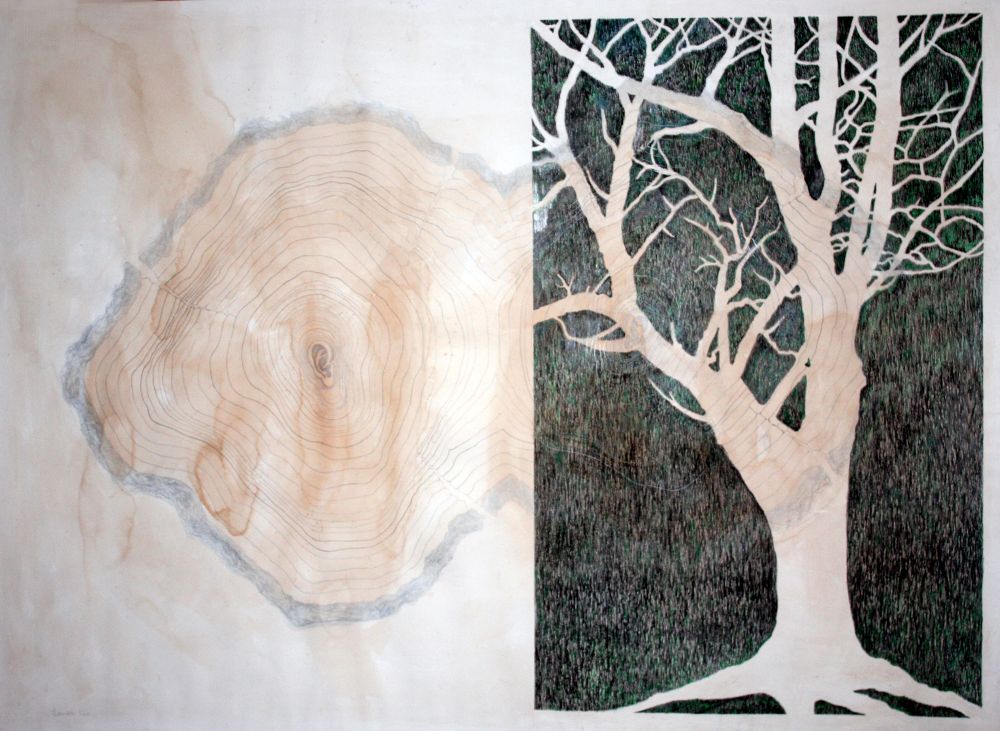
Laura Lío. Untitled, 2025. © Laura Lio. VEGAP, Madrid, 2026
Yes, we will see again and again in this exhibition, the back of the leaves can be linked to these urban approaches – for Lío there are no distant worlds – the body can also expand, become a unit of measurement and be extrapolated to the landscape: to mountain ranges and lakes. Referring to a verse by Olga Orozco (The world is a body, the body is a world), but also to the neural drawings of Ramón y Cajal, he has devised an artist’s book, whose pages we can see projected, in which the bones are inserted in geographies and the final point is placed by his fingerprint.
We can say that the whole of his production is aimed at inviting us to change our perspective: in his work all beings are the object of the rest’s gaze equally, and we are not unique subjects when observing; The world, moreover, can be contained in an eggshell or rest in a crow’s nest: precarious materials acquire resistance in its hands. Nor does it stop at plant and animal species: it pays attention to the overwhelming presence of technology in our lives or our occupation of the sky in the form of space debris.
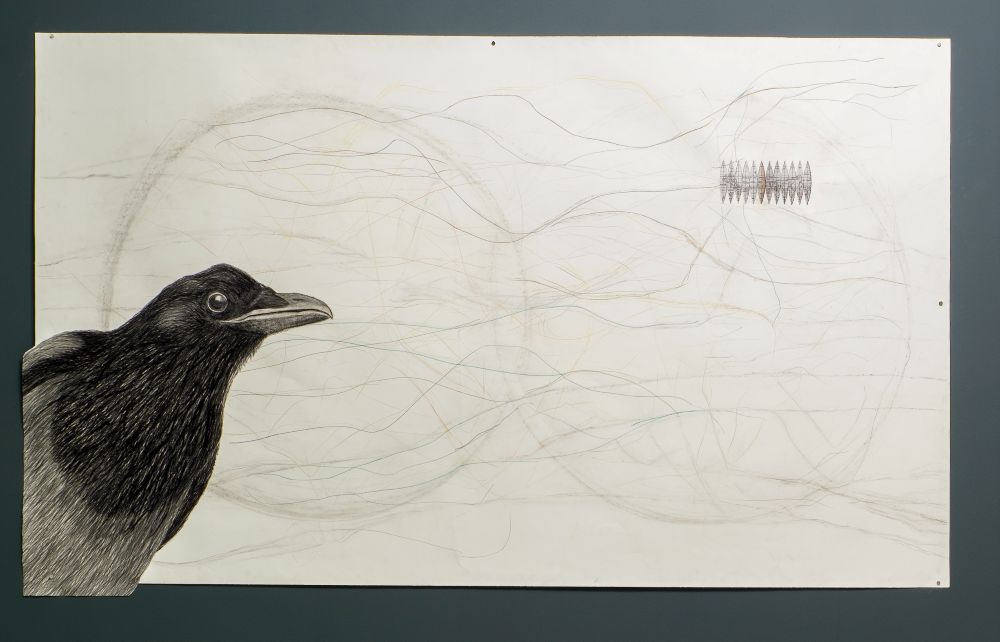
Laura Lío. Behind your eyes2016 © Laura Lio. VEGAP, Madrid, 2026
In some of his pictorial compositions, the appearance of openings suggests exchanges between inside and outside and also points to the human extractivist tendency; Sometimes birds of prey fly over them, recurring in CentroCentro, which symbolize the threats that always stalk us and in the face of which we cannot be paralyzed. These leaky networks refer in part to one of Argentina’s books, Refuges of the body and imaginationin which he delved into the possible relationships between the constructions of animals and contemporary art, analyzing functional and poetic aspects both in works of architecture and in pieces by plastic creators. Know, by the way, that magpies extract anti-pigeon spikes from buildings to make their nests, almost bunkers.
Lío has drawn wings on sheet music, trying to rise where the staff cannot; elaborate nests in different natural materials, which evoke the difficulty of having shelter in times like these; or a wing of votive offerings in plaster, made up of hands. Likewise, he teaches us another book, oval and cosmic, in which heaven is connected with the transcendent, as the place of souls.
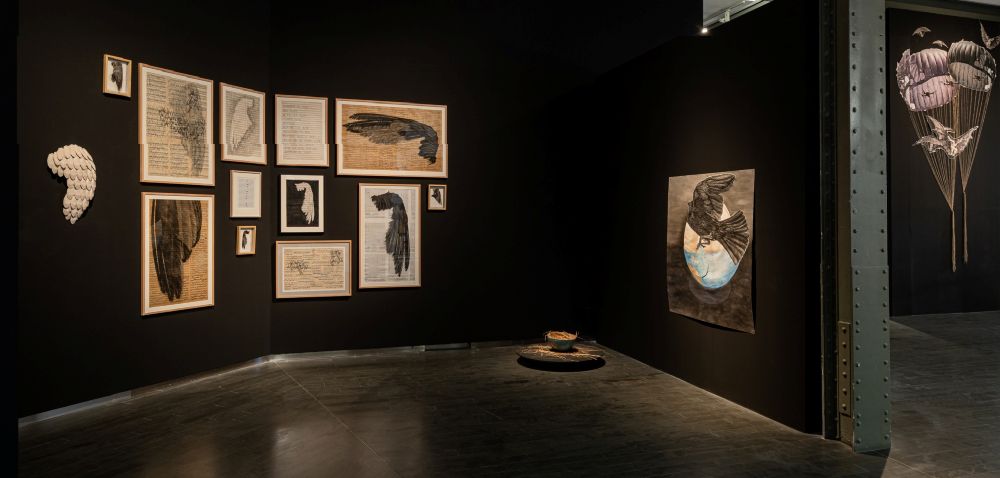
Laura Lío. Shock. CentroCentro, 2026. Photography: Alejandro Cayetano
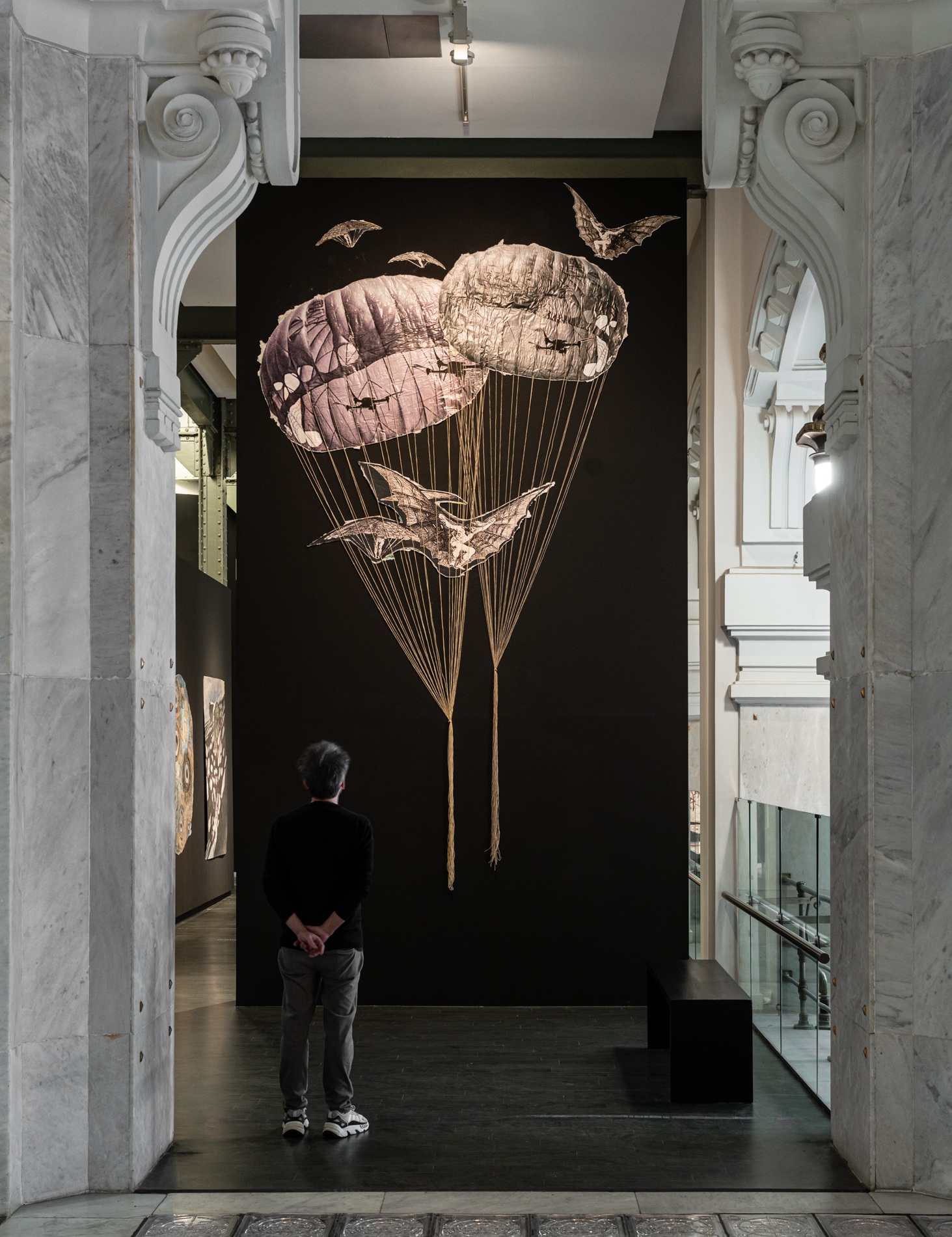
This sky, we pointed out, has also been colonized by technology: our ways of flying are influenced by the parachutes, necessarily closed, that have been placed in the heart of the exhibition and that sometimes emit ambiguous sounds as we approach. Its starting point was, as expected, poetry: a text by Vicente Huidobro, called Altazor or the parachute trip (1931), in which the Chilean metaphorized human existence and our need for bonds and creativity. The artist proposes to us not to think so much about the fall as about the previous enjoyment and to value the tools that prevent us from crashing suddenly.
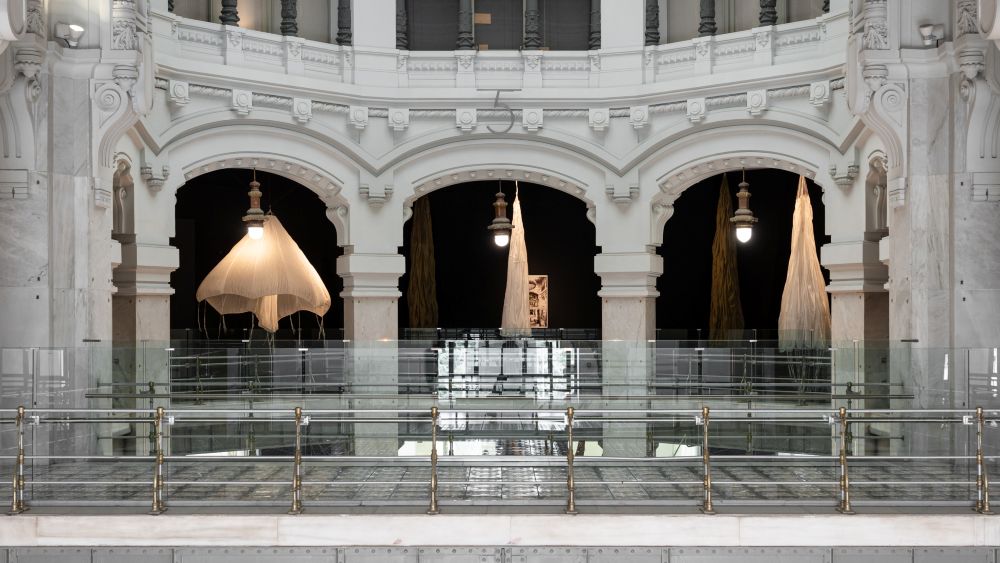
Laura Lío. Shock. CentroCentro, 2026. Photography: Alejandro Cayetano
From heaven to earth, Lío then shows us representations of the life of trees with a marker and on rice paper – they also constitute artist books – and multiple images that emphasize the possibilities of walking paying attention to the roots and leaves, whose ribs connect again and again with the urban design; and, once again rising, collages that represent steel birds, between the mechanical and the natural: less poetic and more aggressive parachutes, in allusion to those threats entailed by the current transformations from the four elements.
The exhibition culminates by presenting a different aspect of his work: the projection and exhibition of a set of his posters, many associated with the need and demand for a refuge or with the invitation to be creative and move away from consumerism (I inhabit the possibility, a house more beautiful than prose); also to the criticism of extractivism and the plunder linked to colonization. In connection with the past function of this building, we will finally contemplate a set of commemorative stamps inspired by Bruno Munari or bestiaries, in the collections of the Archaeological Museum of Naples, on the passage of the African elephant through Cybele in 1930 or transhumance in 1940.
If the veins of a leaf are the circulation routes of a city, seals are the communication channels of yesterday and allow the imagination.
Laura Lío. Shock. CentroCentro, 2026. Photography: Alejandro Cayetano
Laura Lío. “Shock”
CENTERCENTER. CYBELES PALACE
Plaza de Cibeles, 1
Madrid
From November 13, 2026 to March 28, 2027