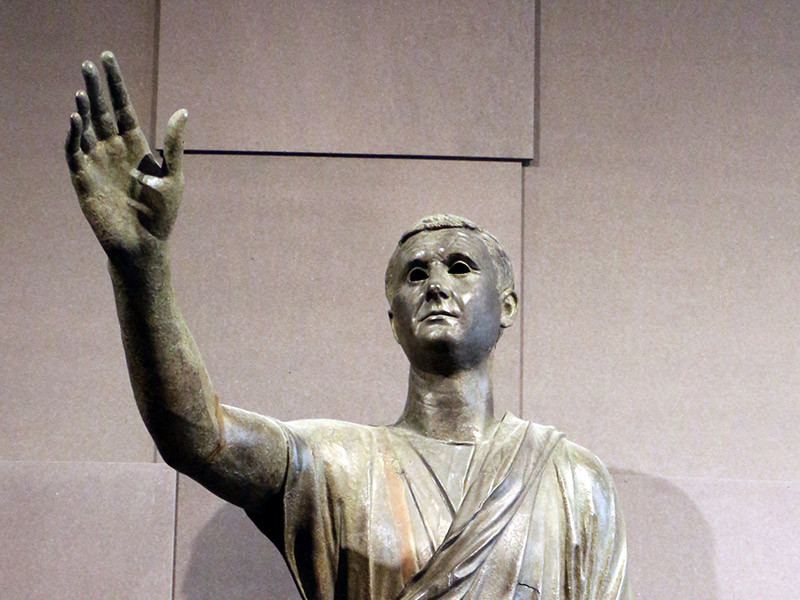
With his right hand raised towards the crowd and his gaze towards the horizon, the life-size statue ofArringatore (“the speaker”, in French) is one of the most famous bronzes of late Etruscan art, as much for its remarkable state of conservation as for the technical prowess it embodies. However, five centuries after its discovery on the banks of Lake Trasimeno in 1567, it has continued to surprise archaeologists, whose latest conclusions have brought to light a new hypothesis, leading us to reconsider the original aesthetic of the Etruscan statue. While its blackened appearance had been attributed to the phenomenon of corrosion, it could be that it was deliberately painted black 2,200 years ago.
Beneath the later brown layers, restorers discovered black areas on the face, hair, clothing and arms, some of which were darker than their covering. Scientific examinations revealed the presence of a copper oxide called tenorite, which gives this black to gray color. According to the researchers, the arrangement of the strata indicates the application of a “intentional blackish patina”because the surface that remained would present “traces of controlled heating”.
The Arringatore (the speaker), bronze, 1st century. av. B.C., h. 179 cm, Etruscan sculpture, National Archaeological Museum of Florence.
If it has not been confirmed, the hypothesis has more consequences than it seems, because it could indicate a precise aesthetic intention, and thus contribute to the definition of Etruscan sculptural art. These results could indicate a desire on the part of the sculptor to highlight the red details on the black surface, dark on purpose, using a contrast technique. This discovery is all the more astonishing considering that, when it was discovered in the second half of the 16th century in Perugia, the statue must have been green in color.
Regarded as one of the founders of art history, Giorgio Vasari presented the statue to Cosimo I de’ Medici shortly after its discovery. The latter included it in the family collections at the Pitti Palace, before its transfer to the Uffizi Gallery in 1588. Three centuries later, in 1871, theArringatore enters national collections. It is exhibited in the bronze gallery of the Archaeological Museum of Florence, alongside other masterpieces of Etruscan bronze, such as the Chimera and the Minerva of Arezzo.
By the anatomical details of its face and its sober representation, the sculpture has been compared to the style of the “verist” portrait, very popular at the end of the 2nd century BC. His name refers to his raised right arm, interpreted as a gesture intended to harangue a crowd. The 1m79 man is shown wearing a toga praetextaworn by curule magistrates during official ceremonies. For Françoise-Hélène Massa-Pairault, emeritus researcher at the CNRS, his gesture could correspond to that of a high-ranking Etruscan asking for Roman citizenship in front of an assembly. An older hypothesis, and denied to this day, had assimilated L’Arringatore to Scipio Africanus, a general who fought the Carthaginians during the second Punic war. Finally, the inscription in Etruscan language on the lower band of the toga made it possible to identify the character as Aule Meteli.