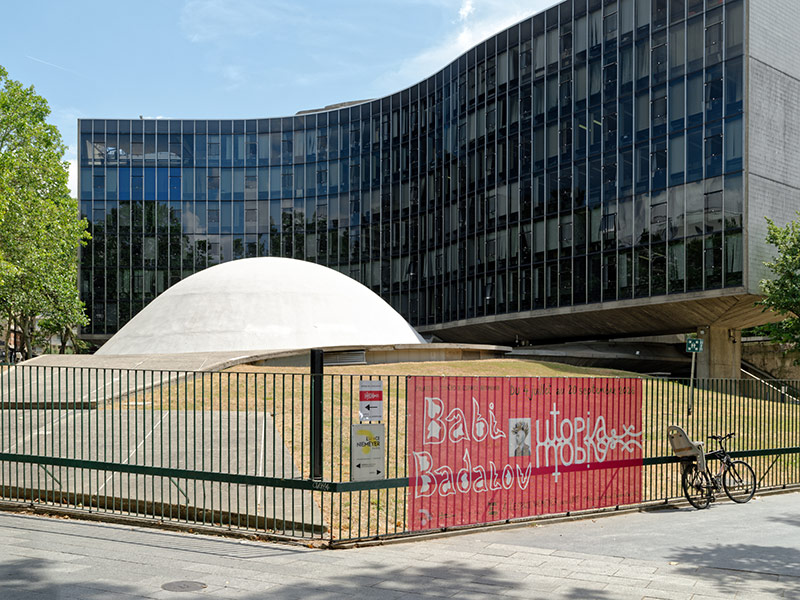
Paris. It feels like we’re in a bunker. The concrete walls of the basement of the headquarters of the French Communist Party (PCF), designed by Oscar Niemeyer, serve as a setting until September 30 for “Utopia Utopia” where the visual poetry and drawn words of Babi Badalov are exhibited. This Azerbaijani artist established in Paris, a self-proclaimed provocateur, does not have the usual profile of places that claim to have a Marxist heritage. “The Niemeyer space demonstrates an openness and even a discreet subversion by welcoming an artist, who having lived in the former USSR, still criticizes many aspects of it”, notes Guillaume Désanges, director of the Palais de Tokyo who co-produced the exhibition with the Poggi gallery. But also with Free as artthe association created in 2021 following the major eponymous retrospective which documented a century of relations between painters and the party. “It’s not a pop-up from the Palais de Tokyo, because the exhibition is as much part of their program as it is ours”continues Guillaume Désanges.
“Utopia Utopia” marks a turning point in the cultural strategy of the PCF. Via Libre comme l’art, it is no longer the custodian of its cultural memory alone, but becomes a producer of exhibitions. And this is just the beginning. Because a second co-production with the Palais de Tokyo is already looming for 2027. Likewise, in the fall of 2026, Libre comme l’art will produce “1936-2026: Résonance(s)”, a retrospective designed in-house on the occasion of the 90th anniversary of the Popular Front, which will bring together works from the period with those of around ten contemporary artists. “Two periods of major upheaval”slips Pierre Laurent, former national secretary of the PCF and in charge of the entity. And this development is only just beginning since the structure will acquire an endowment fund. “It will be on track at the end of summer or beginning of fall”he confirms bluntly. A new stage in the structuring of a cultural project which, until then, functioned according to the words of Nicolas Bescond, administrator of the Espace Niemeyer, “to energy, to voluntarism and to the end of the candles”.
View of the Babi Badalv exhibition, “Utopia Utopia”, at Espace Niemeyer.
© Aurélien Mole
A two-headed legal entity
To fully understand this shift, we must get rid of a preconceived idea. The structure which takes care of events linked to the Niemeyer space is not a cultural institution: the Carrefour Châteaudun real estate company (SICC), created in 1925, by popular subscription and transformed into an SAS in 2018, has a share capital of €750,000 and its clear corporate purpose is to manage real estate. “within the interests of the French Communist Party”. Therefore, to ensure the rental of rooms for events and the provision of offices to private companies: architecture, design, communications, or music production firms. Its turnover is around €2 million per year according to the latest balance sheets available at the registry, i.e. a little over €1.9 million in 2019 and between €2 and €2.4 million in 2016. Culture has been grafted onto this base and the SICC today functions as a two-headed entity. On the one hand, Nicolas Bescond manages everything relating to rental. It also manages event spaces rented, for example, during Fashion Week or for audiovisual productions. On the other hand, Pierre Laurent chairs Libre comme l’art and manages the exhibition programming. Two logics. And two worlds under one roof.
But the borders are strict. When Pierre Dharréville, head of the PCF culture commission, wishes to organize a cultural initiative at headquarters, he does not contact the association created by Pierre Laurent, but calls Nicolas Bescond to check the availability of the room and submits the request to the Party leadership for political validation.“These are political initiatives paid for by the Communist Party and not by the SICC,” specifies Pierre Dharréville. So this current split will give rise to two economic models which do not finance each other.
And all the more so since the main objective of the SICC is to finance the maintenance of a historic concrete-glass-steel monument of the same generation as Beaubourg or La Cité des sciences de la Villette. So with similar imperatives of waterproofing, energy performance and upgrading. To respond to this, the SICC rents its spaces during Fashion Week to Dior for its Rouge Signature campaign. Or to Deezer for a series of eight to ten annual concerts. All with “rates in the high range of 19e district of Paris »according to Nicolas Bescond, therefore around €1,000 to €5,000 per day depending on the type of space and event. “The building consumes all the resources it generates and we need to develop even more”he admits. He speaks of a “ third phase of construction » necessary to ensure the sustainability of the place with major upgrades to standards.
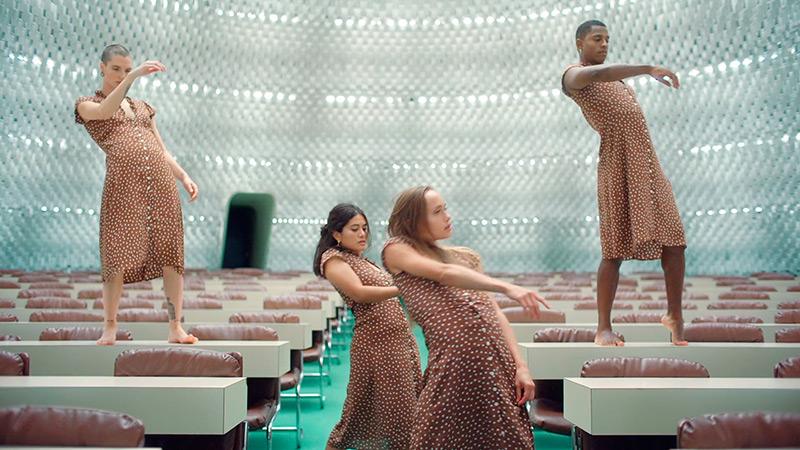
Angèle’s music video “Jalousie” was filmed at Espace Niemeyer in 2019.
© SonyMusic
A large gap under control
Isn’t there an ideological contradiction in hosting luxury brands and Fashion Week? Nicolas Bescond rejects it. Commercial income does not finance the exhibitions, but the maintenance of the building which then allows activities to take place there in good conditions and reminds us that “legal entities cannot finance political parties, especially since the SICC accounts are audited every year”. This is not so far from what Versailles or the major museums are doing, which are privatizing their rooms. With this notable difference that Versailles has no official ideology to defend. And that the Niemeyer Space’s charter of values, as rigorous as it is, – refusal of fast fashion, application of the UN Sustainable Development Goals, exclusion of discriminatory projects – says nothing, or almost, of the tension between the world of luxury and the convictions of the party which presides over the destiny of the building. “The RN will not come to hold a conference there”confirms Bescond without batting an eyelid. But Dior, Angèle and the Manifesto festival sponsored by Goat, a global platform for sneakers of luxury, can settle there without this coexistence having so far sparked any real public debate.
In short, this split between the two entities remains an acrobatic philosophy. It is because Dior rents the dome that Pierre Dharréville’s culture commission can welcome Palestinian poets there the following month. Bescond himself admits this with a formula that says it all: “It is because the commercial activity was present alongside that part of our cultural activity was able to arise and support the activity of the headquarters. » However, in this universe, Libre comme l’art will have to generate its own resources via the endowment fund. The ideological approach is assumed. The association does not seek to become one of these “very rich foundations which flourish in Paris and which go in all directions”slips Pierre Laurent with barely veiled irony. The endowment fund wants to produce “an original, singular, independent cultural activity dedicated both to living creation and to promoting the cultural history of the party”he adds. The Babi Badalov exhibition is a demonstration of this. “It will initially be endowed with between 10 and 20,000 €, by the SICC, the company which owns the Espace Niemeyer”according to Pierre Laurent, then will be open to donations from individuals and businesses. It remains to be seen whether any company will be able to donate there. A future under tension? Acrobatic again? “It is not at all a question of selling out our values, insists Pierre Laurent. But to find ways to continue to independently develop an activity dedicated to the promotion of artistic creation and the enhancement of a unique cultural history. » One question remains that no one is yet asking out loud: would a luxury brand that would like to make a donation to the Espace Niemeyer endowment fund be welcome? Pierre Laurent’s response is cautious. Almost cryptic. “The fund is by definition open to everyone. » By not expressing any refusal to a specific brand, doesn’t his response sound like a half-open door?