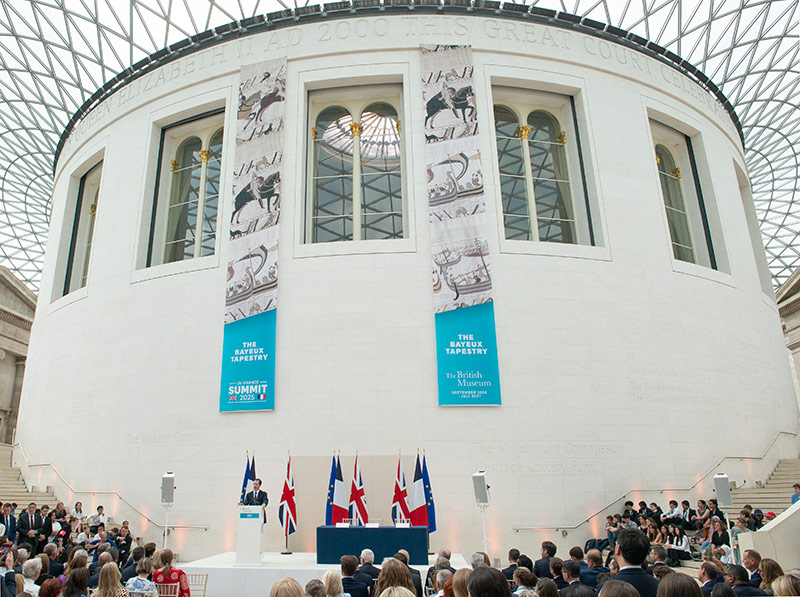
After months of bilateral collaboration, the Bayeux Tapestry exhibition at the British Museum was inaugurated on Wednesday September 2, before opening to the public on September 10. A sign of the highly political stakes of the event, a very high-level official ceremony took place in the presence of Emmanuel and Brigitte Macron, Prime Minister Andy Burnham and his wife Marie-France van Heel, but especially King Charles III and Queen Camilla. “The King sometimes visits the British Museum for specific events, but rarely for official exhibition visits”says Rosalind Winton, head of exhibitions at the British Museum. The last time was at the opening of the exhibition on “Hajj: Journey to the Heart of Islam” in 2012, when he was still Prince of Wales.
Emmanuel Macron arrives at the British Museum to announce the loan of the Bayeux Tapestry in 2025.
© The Trustees of the British Museum
Before the speeches, a reception was given for nearly 400 guests, in the museum’s “Enlightenment Gallery”. Some of the pieces which will go to the museums of Caen and Rouen, as part of this bilateral exchange, were exhibited during this reception, such as some pieces from the Lewis chess set (12th century) or even elements from the treasure of Sutton Hoo, a famous Anglo-Saxon royal burial from the beginning of the 7th century.
In addition to members of the Franco-British community, certain ministers were present, including Jonathan Reynolds, Minister for Business, Innovation, Science and Trade. It was also possible to see Chris Bryant, former Secretary of State for Culture, who knelt in front of Rachida Dati in May 2025 to conclude this cultural exchange. The opposition to the Labor government was also represented, notably by Tom Tugendhat, Minister of Foreign Affairs in the “shadow cabinet” of Kemi Badenoch, the leader of the Conservatives. This French speaker is also the husband of Anissia Morel, the cultural advisor of the French Embassy.
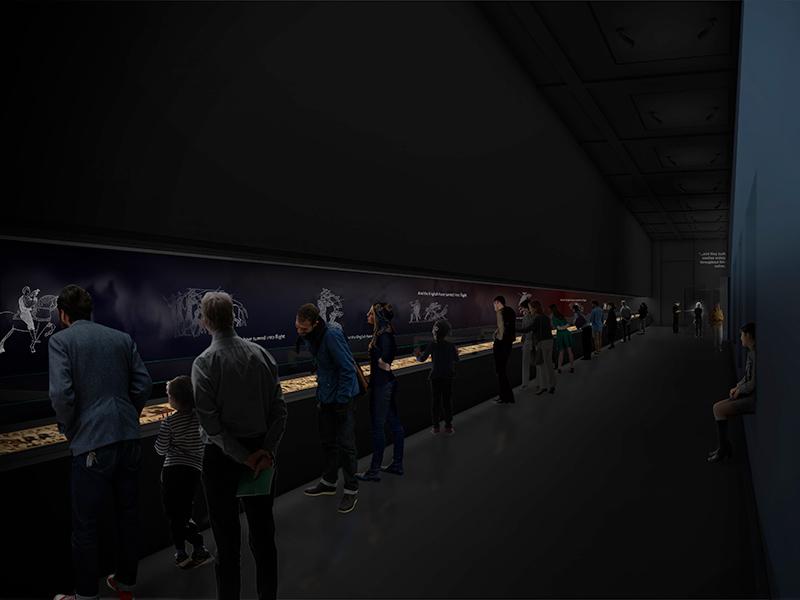
3D projection of the scenography imagined by Opera Amsterdam for the presentation of the Bayeux tapestry at the British Museum.
© Trustees of The British Museum
This exceptional loan is the result of diplomatic work first imagined by Theresa May in 2018, then brought to fruition by Keir Starmer, the former British Prime Minister, and Emmanuel Macron, following the Franco-British summit of 2025. While the transfer of the tapestry was criticized in France, due to the fragility of the work, Emmanuel Macron wants to make the realization of this project proof of the trust and friendship between the two nations, and what they can accomplish together. “What unites us is not limited to what we see in our museums […] he declared. It is also the responsibility that we share within the United Nations, the G7, NATO and the European Political Community. » The idea was taken up by the king himself, who described what is in fact embroidery as “precious symbol of trust, at a time when this unfortunately seems to be lacking between nations”.
Exhibited in one piece, the 70 meter long tapestry is presented flat, for the sake of preservation, below a large room. Plunged into darkness, it is protected by glass. Projections on a wall behind illustrate, in an animated way, the history of the work and translate the embroidered Latin text into English. George Osborne, chairman of the museum’s board of directors, estimates that a million people will come to see the tapestry in the coming months and expects 7.5 million visitors museum-wide for the whole year. The exhibition will last until July 2027.