“Raoul Dufy is a pleasure”. In an aphorism, Gertrude Stein (1874-1946) was able to perfectly synthesize the quintessence of the modern master. Even for neophytes, “Dufy” are in fact four letters that sound like the promise of sweet happiness. Among the heralds of modernity, the immense colorist is the one who best embodies the idea of joy, fantasy, progress and carefreeness of the happy days of the 20th century. Gourmet bathers, voluptuous beach scenes, lush bouquets of flowers and even idyllic landscapes, his work invites you to smile, to daydream and to escape… But also to a certain nostalgia for a fantasized yesterday, hence the artist’s inextinguishable popularity with the public, especially because, with criticism, relations have not always been good. It is undoubtedly the lot of all successful artists to be judged too frivolous and popular. In this sense, Raoul Dufy (1877-1953) is the worthy heir of Pierre-Auguste Renoir, that is to say an artist extremely loved by the general public, acclaimed by collectors, but somewhat shunned by the intelligentsia. “With the public, he did not experience purgatory; he has always been loved and continues to be. On the other hand, when I started working on him, he was relatively despised by modern art historians,” confirms Christian Briend, general curator at the Center Pompidou and author of various exhibitions on Dufy. “The specialists looked down on him a little, especially the “Matissiens” who had a slight contempt for his work. He was underestimated and his painting was considered too easy and a little disconnected from the dramas of the 20th century. » So many elements which, today paradoxically, contribute to its immense success.
A deeper painting
“Everything about Dufy is dressed in festive attire,” summed up the influential critic Christian Zervos in the monograph he devoted to the painter in 1928. This reputation as a “champagne” artist, however, obscured the deep and laborious dimension of his work. Because before being a light painter, Dufy is above all an immense worker. And this until the end because, when he died at the age of 75, he was still working on a new series in which he completely renewed himself. The painter of light tones then confronts the deepest black. In this series which took on a testamentary value and which will only be presented after his death, he reinterprets a motif that is dear to him: the cargo ship. A way of coming full circle by returning to his first loves, the views of the port of Le Havre and the bay of Sainte-Adresse, the territory where the Norman cut his teeth. Or more precisely to return to it in thought since this final series is produced from memory. A memory that takes on a very particular tone in a city that was then almost completely destroyed. From the haven of Dufy’s youth, practically nothing remains apart from his memories of the threatening sky, the imposing silhouette of cargo ships spewing smoke and the dazzling face of the sun and its reflection. To convey this optical shock, the painter of bright colors opts for large black areas. “This surprising series will be very noticed and commented on by young artists,” notes Christian Briend. Notably by Pierre Soulages and Jean Dubuffet, which shows that, even at the end of his career, he was not at all an isolated or old-fashioned artist. Moreover, he was represented by the Louis Carré gallery which exhibited new post-war talents. »
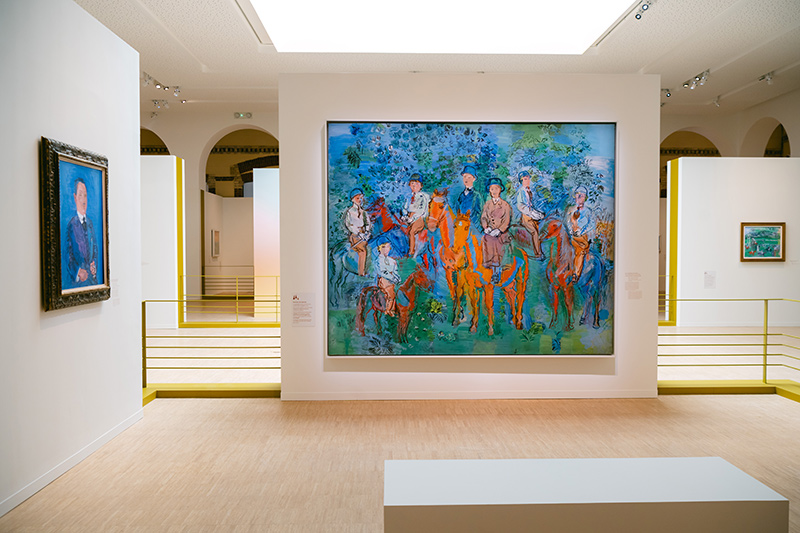
View of the exhibition “Raoul Dufy. The melody of happiness” to the Franciscans.
© Sandrine Boyer Engel
A hard worker
Until his last breath, Dufy never stopped working. And this, even though he has been ill for many years. His hands are in fact eaten away by polyarthritis, a debilitating condition which makes him suffer terribly and prevents him from holding a brush on bad days. Dufy, however, was able to transcend his ailments by modifying his way of painting in large areas of color and by sketching his line. All observers who examine his biography are amazed by his exceptional work force. The artist continues projects in all directions, without respite. Coming from a modest background, he had no other choice in his young years. But, once consecrated and free from want, he keeps this pace for the rest of his life. As a teenager, after obtaining his baccalaureate, he worked in food to meet the needs of his family. For five years, he worked in a coffee importing company where he was responsible for controlling food on liners. A neighborhood with the port and the boats which leaves a lasting mark on his imagination. At the same time, after debauching, he took evening classes at the Municipal School of Fine Arts. Attendance paid off, because the aspiring artist won, at the age of 22, a city scholarship to study in Paris, in the studio of Léon Bonnat (1833-1922) at the Beaux-Arts where he met his friend from Le Havre, Othon Friesz (1879-1949). The two friends lived together in Montmartre and quickly mingled with the avant-gardes.
a chameleon painter
In contact with these new influences, the young man gradually exchanged his impressionist background for a more modern and personal style. But before finding his way and his inimitable touch, the painter methodically tries out all the trends of the moment. Like a trapeze artist, he moves from one avant-garde to another, with the notable exception of surrealism to which he remains resistant. “Dufy is a bit of a chameleon, because he adopts several successive styles to find his own,” remarks Christian Briend. He began in Impressionism, being very influenced by Alfred Sisley, then, when Fauvism appeared, he became fully part of it. It is the same with Cubism. He is very close to Georges Braque and adopted the Cubist style very early, from 1908. Then, he completely changed register and became interested in popular art, and Provençal figurines in the style of Paul Cézanne. Even though he began painting at a very young age, he found his own style relatively late. In the 1920s, he invented this unique aesthetic, dissociating line from color, which means that we recognize a work by Dufy at first glance. His creations with their black rings which make the colors explode are also distinguished by a musical coloratura. They indeed carry an element of improvisation and have a very melodic aspect. Nothing surprising in this for a music-loving creator who gravitates in a world of musicians. Starting with his father who, alongside his job as an accountant, directed a choir. All his life, the painter sought proximity to musicians. As during the Second World War when, a refugee in Perpignan, he met the cellist Pablo Casals (1876-1973) and the pianist Yvonne Lefébure (1898-1986). He represented them on several occasions playing together and even organized concerts in his workshop.
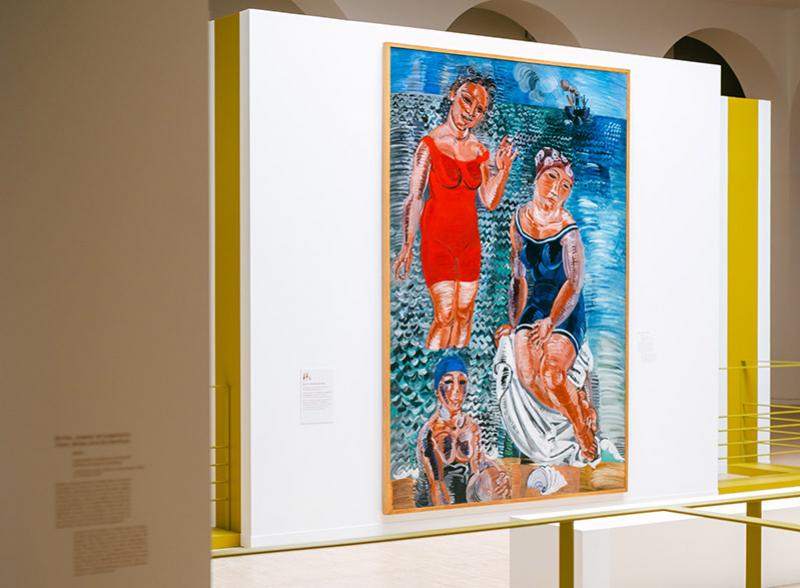
View of the exhibition “Raoul Dufy. The melody of happiness” to the Franciscans.
© Sandrine Boyer Engel
A world of one’s own
It must be said that the studio is a sacred place for the painter. More than any other artist of his generation, he was indeed the cantor of this world of his own. “Dufy strives to represent throughout his career his places of creation which are also his places of life. It’s something quite unique in modern art, confirms Christian Briend. He attributes a different chromatic value to each of his workshops, he plays on a sort of colorful score. Thus, the Paris workshop is blue, while those of Vence are white and orange, for example. He also systematically displays his own works and personal objects in his workshops; which is also an element of great modernity. » Musical instruments, scores, furniture, sculptures and of course paintings migrate from one canvas to another as he travels. This imaginary museum is sometimes inhabited by a nude model who is often the companion of the moment, further reinforcing the sensation of mixing art and life. In his time, he was the only one to practice this form of self-citation almost permanently, anticipating the research of contemporary artists by several decades.
Artist without limits
Dufy is unclassifiable, in the first sense. First of all by his status as an independent master not linked to any movement, but also fundamentally modern and original. Never where we expect him, the artist never ceases to surprise. One of the most secret facets of his production is his activity as a painter reporter. Painter of modern life, Dufy is passionate about the innovations of his time. In the United States, it represents skyscrapers, but also television studios: a first! He is also one of the very first to witness the invasion of cities by advertising. His Posters in Trouville thus perfectly reflect the intrusion of the commercial domain into the urban universe. Like a columnist, the artist also likes to document current events by drawing in particular official ceremonies, such as the funerals of great personalities. In a more celebrity register, he sketched the coronation of George VI in London in 1936. Curious and versatile, Dufy is a talented jack of all trades, trying his hand at grand decor, illustration, fashion, ceramics and patriotic imagery with the same talent and the same freedom. Because if it were necessary to identify a common thread connecting the different poles of his production, freedom would easily emerge as the common denominator of his long and prolific career. Tied, however, with its decorative ambition. “What distinguishes him from most of his contemporaries is that he is truly a genius of decorative art,” believes Christian Briend. Everything he touches is virtuosic: his ceramics are superb, his textile work is remarkable and he is a genius illustrator. In addition, he has an original way of working by constantly reactivating themes that are almost obsessive. It is less the subject that counts than the way of restoring the motif and transforming it through a play of stylistic mutations from one work to another. » A fluidity of genres which also finds a very powerful echo in the philosophy of current artists.