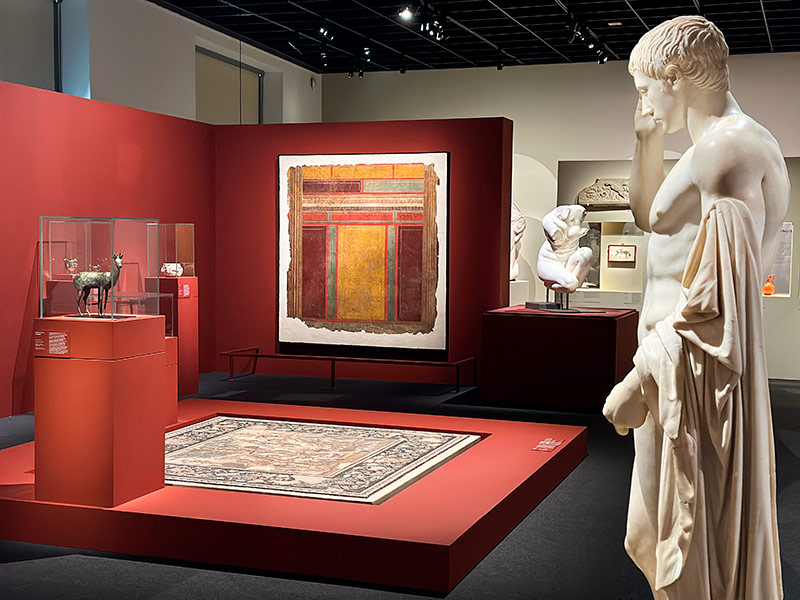
Nîmes (Gard). Images in the temples, homes and streets of the city. Images during banquets, civic events, religious and funeral ceremonies. In ancient Rome, art was omnipresent. The alignment of statues in museums, the isolated fragments of frescoes on the picture rails today tend to make us forget that these works were once at the heart of the social, political and religious life of the Romans, permeating every aspect of their daily life. It is in this shift in perception that the new exhibition at the Musée de la romanité takes on its full meaning. By evoking its original context, the museum engages in in-depth reflection on what Roman art truly is. “Roman art is a useful art. It is an art made to serve society, to respond to functions, to convey a message, the primary purpose of which was not necessarily aesthetic. But, for all that, this aesthetic dimension permeates all of this material culture. explains Nicolas de Larquier, curator at the museum, who curates alongside Isabel Bonora Andujar, Manuella Lambert and Martin Szewczyk, all curators at the Louvre.
A pragmatic aesthetic
To deconstruct the contemporary view of these productions, the Nîmes museum relies on an exceptional selection, i.e. 120 masterpieces from the permanent collections of the Louvre, loans made possible by the temporary closure of the Roman Antiquities department. Upon entering, the face-to-face encounter between a helmet and a fresco proves very enlightening. On one side, a gladiator helmet displaying a Gorgon’s head and a griffin protome, a marvel of ornamentation which was nevertheless used during combat. On the other, a fragment of a wall painting from Pompeii, which was then removed, framed and transformed into an easel painting. Two pieces that tell the same story: in Roman art, beauty and use go hand in hand.
Honorary statues, funerary altars, religious and historical reliefs, tableware and even precious ornaments. Each work is related to its original function, which the cartels do not fail to explain: asserting a social status, honoring the deities, commemorating the living as well as the deceased… A contextualization that is subtly supported by the scenography (Sceno agency) by multiplying the architectural forms. The works of the Louvre are thus seen differently, far from the aesthetic approach that modern collecting has shaped.
However, the exhibition does not fall into the pitfall of erasing any aesthetic desire. A little excursion nuance the point by recalling that “art for art’s sake” exists, but remains a marginal approach. From borrowings from Greek models to the practice of reuse, from the search for mimêsis to the monumentality of forms, the exhibition deciphers with finesse the codes of Roman art.