Paris. “It’s Michelangelo’s drawing, with Titian’s color, but above all, it’s the strength of the painting. See the touches with which he signed the sky of this image: if we take a detail like that, it is already van Gogh”enthuses Giovanni Carlo Federico Villa in front of the signOrpheus imploring Plutopainted by Tintoretto (c. 1518-1594) early in his career. The director of the Palazzo Madama in Turin, who shares the curatorship with Neville Rowley (curator at the Gemäldegalerie in Berlin) and Pierre Curie (curator at the Jacquemart-André Museum), highlights all the pictorial audacity of the Venetian master. “Tintoretto’s painting is exceptional for its innovative strength. There is nothing academic in his brushstrokes, and this freedom will be very inspiring for successive generations. ».
By honoring Tintoretto, the Jacquemart-André Museum continues its exploration of the great names of the Italian Renaissance. After Caravaggio, Botticelli and Bellini, the institution is this time turning to one of the great masters of Cinquecento painting, whose last French exhibition – at the Luxembourg Museum in 2018 – focused specifically on his early works. But exhibiting Tintoretto quickly raises a difficulty: that of space. If Jacquemart’s exhibition encompasses his entire career, this panorama is necessarily restricted given the cramped nature of his temporary exhibition rooms. A particularly strong constraint when it comes to Tintoretto, whose fame is due in particular to his spectacular compositions and his immense canvases which populate palaces, School and the churches of the Serenissima. Difficult, therefore, to fully appreciate the impressive Miracle of Saint Augustine (see ill.), one of the rare large formats hanging from the picture rails, without being able to take the necessary distance.
Tintoretto (1518-1594), The Miracle of Saint Augustine1547-1549, oil on canvas, 255 x 174 cm, Vicenza, Musei Civici di Vicenza, Palazzo Chieric.
© Bozzetto Sas
A relevant selection
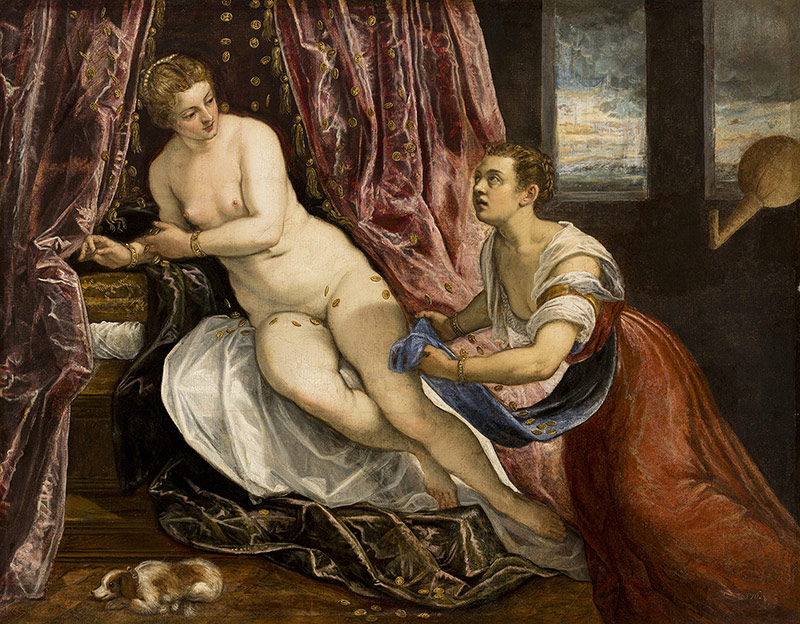
However, the demonstration is there. The selection, narrow but of quality, brings out all the modernity of a painter who loses none of his strength in more modest formats. The comparison of three female nudes offers one of the most striking illustrations. Under Tintoretto’s brush, eroticism mixes with burlesque, and sensuality never deviates from a certain irony. Seduced by Zeus transformed into a rain of gold, his Danae, very down-to-earth, hastens to pick up the pieces to put them in a cassette (see ill.). The old men who spy on the beautiful Suzanne in the bath echo, not without malice, the voyeurism of the spectator in front of the painting. As for the gentle Leda, approached by Zeus in the form of a swan, she seems to grab the animal by the wing to lock it in a cage alongside a duck.
The exhibition allows you to appreciate up close the extraordinary freedom of Tintoretto’s touch. In his numerous drawings in particular, where everything is muscular tension and plastic power. In his portraits too, where the artist, who became an official portraitist of the Serene Republic around 1560, excels at restoring the intensity of expressions. “Tintoretto moves towards portraits which represent almost only the face. He paints them, that’s what interests him, and leaves the task of completing them to his workshop which was made up of brilliant artists.specifies Neville Rowley. Thus, in one of his portraits of a man kept at the Nantes Museum of Arts, the painter makes the model’s face and the redness of his beard emerge from a background of dark tones. And further, in a portrait from the Christ Church Picture Gallery in Oxford, he accurately captures the features of a gentleman dressed in a black coat trimmed with fur.
After such a demonstration of virtuosity, the section dedicated to the influence that Tintoretto had on French artists at the end of the 18th and 19th centuries struggles to convince. Without any real transition or in-depth development, it seems intended more to flesh out the display than to enrich the subject of the exhibition. The modernity of Tintoretto’s touch is evident when reading his works alone, without the presence of an engraving by Dominique Vivant Denon taking up the composition of Worship of the Shepherds (around 1790), or that of a more modest copy of the Original sin by Paul Baudry (1853), does not really shed any additional light. In the middle of the episodes of the Passion painted by Tintoretto, where the movement of the bodies and the dramatic power unfold with rare intensity, the imposing Crucifixion by Eugène Delacroix (1835) appears very restrained. Just like the copy by Édouard Manet (1854) which, placed right next to the famous Self-portrait of the Venetian master, is somewhat eclipsed by the latter’s striking frontality. Basically, the exhibition convinces in its exploration of Tintoretto’s work, but loses its strength at the very moment when it seeks to extend its scope.
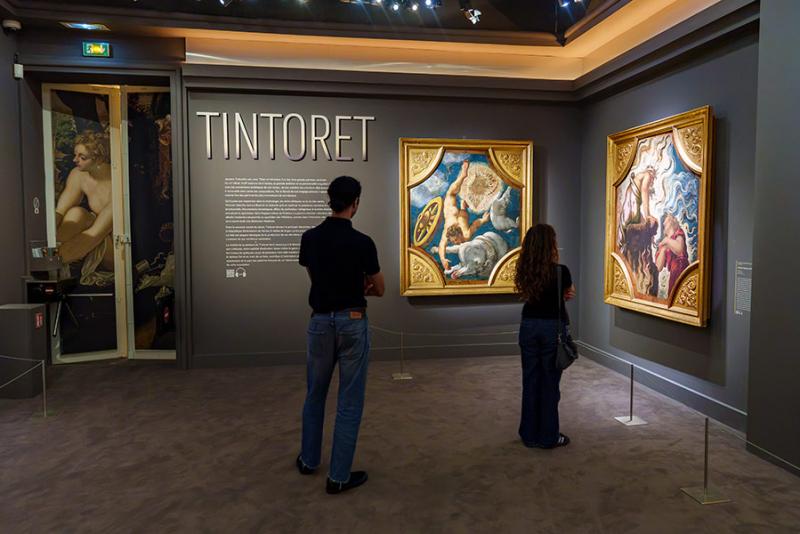
View of the “Eternal Tintoretto” exhibition at the Jacquemart-André Museum.
© Culturespaces / C. De la Motte Rouge