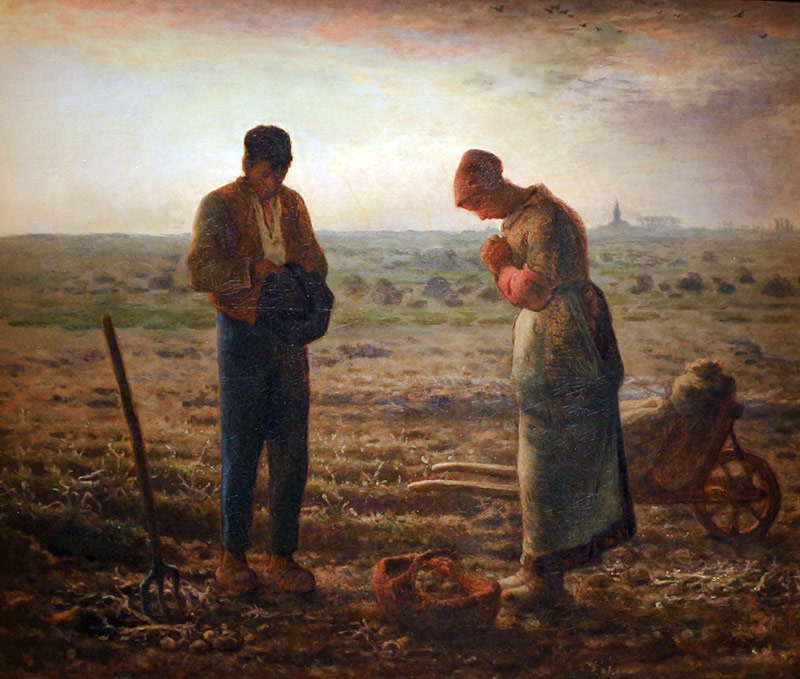
The recent surprise reappearance of Desperate by Gustave Courbet, who opaquely escaped French museums for the benefit of Qatar, has relaunched the debate on the export of masterpieces. Properties recognized as exceptional enjoy the privileged status of “national treasure”, a system allowing them to be retained in the territory while the funds necessary for their acquisition are raised. If the law on the circulation of cultural goods dates from 1992, attempts at regulation date back to the beginning of the 20th century. They stem from the emotion of heritage lovers who deplored the fact that great American fortunes were grabbing the most beautiful pieces on the market to fill the new museums which were then multiplying at breakneck speed. Several spectacular sales have had a lasting impact on public opinion and triggered this awareness, starting with the serial of The Angelus (around 1859) which held France in suspense in 1889. A chronicle rich in adventures, extensively commented on by the press, which elevated this painting to the rank of icon and patriotic standard.
The success of a painting that is nevertheless unloved
In fact, the painting is today one of the best-known French paintings. Available endlessly on all types of trinkets, it has also been copied and diverted by a number of artists, from Van Gogh to Dalí and even Cabu. An extravagant fame that he owes in large part to his extraordinary destiny. However, the work began its public career with a fiasco since Thomas G. Appleton (1812-1884), the collector who ordered it from Jean-François Millet (1814-1875), never came to collect it. In 1859, the artist found himself with unsold items on his hands, but this would not last long because the work would then pass from hand to hand at dizzying speed.
Exhibited in the workshop of his colleague Narcisse Diaz in Barbizon, it caught the eye of Victor Papeleu, a Belgian painter who bought it for the honest sum of 1,000 francs (around €5,000 today). The latter smelled the potential of the painting and sold it to Jules van Praet, a minister of King Leopold I of Belgium, who quickly sold it to a great collector of Dutch and Flemish masters from the 17th century and the Barbizon school. However, the latter also relinquished it and the work was then purchased by Émile Gavet, a Millet lover who also did not cherish it and quickly sold it. Each time, its owners did not appreciate it and found it too religious and not representative enough of the style of its author. A shame because The Angelus is today the only work of the painter identified by the general public.
The canvas subsequently returned to the market where, commissioned by Paul Durand-Ruel (1831-1922), it gained visibility. The merchant, who wanted to establish Millet’s reputation, exhibited it in Paris and then in London, offering it a superb showcase and boosting its value. John W. Wilson, a wealthy Belgian industrialist with a love of realism, paid 38,000 francs to acquire it in 1872 and sold it four times as much nine years later to Eugène Secrétan. Even crazier, this copper magnate sold it almost immediately to the merchant Georges Petit for 200,000 francs (approx. €1.2 million today) before changing his mind and buying it back from him for 300,000! The painting is the first modern work to this extent shaped by speculation. In the meantime, the status of The Angelus has changed profoundly since, in the context of the post-war of 1870, this scene takes on a completely different meaning. This couple of humble and pious peasants in communion with the French countryside inevitably takes on a patriotic connotation. This reading will only grow over the years and reaches its peak during the legendary Universal Exhibition of 1889, which is intended to be a demonstration of the return of France to the concert of nations. During this exhibition, Millet is well represented, notably through The Angelusunanimously admired and praised as an eminently symbolic work. Its notoriety is at its height when its owner goes bankrupt and has to part with it.
The most hotly contested piece in the Secrétan sale, the painting gave rise to an epic bidding battle. For years, Americans who idolize Millet have been eyeing this icon. The Rockefellers and then the Vanderbilts tried, in vain, to acquire it. The dispersal of the collection is therefore the perfect opportunity for the American Art Association (art gallery and auction house) to offer itself what the sale catalog celebrates like the painting “the most beautiful of the modern school and certainly the masterpiece of Jean-François Millet”. Observing the enthusiasm with which Antonin Proust, French Minister of Fine Arts, bid, the American Art Association, fair play, withdrew for the benefit of France. When Proust won the work for 553,000 francs, a record, the room resonated with loud applause and “Long live France”! But the award is nothing like a happy endingit is on the contrary the beginning of a frightening soap opera. Because the minister bought the work with a blank check and must still have the necessary funds voted for by the House. However, due to administrative delays and the opposition of certain parliamentarians who criticize its exorbitant cost, the project fell through. To remedy this, a public subscription was then considered, but it did not materialize. We must resolve to return the work to the Yankees. “They are the ones who will own this symbol of our old Europe», laments the minister in the columns of Time. This epilogue is experienced as a pitiful humiliation.
The departure of the work arouses emotion, incomprehension and instant nostalgia. Photographs, chromos but also various derivative products ranging from plates to window curtains abound in all interiors. The painting crossed the Atlantic where it began a triumphant tour taking it to New York, Boston and Chicago. But, against all expectations, this American adventure will only be short-lived. A year after its shameful departure, the work returned to national soil, bought by Alfred Chauchard, one of the greatest fortunes in France. The “Napoleon of commerce”, as he is nicknamed, in fact paid the crazy sum of 800,000 francs (approx. €5 million) to acquire the work and subsequently made it the centerpiece of his legacy to the Louvre.
“At the auction house – a painting from Dad! », caricature by Jean-Louis Forain (1852-1931) published in 1920 about the sale of The Angelus by Jean-François Millet.
© DR