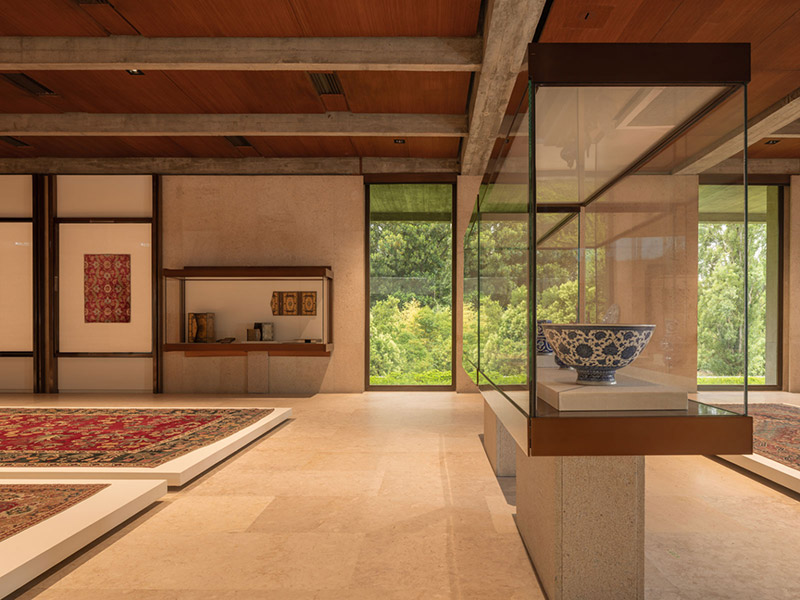
Designed from archives, the renovation of the Calouste Gulbenkian Museum looked to the past to pay homage to the museum from the late 1960s, and to celebrate the 70th anniversary of the Calouste Gulbenkian Foundation on July 18. The new scenography is inspired by the historical appearance of the Museum of Fine Arts while integrating contemporary museographic tools.
Under construction since March 2025, the project aims to make the journey more fluid in order to better promote the collections. The work mainly focused on air conditioning, lighting and security systems, as well as conservation and public circulation conditions. Some original materials have been reinvested, such as silk, carpet or wood, to recreate a 1960s-1970s atmosphere. The renovation re-establishes the dialogue between the galleries and the gardens, in particular by providing certain perspectives on the interior courtyards.
The historic building was designed by the trio of Portuguese architects Ruy Jervis d’Athouguia, Alberto Pessoa and Pedro Cid, accompanied by international consultants including Georges-Henri Rivière, museologist of the former Trocadéro Museum of Ethnography, and the Italian architect Franco Albini. Echoing an element of the original scenography, which had been replaced by a wall separation, a metal and wood screen was placed between the European galleries and that dedicated to China and Japan, modernizing the slatted perception device which allowed visitors to glimpse the paintings exhibited in the next room.
The René Lalique room, dedicated to one of the most important sets of works by René Lalique in the world, has been completely redesigned on the model of the old one. The windows have been replaced by convex glass reminiscent of art nouveau curves, and the walls have regained their green color.
To complete the sophistication of the Lalique room, paintings by the American painter John Singer Sargent and the Pre-Raphaelite Edward Burne-Jones are on display. Works from Calouste Sarkis Gulbenkian’s collection resurface throughout the course, after having been kept in reserve for years. Japanese prints, 19th century bronze sculptures, and a ceremonial Venetian parasol, presented as an emblematic piece of the museum during the “Splendors of Venice” exhibition in 2024-2025, are returning to permanent hanging.
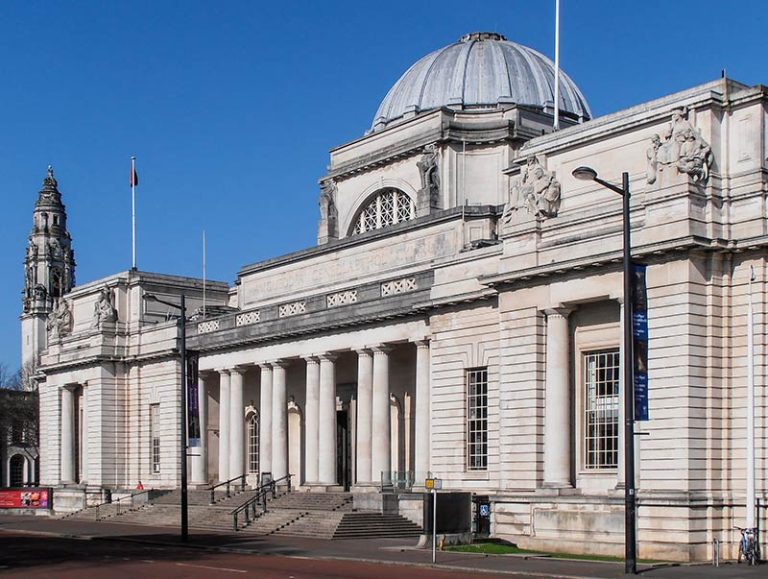
Main entrance to the Calouste Gulbenkian Museum in Lisbon.
The reopening of the museum is one of the highlights of the program organized for the 70th anniversary of the Foundation, which celebrates the arts in the plural. An inauguration exhibition retraces the history of the foundation in posters. The Gulbenkian choir and orchestra, conducted by Carlo Rizzi, perform arias by Verdi, Puccini and Bizet, accompanied by Bulgarian soprano Sonya Yoncheva. Screenings of cult concerts are added to the list from September, including The Last Waltz (1978), final concert of the Canadian group The Band filmed by Martin Scorsese, or even Don’t Look Back (1967), on Bob Dylan’s tour of the United Kingdom in 1965. The festivities will continue until December, with conferences, meetings and debates.
Created in 1956 in Lisbon following the will of Calouste Sarkis Gulbenkian, an Ottoman Armenian entrepreneur, the Gulbenkian Foundation has branches in Paris and London. In 1969, the first museum was inaugurated with Gulbenkian’s works, which constitute one of the most important private art collections in the world, consisting of more than 6,000 pieces. Covering an immense historical and geographical panorama, works by emblematic European painters appear there, such as the Vold man sitting with a cane (1645) by Rembrandt, theCherry Child (1858) by Edouard Manet or The Sinking of the Minotaur (ca. 1810) by Turner, as well as several illuminated manuscripts and ceramics from Iznik.
The Gulbenkian Center for Modern Art (CAM) was inaugurated in 1983 in the Foundation’s gardens. In 2024, its building was renovated by architect Kengo Kuma, and was awarded the “Building of the Year” prize by ArchDaily in 2025.