Saint-Étienne (Loire). If we consider that the last institutional exhibitions in France dedicated to Frank Stella (1936-2024) date back to the 1980s – at the CAPC-Museum of Contemporary Art in Bordeaux, and at the Center Pompidou, in Paris – the one which opened at the end of June at the MAMC+ has no need to demonstrate great originality. That in itself is an event. The two curators, Alexandre Quelle, head of the scientific department of the Saint-Étienne museum, and Stella’s daughter, the art historian Rachel Stella, however wanted to offer a rereading of her sensational entry onto the art scene in 1958.
A black and white portrait of the artist as a young man in front of a wall of works from his collection (Jasper Johns, Yves Klein, etc.) opens the tour, placing him in his time, as a figure of his generation. The first room follows him step by step through his formative years, from 1950 to 1954, at Phillips Academy in Andover – partner of the exhibition and recipient, via the Addison Gallery, of a large donation made by his former student in 1991.
The influence of abstract expressionism is evident in this period of learning, but also, in a still life in the style of Seurat, never before shown to the public, an attentive look at the beginnings of modernity in painting. Among its rarities, a large composition in red and orange tones by Hans Hofmann (Exaltation1947) hanging at the time in the living room of his teacher, Patrick Morgan, is among the works which would have greatly impressed the painter, a syncretism of the contributions of Cubism, the research of Cézanne and Matisse’s passion for color. It is this kind of lighting which adds flavor to a journey which is otherwise quite classic in its chronological progression and which does not claim to be exhaustive.
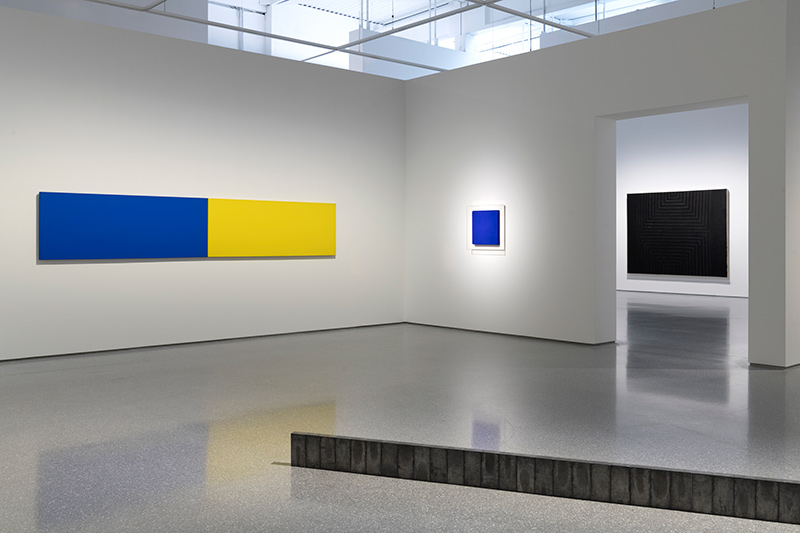
View of the exhibition “Frank Stella, Minimal / Maximal” at MAMC+.
© Marc Domage / MAMC+
© Adagp Paris 2026
With a focus on the series of “Blacks Paintings”, which gave Stella, just 23 years old, the stature of a master of minimal art, the second room highlights two large transitional paintings, where subjectivity has not yet completely given way to abstraction. Passportsort of scrapbook created by Carl Andre in 1960, provides a valuable testimony since it gives an important place to his friend Stella. In particular, we see one of his preparatory pencil drawings, characteristic of his creative process. Occupying an entire section of wall, a set of lithographs produced later, in 1967, shows all the variations of the famous black canvases with rectilinear stripes.
Visual finds
The hanging surprises with some visual finds: like this monochrome by Klein placed alongside two blue and yellow panels by Ellsworth Kelly, which precede a neon striped screen print in the same shades (Untitled, Rabat, 1964), inspired by Stella by a trip to Morocco. Or, more significantly, this late Kandinsky, Simple complexity, Or Ambiguity (1939), striking for the formal connection it suggests with the most baroque paintings of Stella, who had great admiration for her. The visitor has then reached the end of the journey, which accelerates, from the appearance of color to the dynamic paintings emerging from their frames, before approaching the most exuberant turning point in Stella’s production and her final sculptures.
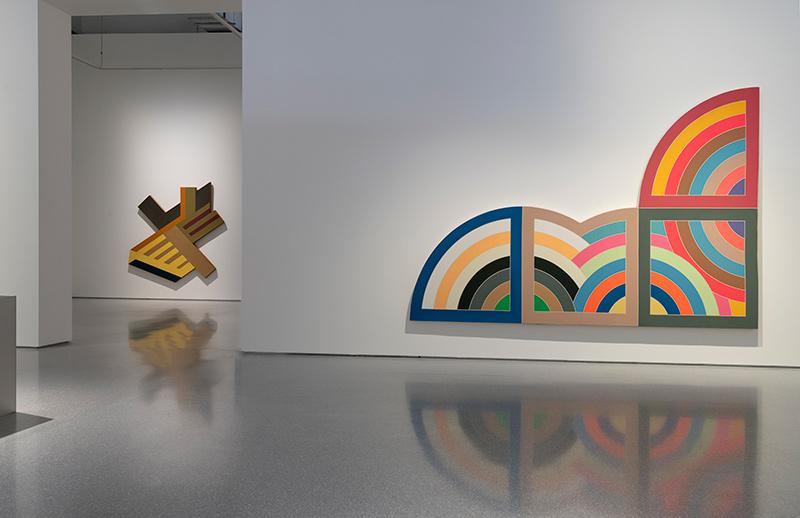
View of the exhibition “Frank Stella, Minimal / Maximal” at MAMC+.
© Marc Domage / MAMC+
© Adagp Paris 2026
Due to its historical and geographical links with the Saint-Etienne museum, the Ceysson & Bénétière gallery, which represents the estate in France, provided assistance, in particular for transport costs. In addition to loans from the Adisson Gallery, of the three masterpieces kept at MAMC+ – the first of which was acquired by Bernard Ceysson in the early 1980s – the pieces come from private collections and the Frac Auvergne. Embracing the career of an artist as prolific as Stella in a hundred works was a challenge. The MAMC+ succeeds with flying colors and even allowed itself the luxury of refusing the loan of a gigantic Monel Star of several tons. “I don’t see where we could have found space to exhibit it,” esteems Alexandre Quelle, smiling.