Now fixed but not yet extinguished, the fires have covered more than 2,000 hectares of the Fontainebleau forest (Seine-et-Marne) since Sunday July 12. The 850 firefighters mobilized finally managed to control the flames, but the persistence of flames and fumaroles does not yet allow the risk of resumption to be ruled out. The famous castle was never really threatened. The Fondation de France and the Heritage Foundation launched calls for donations in favor of forests on Wednesday July 15.
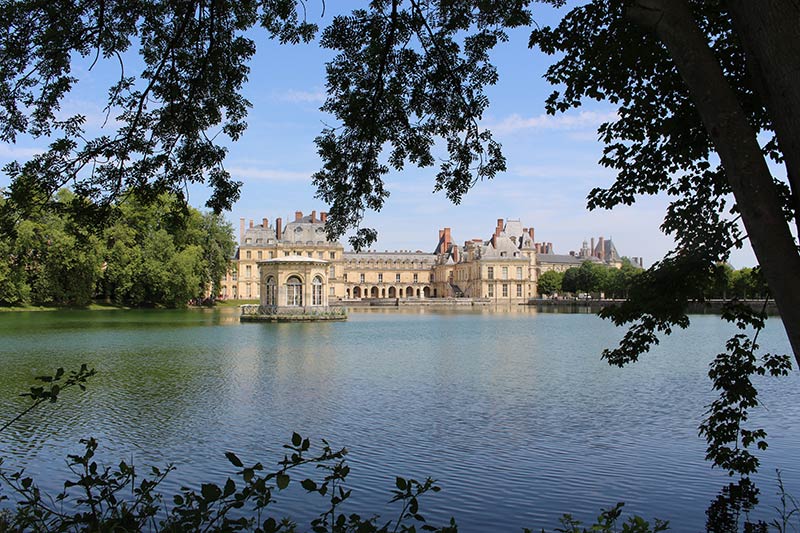
Located on the edge of the national forest, in the heart of the town of Fontainebleau, the castle is surrounded by a vast estate including gardens, wide paths and above all, the Grand Canal, created during the reign of Henri IV. A favorable configuration, the different attributes of which could probably have contained the flames if they had headed towards the building. Despite its relative proximity to one of the incendiary sources, located 3 km away, only strong winds could have posed a serious threat. In this case, the direction of the gusts was contrary to the direction of the castle.
On July 13, water bomber helicopters flew back and forth to the Grand Canal and the castle’s Carp Pond to resupply. Consequently, the gardens of the estate were evacuated, to facilitate the action of the firefighters. The building also closed earlier due to extreme heat, as well as on July 14, when it was overlooked by thick plumes of smoke. Otherwise, the area remained accessible to the public, without imminent danger.
The horses from 7 stables which had been gathered at the Grand Parquet de Fontainebleau, a site close to the castle, were evacuated to reception facilities as a precautionary measure. Despite this, concerns for the Château never evolved into serious concerns during the three days of intervention by the firefighters. The president of the estate Marie-Christine Labourdette did not activate the crisis unit, but remained in close contact with the Prefecture in case an evacuation plan for the works of the castle had to be deployed.
The history of the Château de Fontainebleau is closely linked to King François I (1515-1547), who made it his principal residence and one of the places of residence of many French sovereigns who succeeded him. On the ruins of the medieval building, he built a Renaissance-style structure, bringing in famous Italian artists to whom he entrusted the decor. The gallery designed by the esthete king was decorated with mythological scenes on the theme of love, painted in particular by the Florentine Rosso Fiorentino and The Primaticcio, from Bologna. The emulation there was such that we speak today of the “School of Fontainebleau”. Several frescoes by Rosso are still visible in the so-called Francis I Gallery, but the scenes from the Primaticcio have mostly disappeared: only his Danae has survived. Framed by the stucco work of Rosso Fiorentino, it serves as a flagship example of the paragone, an artistic debate of the Renaissance which confronted painting and sculpture.
Fontainebleau School, Presumed portrait of Gabrielle d’Estrées and her sister the Duchess of Villars1594, oil on canvas, 96 x 125 cm, Louvre Museum.