New York. Piqueing the curiosity of the New York passerby, who nothing really surprises or impresses, has never been easy. However, in recent weeks, a poster campaign has tried its luck in a Manhattan saturated with visual demands. On a Midtown bus shelter, between two advertisements for a Broadway show and a brand of sneakers, an invitation catches the eye: ““Hidden Treasures”: the most exclusive exhibition ever dedicated to French luxury in New York. » And you have to run, because it will only last a few days…
The promise may be surprising in a city that claims to be familiar with all excesses, but it is not made lightly. For the first time since its creation in 1954, the French luxury lobby, the Comité Colbert, brought together more than sixty major houses in the United States in a seduction operation intended for the American public and market. While China is slowing down and Europe is lacking momentum, the United States has once again become the key, decisive market for global luxury. It is also one of the most difficult, where consumers are increasingly questioning price, value, and even the very meaning of luxury.
At the “Hidden Treasures” exhibition, presented at the Shed, this prestigious new building overlooking the Hudson River, and organized by the Comité Colbert, bags, perfumes and jewelry are almost absent. In their place, the major French luxury houses have chosen to display archives, drawings, photographs, and some historic creations such as this Cartier space capsule. Because the stated object of this offensive is the celebration of a common history, a long history of friendship between two nations, the United States and France, who came like Minerva to help the American Hercules escape from the clutches of British colonial domination two hundred and fifty years ago.
In 2026, the Franco-American alliance has evolved. The Marquis de La Fayette and the third President of the United States, Thomas Jefferson, gave way to consumers, and philosophers to brands, but the strategic stakes remain high. As the objects on display reveal, this common history is also that of the links forged for more than two centuries between the great French houses and the United States. From the bottles of Château d’Yquem ordered by the Founding Fathers to the Saint-Louis crystal service offered to the Kennedy couple in 1961, these exchanges tell the story of a relationship whose importance appears today in a new light.
“The American market never disappeared. But, over the last fifteen years, it has been eclipsed by a major competitor: the Chinese market. observes Thomaï Serdari, professor of luxury marketing at the Stern School of Business at New York University. For nearly two decades, Chinese growth masked the resilience of the American market. But the global balances have shifted. The Chinese slowdown, geopolitical tensions and new consumption habits born from the pandemic have put the United States back at the center of the game.
View of the “Hidden Treasures” exhibition at the Shed.
© Colbert Committee
“Covid has changed everything”, continues Marie Driscoll, luxury analyst and professor at Parsons (New York). Deprived of travel, restaurants or shows, many Americans shift part of their spending to luxury. “We could no longer go to the opera, travel to Paris or go on a cruise. Overnight, many consumers found themselves with more money to spend. I’ve seen people who weren’t particularly interested in luxury suddenly decide to treat themselves to a beautiful handbag. This is how new customers entered this universe”she says.
The houses support their customers well beyond New York, Miami or Los Angeles. “Many luxury houses have followed their clients to secondary or tertiary cities,” specifies Marie Driscoll, citing in particular Boulder, in Colorado, or certain regions of northern New York State.
Leading global luxury market
The United States has once again become the main engine of growth for major groups in the sector, from LVMH to Hermès via Kering. Consulting firm McKinsey forecasts that the American luxury market is expected to grow 4 to 6% per year between 2025 and 2027, more than China or Europe. At the same time, Bain & Company estimates that wealthy American consumers remain the mainstay of the global luxury personal goods market, valued at €358 billion in 2025.
“We must never forget that the United States is the leading luxury market”recalls Bénédicte Épinay, general delegate of the Comité Colbert. For French houses, the stakes are considerable to stay in the race in this very competitive sector. “It’s a market that matters (…) and we are determined to invest in it for the long term,” thus indicates to Arts Journal Stéphane Blanchard, general manager of Chanel in the United States.
The paradox is that this return of America to the heart of the market comes at a time when consumer morale has never been so low. In May, the University of Michigan’s confidence index fell to 44.8 points, its lowest level on record. Americans say they are more worried today than at the height of the 2008 financial crisis or during the first months of the pandemic. “But even though confidence indicators are catastrophic, Americans continue to spend, puts Marie Driscoll into perspective with humor. When times get tough, they go shopping. »
After several years of spectacular price increases, luxury is facing a challenge to its economic plan. According to McKinsey, more than 80% of the sector’s growth between 2019 and 2023 was generated by price increases, such as at Dior, Chanel or Louis Vuitton, rather than by volumes. “I think overall prices have increased by about 15%, but some brands have raised prices by 50%, without any significant improvement in quality or design,” notes Pamela Danziger, researcher and consultant.
“Luxury has simply become overvalued, believes Marie Driscoll. Many people who can afford it now say: it’s no longer worth it. » She cites the example of a customer entering Bergdorf Goodman determined to buy a Chanel bag. When she discovered that its price had now reached $12,000 (€10,350), almost double what it cost a few years earlier, she turned around.
“Desire gradually merged with aspiration, continues Pamela Danziger. Aspiration refers to a logic of social status. Desire corresponds to something that has meaning for me, something that is personally valuable to me. » It now appears that, for a new generation of buyers, status is no longer everything. More demanding than their elders, Generation Z consumers are looking more closely at quality, provenance and the values defended by brands. “They have much more information than any generation before them. »
For French luxury, the current challenge is all the greater as the market is highly competitive. “Dior, Chanel, Valentino or Celine are now competing with new brands like Khaite, Totême or Sacai,” observes Marie Driscoll. These new brands appeal to a clientele looking for novelty and authenticity, but also a certain distrust of the big luxury groups. “There is a real distrust towards large conglomerates, agrees Pamela Danziger. France appears to be a world more dominated by large groups while Italy remains more associated with independent houses and entrepreneurs. »
After selling rarity and status for a long time, the big names are now seeking to restore meaning. In this context, taking the time to return to its history, to its roots, paradoxically becomes an asset for a French house to project itself into an American future. A spirit of the times well captured by the Colbert Committee, whose New York exhibition features letters dating from the Enlightenment period, stories and know-how rather than advertising campaigns or major commercial performances.
The transmission of know-how
For Thomaï Serdari, French houses have a historical advantage here, which certain names, like Hermès, know how to transform into contemporary strength. “French houses have a real talent for telling their story, transmitting their heritage and creating experiences around these stories,” she explains. This strategy also responds to a growing expectation of the American public eager for know-how and history, especially for younger generations. “ahistorical” according to the professor, constantly looking for novelty and innovation, certainly, but also for codes. “ What touches me is how the American public sincerely appreciates the human hands and hundreds of hours of work that go into a single creation.”observes Stéphane Blanchard, who also represents the Comité Colbert in the United States.
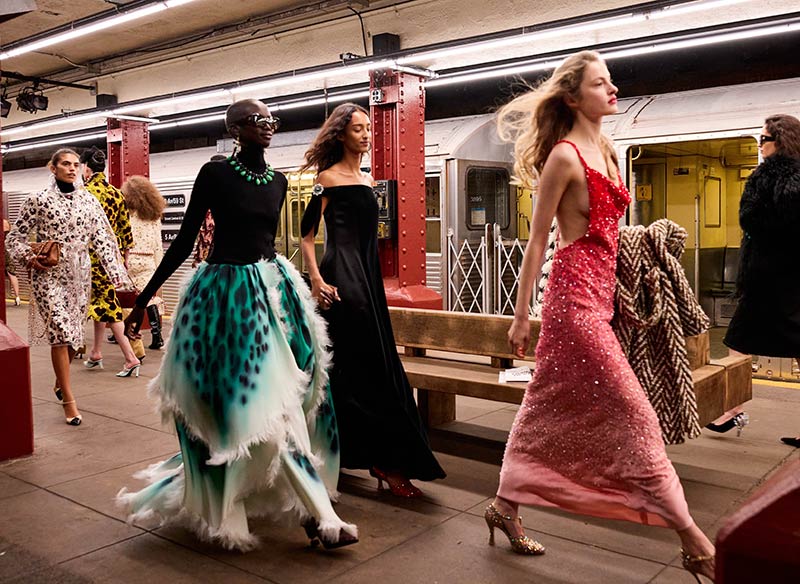
“Hidden Treasures” is part of a broader movement. In December 2025, Chanel presented its Métiers d’art fashion show in a New York subway station, while other houses are multiplying exhibitions, foundations and artistic collaborations. “Authenticity has become an essential value, adds the general director of Baccarat, Thaïs Rhoda. Handcrafted items will become even more valuable than they were before. » Just like the traceability of products and their production conditions.
Behind these cultural initiatives finally emerges a broader issue of French influence, supported by the public authorities, in a context marked by geopolitical tensions and new customs barriers. “That’s what soft power is”, summarizes the French ambassador in Washington, Laurent Bili. At the origin of the project, he explains to JdA having himself requested Bénédicte Épinay and the Comité Colbert to celebrate 250 years of Franco-American friendship.
At a time when global luxury is going through a phase of doubt, French houses are seeking to restore confidence as much as to stimulate desire. More than a communication operation, this return to archives, to craftsmanship, appears as an ode to the long term and an attempt at rebalancing, after several years of price increases, to better reconcile value and legitimacy. And, despite trade tensions, no house seems ready to look away from the United States. “We cannot imagine growing… without America”underlines Bertrand Pochet, USA general manager of Guerlain.