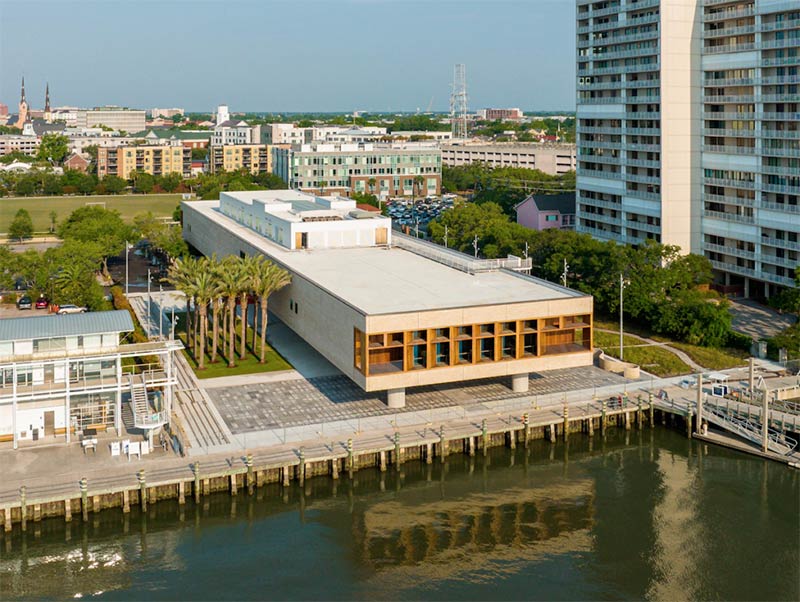
The International African American Museum (IAAM) in Charleston, South Carolina, announced last week that all of its employees, even management, will have to be furloughed for 20 days, staggered until the end of 2026. A way for the museum to remain open without laying off members of its teams.
Faced with an unprecedented economic situation since its opening in 2023, the IAAM presented these measures as a lesser evil. The museum explained that it wanted to reduce its expenses to give itself time to develop a two-pronged financial strategy: strengthening its own resources and continuing to raise funds. In a context of “change in the political environment and financing arrangements”the institution, which had reached half a million visitors earlier in the year, is taking the hit, hoping to succeed in increasing its endowment fund.
Marking the culmination of a project carried out for 20 years, the IAAM was inaugurated on the Gadsden quay, a major place in the history of the slave trade, which hosted the disembarkation of around a hundred thousand Africans reduced to slavery. The symbolic location of the institution sets the tone of the museographic statement, which aims to “tell the unvarnished story of the African-American experience”.
If the construction of the building was based on a mix of public and private funding, to the tune of 75 million dollars (around 65 million euros), the IAAM today depends mainly on private resources, like most American museums. In 2024, almost three quarters of its turnover came from donations. The structure has notably received donations from the Lilly Endowmentone of the largest philanthropic players in the country, including one of 10 million dollars (more than 8.5 million euros).
Professor of American literature at the University of Nantes, Michel Feith indicates to Arts Journal “donors have the reputation of their establishment in mind, and tend to try not to make waves”referring to government pressure placed on philanthropic organizations.
IAAM is not an isolated case in the United States. Last March, a report from the Government Accountability Office (GAO, the audit, evaluation and investigation body of Congress) reported an alarming situation which concerned the majority of North American museums, unable to maintain their buildings, due to lack of necessary funds. Clémentine Tholas, lecturer in American history and civilization at Sorbonne Nouvelle University, explains to Arts Journal : “the Trump administration wants to take away public subsidies for culture by trying to put an end to National Endowment for the Arts which has been financing numerous cultural projects for years”.
Although the IAAM had received, at the time of its construction, a significant sum of money from the State of South Carolina, the values promoted by the museum do not fall within the funding criteria of Trumpist culture. Discourses similar to that of the IAAM, explicitly directed at recognizing the United States’ slavery past and promoting African-American culture, have already been the subject of challenges from the government. Clémentine Tholas confirms that“a permanent fear weighs on American museums, particularly those which are committed in a fairly frank and open manner to promoting DEI values through their collections and their programming (Diversity, Equity, Inclusion), which are rejected by the new Trump administration ». However, according to the researcher, the difficulties of the IAAM are, at present, essentially linked to a limited influence due to an approach which remains above all regional. She believes that the Charleston museum does not benefit from a “cultural impact powerful enough for the White House to particularly target it”.