Paris. A unique testimony to Franco-English relations, the Bayeux tapestry had been the subject of several loan requests since the beginning of the 20th century, all of which were refused. President Emmanuel Macron’s decision to lend the tapestry to the British Museum in London constitutes a break, and testifies to “the common history between France and the United Kingdom”, underlines Catherine Pgard, Minister of Culture.
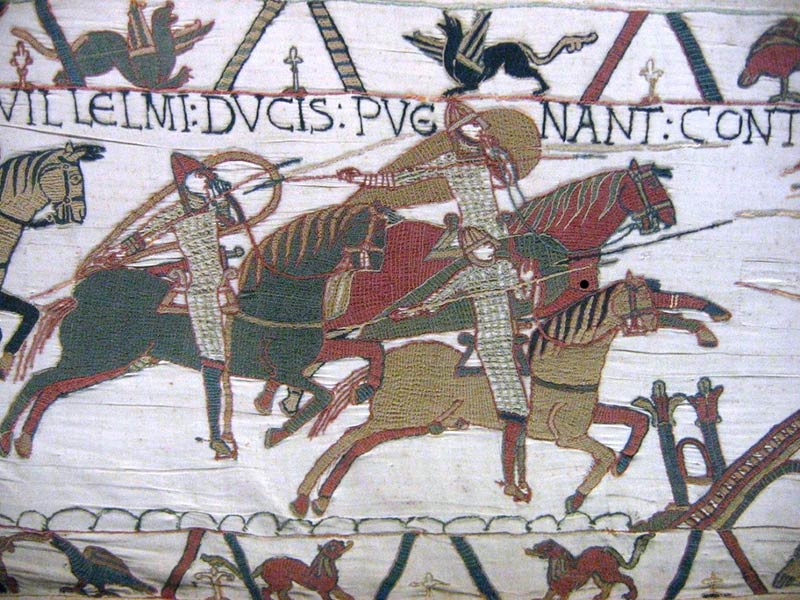
This work from the Romanesque period (1066), 69 meters long, recounts the Battle of Hastings during which William the Conqueror (c. 1027-1087) defeated the English troops and established his power in England. It constitutes a unique example in the world of embroidered textile preserved in exceptional condition, despite its fragility. Stored for a long time in the treasure of Bayeux Cathedral, in Normandy, and rarely exhibited apart from a few festivals, the tapestry was therefore kept away from light until its rediscovery in the 18th century. It had escaped two fires in the 12th century and then pillage by the Huguenots in 1562. From 1800, it was widely displayed. Napoleon I had it exhibited at the Louvre in 1803-1804 before it joined the Bayeux library in 1835. Transferred to an abbey by the Germans during the Second World War, it passed through the Louvre in 1944 then returned to Bayeux in 1945. Since the 1980s, it has been exhibited in the former seminary which became a museum, under controlled conservation conditions.
Vibration risks
This tapestry has therefore been handled several times during the 20th century, but it has never been transported over long distances as will be the case next July and then in September 2027, for its return. During its partial restoration between 2020 and 2025, nearly 9,600 holes were listed by the curators, as well as thirty tears: the linen and wool fabric is therefore weakened. The technical study that was carried out partly responds to concerns by providing numerous figures on the risks linked to vibrations, the main problem point. Several scientific and technical specialists participated under the aegis of SMACH (Science and mechanics in heritage conservation), a group of experts. The blank transport conditions, with a facsimile of the tapestry, were tested on two occasions, including once on the entire journey between Bayeux and London (the itinerary remains confidential). The tapestry will be transported partially folded on a metal screen, then in a “one-of-a-kind “super-insulated” box”specifies Cécilia Gauvin, who directs SMACH. The body will be surrounded by a metal structure flexible enough to also attenuate part of the vibrations thanks to twelve springs. Finally, the truck itself will be equipped to limit these vibrations. All types of vibrations have been studied, and the entire transport device must reduce vertical vibrations and “transform into flexible oscillations”indicates the study. In both tests, almost 96% of the vibrations were absorbed.
3D projection of the scenography imagined by Opera Amsterdam for the presentation of the Bayeux tapestry at the British Museum.
© Trustees of The British Museum
If the study concludes that the risks of tearing are limited in these conditions, several heritage experts remain doubtful. The former restorer of the tapestry Béatrice Girault expressed her concern in 2022, explaining that the canvas was impossible to roll or fold due to the risk of repeated friction on the fibers. The study does not directly address this issue. Furthermore, it is largely “redacted”: 44 pages out of 128 in total are censored, in particular those concerning the route and the transport truck. The study also does not specify under what conditions the tapestry will be loaded and unloaded on the way there and back, other risky moments after transport. And it was not possible to “reproduce the mechanical and chemical oxidation of the canvas” on the facsimile, recognizes Cécilia Gauvin, who nevertheless remains confident about the resistance of the tapestry to vibrations. Finally, as noted by Julien Lacaze, president of the Sites & Monuments association, the authors of the study are the very companies that won the call for tenders. There is therefore reason to wonder. These elements led the association to challenge the legality of the loan decision before the Council of State, which declared itself incompetent because the loan falls under a “act of government” within the framework of cultural diplomacy.
Exhibition conditions at the British Museum
If the details of the arrival of the Bayeux tapestry at the British Museum in London remain confidential, the British authorities have provided details on the exhibition itself. The tapestry will be “exposed flat in its entirety”indicates former ambassador Lord Ricketts, special envoy of the United Kingdom for the loan of the tapestry. He specified that the exhibition room, 75 meters long, had just been renovated, and that the presentation support had been custom-made for the tapestry. This had until now been exhibited only vertically, including at the Bayeux museum. Visitors will be able to view the tapestry from a mezzanine then go back down to pass in front of the embroidery, and look at objects from the same period on loan from British institutions. Managing the flow of visitors was not mentioned during the press conference given on June 3, but the British website specifies that reservations are made in 40-minute slots, a sign that visitors will not be able to linger in front of the work.