Paris. THE “handsome Martin” : this is the nickname that Albrecht Dürer (1471-1528) attributed to Martin Schongauer (around 1445-1491), probably as a sign of the admiration he had for his work. The exhibition at the Louvre Museum confirms the extraordinary virtuosity of the man who, if he is best known for his work as an engraver, also worked as a painter. The approach also resonates as a form of recognition for this artist who has long remained in the shadows. Although Schongauer is not absent from museum collections, he has until now never been the subject of such a major retrospective.
Martin Schongauer (1448-1491), The Censer (c.1472), 26 x 20 cm, and Saint Anthony tormented by demons (c.1471), 30 x 22 cm, engravings, Paris, Musée du Louvre.
© GrandPalaisRmn / Philippe Fuzeau / Gabriel De Carvalho
To introduce the artist, grandson, son and brother of goldsmiths, the engraving of The Censer [voir ill.]serves as a subtle nod to the family profession. Schongauer enjoys meticulously restoring volumes, playing with hatching to add texture, and reproducing chains, ornaments and metal interlacing as faithfully as possible. “Martin Schongauer is a big question mark despite everything. We have few sources, we do not even know his exact date of birth. But his art speaks for itself, everything is before us,” marvels Pantxika Béguerie De Paepe, honorary curator of the Unterlinden Museum in Colmar (Haut-Rhin), co-curator of the exhibition with Hélène Grollemund, collection manager at the Graphic Arts department of the Louvre.
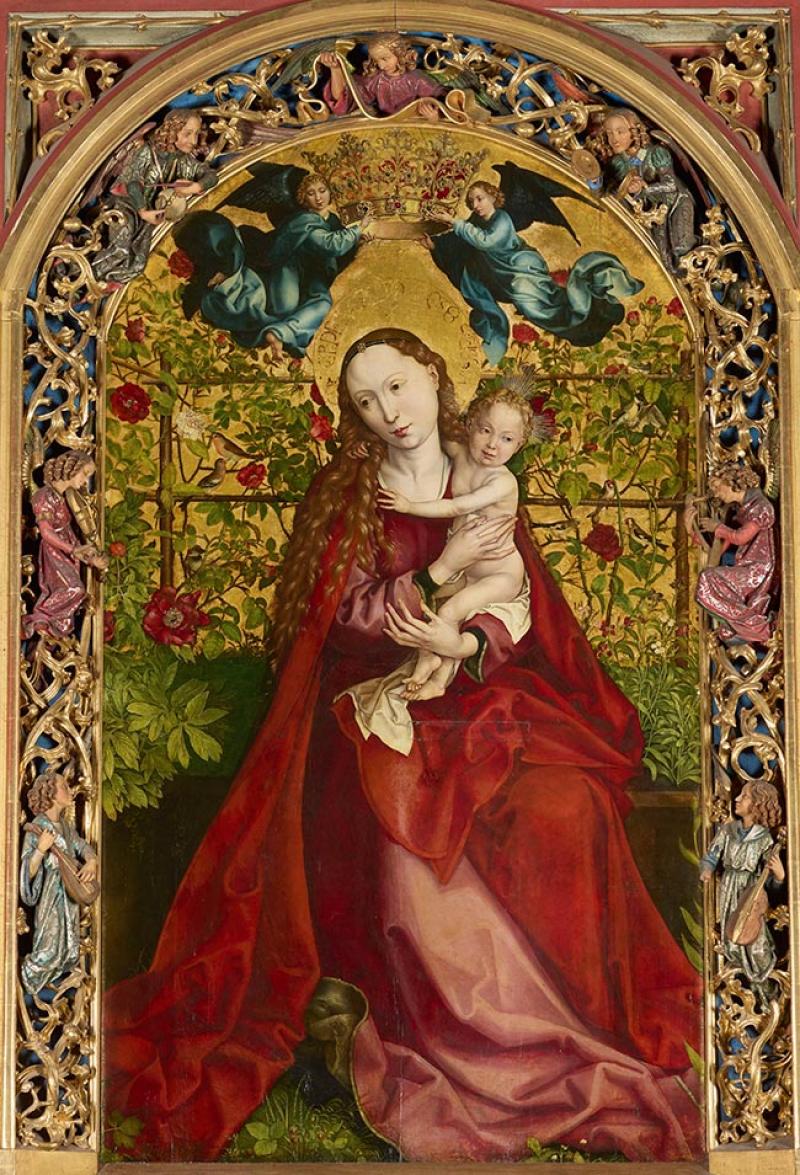
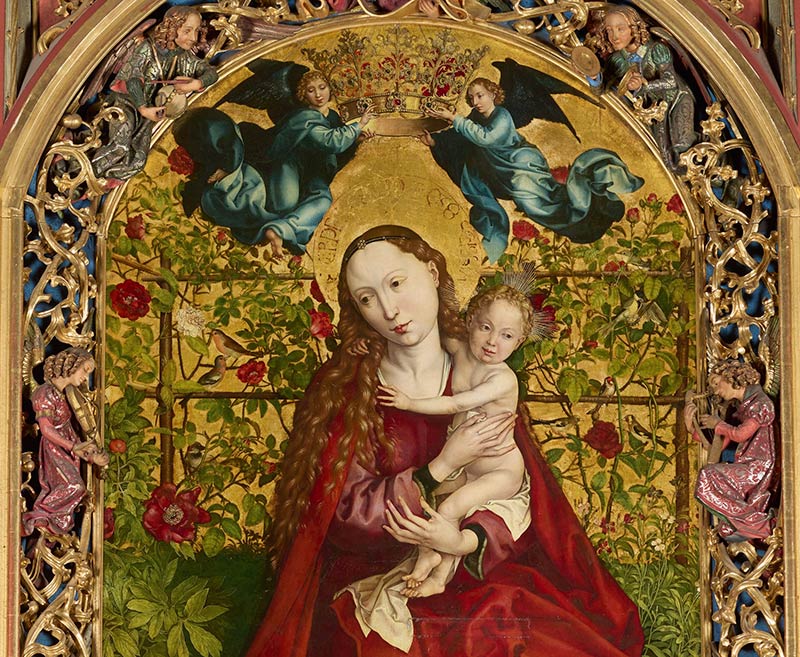
Martin Schongauer (1448-1491), The Virgin of the Rose Bush1473, oil and tempera on wood, 200 x 114 cm, Colmar, Dominican church.
© Grand Est Region – General inventory / Bastien Garnier
Almost all of the paintings
This observation becomes obvious as we progress through the hundred or so works on display, such a collection having never been brought together before. In total, around fifty of his engravings punctuate the picture rails, punctuated by five of his very rare drawings (out of the twelve existing). And for the first time, almost all of the paintings attributed to him are presented together: of the eight paintings that have come down to us, only the Holy Family kept in Vienna did not make the trip because it was too fragile to travel. We can thus admire the little Virgin and Child at the window (around 1480), remained in private hands for a long time before joining the collections of the Getty Museum (Los Angeles), or the Orlier Altarpiece (c. 1470-1475) commissioned by the superior of the Antonin commandery of Issenheim (Haut-Rhin), today preserved at the Unterlinden Museum. But the highlight of the exhibition undoubtedly remains its extraordinary Virgin of the rose bush (1473, [voir ill.]), which usually sits in the Dominican church of Colmar. Here, the low hanging allows you to fully appreciate all the little details: birds in the branches, strawberry plants and delicate flower petals, captured with botanical precision.
This naturalist concern taken to the extreme is not confined to the religious subject. The exhibition shows the remarkable diversity of subjects that Martin Schongauer addresses through engraving. Hybrid creatures, apostles and saints, animals, ornamental scrolls… One of the great interests of this presentation lies in the multiple connections made between the artists. “Throughout the exhibition, we understand that all these artists not only have workshops, companions and apprentices, but above all access to very important documentation through drawings and engravings,” recalls Pantxika Béguerie De Paepe. So, next to the Triptych of the Braque family by Rogier Van der Weyden (1399-1464), the presence of a Christ blessing Schongauer’s later work makes his influences much more palpable. And his legacy is even more so.
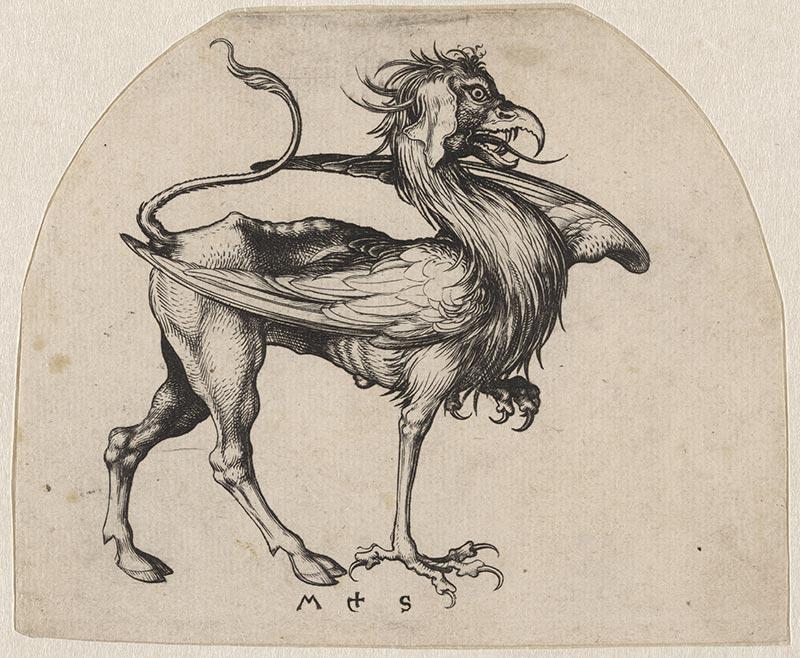
Martin Schongauer (1448-1491), The Griffincirca 1470-1475, burin engraving, 10 x 13 cm, Paris, Louvre Museum.
© GrandPalaisRmn / Tony Querrec
Already during his lifetime, until the 17th century, Martin Schongauer was copied many times. His prints circulate widely and his models inspire engravers and painters, but also sculptors, enamellers, weavers… Among this important corpus, the Louvre makes a fine selection by presenting, alongside the original engravings, around thirty works which sometimes borrow a simple detail, other times repeat an entire composition by the Colmar master. Fascinated by the crazy inventiveness of Saint Anthony tormented by demons by Schongauer, Lucas Cranach the Elder (1472-1553) reappropriates this scene teeming with grotesque demons and chimerical creatures. Hans Baldung Grien (1484 or 1485-1545) metamorphoses The Death of the Virgin by exacerbating the impression of suffering and agitation that emerges.
Martin Schongauer’s posterity goes beyond the medium of engraving, and does not only affect the big names. The Louvre highlights several little-known works, ranging from a relief of The Great Nativity carved on a mollusc shell to a tapestry of The Arrest of Christ which borrows some details from Schongauer, passing through a Baptism of Christ performed by an anonymous Tyrolean sculptor. What emerges is one certainty: Schongauer’s art has seduced people across eras and borders.