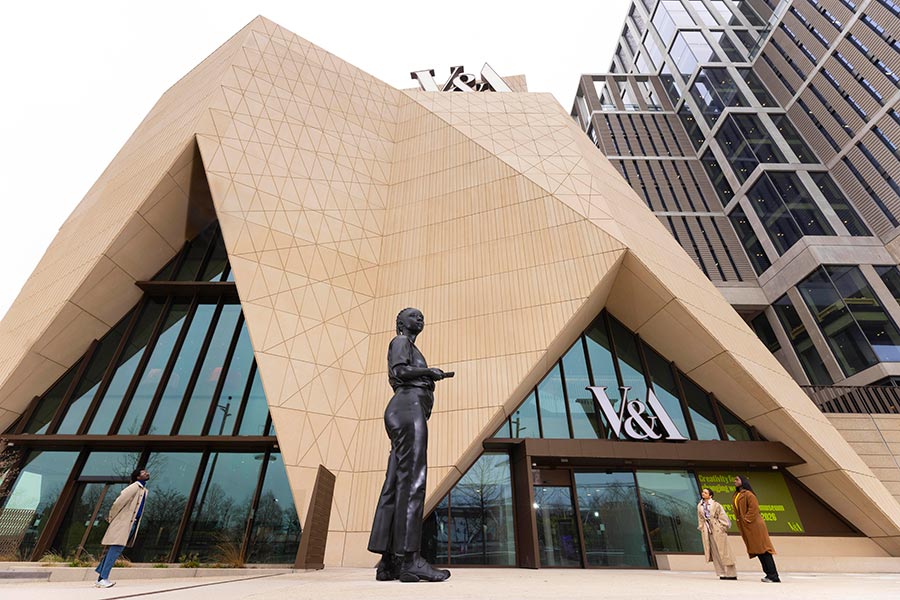
London. To get to the “V&A East”, the new branch of the Victoria and Albert Museum, you have to venture into the huge shopping center of Stratford, east of London. Nestled in the former Olympic district of the British capital, this new site cost 135 million pounds (€155.8 million). It is part of East Bank, the cultural complex supported by the City of London. The building, designed by the architectural firm O’Donnell and Tuomey, resembles from certain angles a face turned towards the horizon, facing a vacant lot and a series of buildings under construction. Its silhouette, inspired by designer Balenciaga’s dresses, is made up of 479 sand-colored prefabricated concrete panels, whose lines echo the V&A logo.
At the different entrances to the museum, which opened its doors on April 18, employees dynamically direct a sparse audience. Winding circulation spaces invite you to wander inside the building, following a route punctuated by large windows, integrated benches and works by local and international artists. To those familiar with the historic V&A in central London, the new five-story building appears airy but modest. The two permanent galleries, called “Why We Make”, contain around 500 objects from the V&A collections. This is incommensurate with the more than 62,000 objects presented in the 145 galleries of the national museum.
Young people but also local residents
But the goal is not to duplicate the parent institution. The aim is to reinterpret the historical collection in the light of the neighborhood and the interests of its inhabitants. “The V&A East is open to everyone, but is particularly aimed at 16-35 year olds and those who live, work or study in east London,” confirms Gus Casely-Hayford, the director. To meet the expectations of this audience, whose interests focus on topics such as social justice and the environment, the permanent collection was created in consultation with 30,000 young people aged 16 to 25, as well as creatives in east London. Several permanent and temporary installations evoke the life of local communities and the transformation of the neighborhood. The photographic exhibition on the top floor, titled “Dispersal,” shows small businesses that had to be relocated during the construction of the Olympic Park for the 2012 Games.
View of one of the exhibition rooms at the V&A East Museum.
© David Parry
But for Gus Casely-Hayford, this anchorage does not prevent the international reach of the museum. Alongside the creations of British pioneers such as Alexander McQueen and Vivienne Westwood, the collection presents some Renaissance paintings, including a self-portrait by the Italian Sofonisba Anguissola, and even stage costumes by the Australian artist Leigh Bowery.
The permanent collections are structured around ten themes designed to answer young people’s questions, such as “Our place in the world” or even “Take care of yourself”. Thus, the visitor is not rushed, on the contrary he is taken by the hand to discover the V&A collections through the prism of “creativity that brings change”. A sign even states: “Don’t feel like you have to see everything today. “Why We Make” is available for free at any time. »
This position is fully assumed by the director, who wants to attract “those who do not feel comfortable in museums”. “East London has long suffered from underinvestment in national museums,” he recalls. The scenography designed for the youngest, which includes elements to touch and tables to explore oneself, follows the same logic. “Young people are the future visitors to museums. It is therefore essential to capture their imagination from an early age and give them the opportunity to express themselves and act in the creative process. »
The inaugural exhibition, “The Music is Black: A British Story”, on the other hand, is more daring in its theme. Through the history of black British music, this immersive presentation highlights the importance of slavery in the country’s colonial past. The museum even displays a reproduction of the charter that legalized the slave trade, signed by King Charles II. However, this document is often cited as an argument in favor of the payment of reparations by the English crown. This exhibition occupies the entire third floor, devoted to temporary exhibitions. “With almost 900 m2 and a ceiling height of 6 m, it is the second largest temporary exhibition gallery at the V&A, after the Sainsbury Gallery at the V&A South Kensington”underlines Gus Casely-Hayford.
Regarding the numerical objectives, the director is more cautious: “The number of visitors is not the only indicator of our impact: above all, we want to attract and welcome a wider and more diverse audience. » Since opening in May 2025, the V&A East Storehouse, the sister institution of the V&A East, has welcomed more than half a million visitors, more than double its original target.