Rains of Iranian missiles and drones hit the region, tourists fled, the Dubai Art Fair was reduced by half. Yet Dubai has just announced a new digital art museum. A weakened city tries, through culture, to achieve normality. But a museum without a date or budget is less about the promise than about its staging, intended to erase the situation in the region.
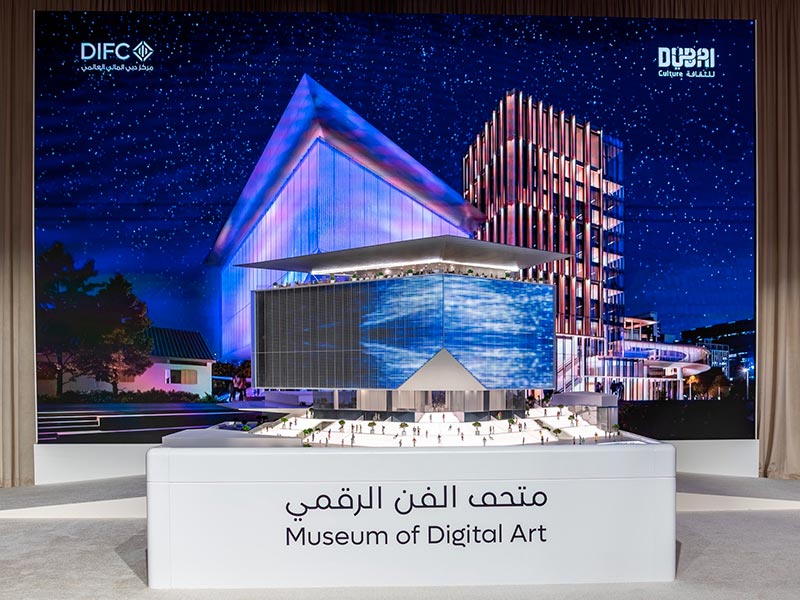
The Museum of Digital Art (MODA) will be located in the DIFC Zabeel District, an extension of the Dubai International Financial Centre. Five floors, permanent and temporary exhibitions, immersive experiences, educational spaces, interactive platforms. A “digital twin” will allow access to exhibitions around the world. The building will be designed by Adrian Smith + Gordon Gill Architecture, a Chicago-based firm that designed the famous Burj Khalifa tower. MODA adds to the vast transformation project of the DIFC estimated at 27 billion dollars (24 billion euros).
Understanding this announcement requires understanding what Dubai really is, a global brand built on a promise of absolute security, carefully maintained by an army of influencers touting swimming pools and sunsets. The emirate has built its attractiveness on stability, neutrality and the idea of a territory outside the world.
This fiction is, however, put to the test. In February, the United States and Israel launched Operation Epic Fury against Iran. The Iranian response was massive and immediate. The Revolutionary Guards fired ballistic missiles and drones at six Gulf countries, including the United Arab Emirates (UAE), within hours. Dubai received its first impacts on March 1. The international airport was hit and the 23 Marina tower was hit. The total toll, at the time of the first partial ceasefire in early May, stood at 551 ballistic missiles, 29 cruise missiles and 2,263 drones intercepted on Emirati territory alone. Damage to energy infrastructure is estimated at around $60 billion (€51 billion). The UAE is, by far, the Gulf country most affected by Iranian strikes.
The 20th edition of Art Dubai, a showcase of the emirate’s cultural ambition, suffered from the war. Announced with 120 international galleries, it was reduced to 50 stands and free entry. To attract a few more participants, fees were indexed to sales. At the same time, the authorities encouraged the looping of images of brunches and rooftops, while restaurants and hotels emptied. Those filming missiles and debris were arrested, threatened with heavy fines and ordered to delete their videos.
Before MODA, Dubai had already announced in October 2025 the Dubai Museum of Art entrusted to the Japanese architect, Tadao Ando. Inspired by shells and pearls, the building appears as a rounded concrete monolith placed on a jetty on Dubai Creek, with galleries, a library and spaces for collectors. It would be a real museum with strong architectural ambition, presented as a beacon for the city. However, no timetable is specified.
The choice of digital art responds to a logic of avoidance. Dubai keeps its distance from Abu Dhabi’s supremacy in the museum sector, embodied by the Louvre Abu Dhabi, Frank Gehry’s future Guggenheim and the Zayed National Museum. In a context of financial dependence with its neighbor, the city cannot engage in head-on rivalry and invests in a more flexible, less institutional and less symbolically marked territory.