Venice (Italy). The final about-face, before the opening of the Biennale, by the organizers of the famous contemporary art event was not enough to extinguish the fire which had been threatening to engulf the city of the Doges for several weeks. As a reminder, Pietrangelo Buttafuoco, the president of the Biennale, attracted the wrath of part of the art world and the international political sphere by announcing on March 4, 2026 the return of the Russian pavilion when the country was no longer represented in Venice since the start of the war in Ukraine – during the 59th edition 2022, the artists and curators of the pavilion withdrew in protest, and Russia had not been invited in 2024. Under pressure from the European Commission, which announced on April 23 the suspension of its subsidy of 2 million euros for the 2028 edition, Buttafuoco, weakened by the historic resignation of the entire Biennale jury on April 30, just a few days before the pre-opening, finally declared that the Russian pavilion would remain closed to the public for the duration of the event.
The Israeli pavilion, also back for this 61st edition after being closed by its own representatives in 2024 due to the ongoing genocide in the Gaza Strip, will be open on the Arsenal site, the national pavilion at the Giardini being under construction, despite the publication, on March 31, of an open letter requesting its exclusion, signed by nearly 200 artists and associated curators of the Biennale.
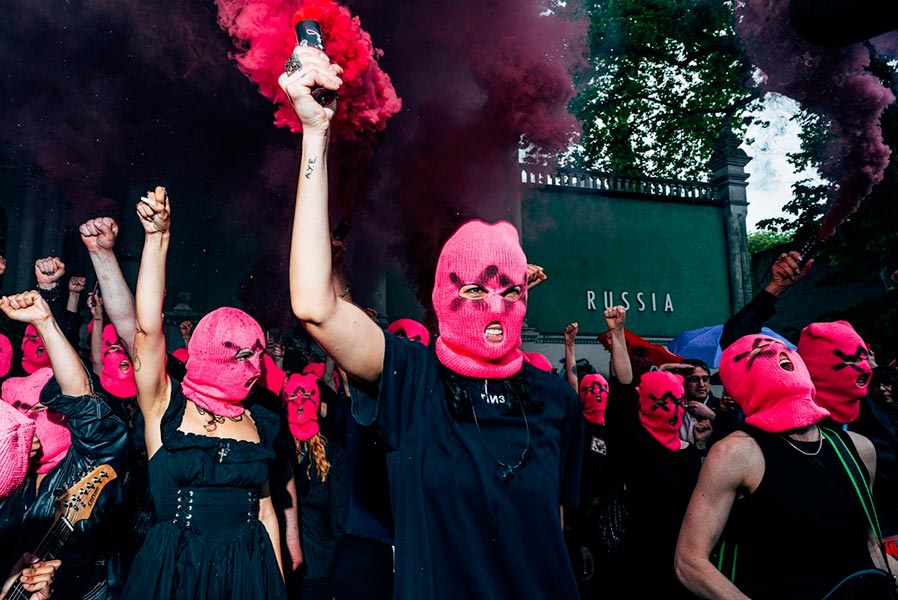
Despite the announcement of the closure of the Russian pavilion to the public, a wave of protest actions swept over the Arsenal and the Giardini during the three pre-opening days of the Biennale, May 6, 7 and 8, which attracted nearly 28,000 professionals from the world of art and the media. On Wednesday May 6 in the morning, around twenty members of Pussy Riot (including the founder of the Russian feminist collective herself, the musician Nadya Tolokonnikova) dressed in black and balaclavas (hoods), lit smoke bombs and sang punk songs in front of the Russian pavilion (see ill.). Present at the same time, members of Femen, including Ukrainian activist Inna Shevchenko, displayed signs with slogans such as “blood is the art of Russia”.
Entrance to the international pavilion of the Venice Biennale 2026.
© Andrea Avezu
Russian separatist movements
At the entrance to the Giardini, another collective had met that same day in the morning: the Free Nations League, an alliance representing 15 separatist movements in Russia, founded shortly after the start of the war in Ukraine. In front of a stand covered with the names of political prisoners who defend the rights of people colonized by Russia, the activists had placed paintings by the artist Simon Skrepetski, notably representing Vladimir Putin on top of a mountain of corpses. At the same time, Georgian-born artist Shalva Nikvashvili performed in front of another entrance. Motionless, wearing a black hood resembling a muzzle, she held a sign on which the phrase was written “La Biennale di Venezia loves violence”.
The artists, curators and organizers of the Latvian pavilion coordinated a protest campaign called “Death in Venice”, in reference to the eponymous book (1912) by Thomas Mann, and whose logo design was created by the artist Krišs Salmanis during a workshop at the Latvian Center for Contemporary Art (LLCA) in Riga. Also on May 6, the commissioners of the Baltic pavilions organized a march in support of Ukraine – the demonstration started in front of the Latvian pavilion, continued at the Arsenal where the Lithuanian pavilion is located, and ended at the Estonian pavilion.
In solidarity, 30 pavilions closed for one day
Many pro-Palestinian activists also mobilized from the pre-opening to contest Israel’s presence at the Biennale. The Art Not Genocide Alliance (ANGA) collective led a first demonstration at the Arsenal on May 6 at 12:30 p.m., during which around a hundred participants blocked the entrance to the Israeli pavilion for around thirty minutes – many leaflets carrying messages such as “Can you tolerate this?” No to the genocidal pavilion » were scattered throughout the Arsenal and the Giardini.
ANGA also issued a call for a 24-hour strike to workers and participants of the Biennale on Friday May 8; he also organized a demonstration the same day in the streets of Venice, which attracted more than 1,000 people – among the slogans appearing on the banners, “No Artwashing Genocide”. In solidarity with the movement, nearly 30 national pavilions, including those of France, Belgium, Austria, the United Kingdom and Finland, did not open their doors that day.