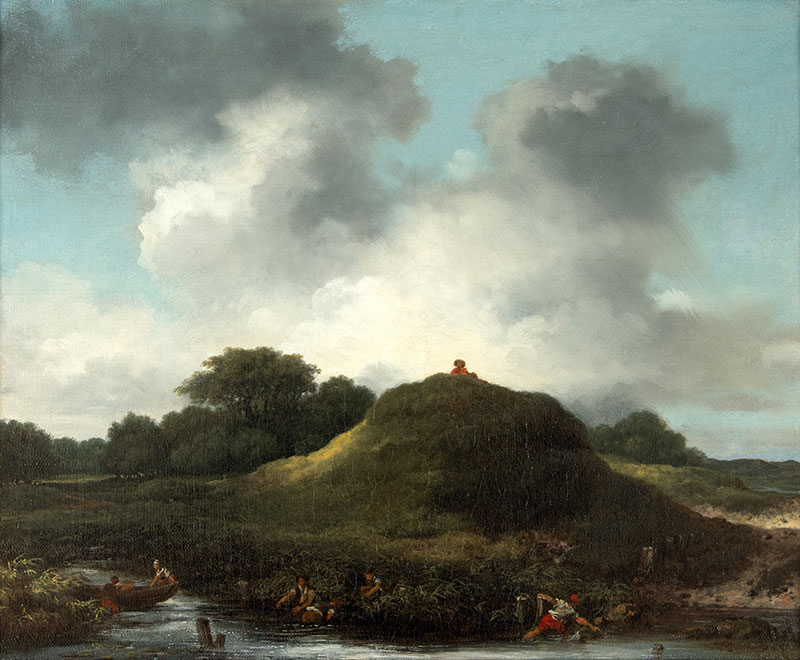
Valencia (Drôme). Comparing Hubert Robert and Fragonard: the association seems almost self-evident. Not only because the two artists, each in their own way, had a profound impact on the art of the second half of the 18th century in France, but also because their paths intertwined on several occasions. When Jean Honoré Fragonard (1732-1806), after winning the first prize for painting in 1752, arrived at the French Academy in Rome, he met Hubert Robert (1733-1808), who had been staying there for two years thanks to the protection of the Duke of Choiseul. One is already a renowned artist, the other is on the fringes of strict academic training. Forty years later, they met again, both getting involved in the major project of the future Louvre Museum.
From their meeting an obvious artistic emulation was born. So obvious that the Villa Medici dedicated, in 1990, a rich exhibition to their Italian production, bringing together 190 works by the two young painters. It is in a tighter format that the Valence Museum reactivates this Hubert Robert-Fragonard face-to-face, with nearly 80 paintings, engravings and drawings presented. Above all, this time the exhibition retraces their entire career, opting for a very specific bias. “Our desire was to re-examine the relationship they had through the theme that brought them together: the landscape,” explains scientific curator Sarah Catala, specialist in ancient drawing and the work of Hubert Robert. For the Valencia Museum, it is also an opportunity to bring out the famous red chalks of the “painter of ruins” which constitute the core of its drawing collections and make it the French establishment of reference on Hubert Robert after the Louvre.
Hubert Robert (1733-1808), The Cascatelles of Tivolicirca 1777, oil on canvas, 241 x 217 cm.
© Coatalem Gallery, Paris
Subtle differences
Thematically required, the course presents relatively uniform content. If each person’s own style evolves, Hubert Robert quickly cultivates the theme of nature in ruins, as evidenced by his early sanguine The overturned tree (1760-1763), while Fragonard turned to the representation of luxuriant nature. Both developed a taste for the pastoral very early on, rearranging the landscape to make it a little more flamboyant, playing with the codes of the romantic celebration which transformed the garden into a space of enchantment. Ultimately, the added value of the exhibition lies in the precise characterization of their gesture. The airy hanging allows us to clearly perceive their similarities, but also their subtle differences by comparing the ways of drawing. Fragonard is interested in the vitality of life, Robert in natural accidents. The first leaves room for emptiness, the second saturates the space. In his General view of the Mécène villaHubert Robert draws the entire site playing on contrasts, covers his sheet with details. Conversely, Fragonard’s red chalk, alongside it, testifies to a composition more meticulously developed and completed in the workshop.
Far from being limited to a simple juxtaposition of works, the exhibition therefore draws a coherent parallel which invites us to reflect in depth on their artistic dialogue. And since the devil is in the details, careful examination of the artists’ style has led to the redefinition of certain attributions. Thus, the drawing of the View inspired by the Ovato fountain in Tivolion loan from the National Gallery of Art in Washington and compared with its rediscovered pictorial counterpart, is here returned to Fragonard after having long been attributed to Robert. A decision which is based on a few clues: the choice of subject, but also the central fold of the sheet and the preparatory use of graphite. In this same scientific approach, the exhibition also highlights more unknown works, from private collections, like the introspective drawing The Walk by Fragonard (around 1780-1790).
“The exhibition focuses on the emulation between Hubert Robert and Fragonard, but also on what they look at, what they remember from certain artists, what they appreciate less, what makes them want to surpass themselves…”, adds Sarah Catala. These are a few specific models, which the two painters were certainly able to consult, which were then selected: Piranèse, the Lorraine, Joseph Vernet, Jacob Van Ruisdael… In this period of connoisseurship where references abound, the influence of François Boucher is felt in their beginnings, in the same way that the landscapes of the North then deeply influenced Fragonard, a fervent admirer of Dutch painting of the 17th century. By presenting the complementary approach of the two artists, the exhibition traces the thread of a small history of the landscape.