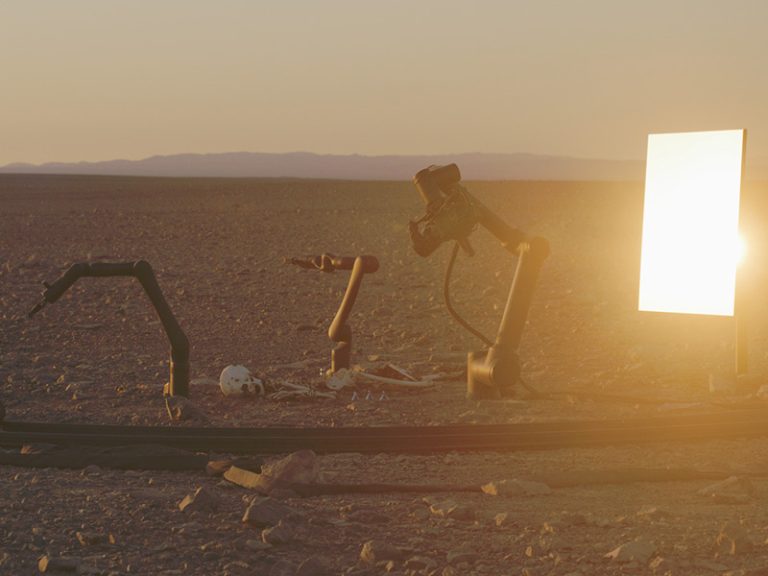
Mouans-Sartoux (Alpes-Maritimes). Would Gérard Azoulay seek to establish himself as the spokesperson for a new kind of contemporary scene, as eminent art critics such as Gabriel Albert Aurier (1865-1892) and Pierre Restany (1930-2003) did in their time? The head of the Space Observatory, the cultural laboratory of the National Center for Space Studies (Cnes), readily describes the exhibition he designed for the Concrete Art Space as“manifesto exhibition intended to be foundational in the conceptualization of contemporary extraterrestrial art”. The eleven artistic gestures carefully selected by the curator from the sixty works in the Observatory’s contemporary art collection would therefore, in a certain way, be the “witnesses” of space art as it is developing today. But is it enough to conceptualize an approach adopted by several creators over a short period of time to glimpse the emergence of a new artistic sensitivity? Nothing is less certain.
Works “impossible to produce on Earth”
The genre of the artistic manifesto having a dual prescriptive and normative function, the authors of the texts in the exhibition set out to state the fundamental principles of “extraterrestrial art”. Firstly, this type of art requires technological means of access to space in the sense of the cosmos: “zero gravity” planes offering parabolic flights, the International Space Station (ISS) or even stratospheric balloons. Second, extraterrestrial art is neither the emanation of a technicalist vision of art – it can be embodied through various mediums – nor the reflection of a conquering vision of the cosmos. Third, works relating to extraterrestrial art are “impossible to produce on Earth”,according to Gérard Azoulay. The idea is shared by the writer Éric Pessan, who, in an essay published in the exhibition catalog, argues that “space art occurs in space, or in a plane whose engines have just shut down and which offers the closest experience to true weightlessness.”
Through these lines, we understand that what works in spatial art is the interaction of the body of the artist and/or a medium with space – a very specific form of land art, in short. Contemporary extraterrestrial art is therefore an extension of the Space art experiments carried out in the 1980s-1990s by artists like Pierre Comte and Joseph McShane. However, if we “does not make extraterrestrial art from the comfort of his studio” according to Pessan, oil on wood ISS Screenspace (2025) by Rob Miles is presented in the exhibition even though its creation in no way results from an interaction with space: the artist simply used a virtual reality headset and Cnes archives to represent the interior of the International Space Station.
By including this type of work in the corpus of extraterrestrial art, Gérard Azoulay takes the risk of turning it into a catch-all label that can literally encompass all the works produced during the Observatory’s creative residencies, however different their methods of production.
A manifesto makes it possible to publicize the existence of a group of artists. However, as sociologist Nathalie Heinich noted in 2017, “an artistic group is not only an aggregate of people: it is also the expression of an aesthetic tendency, the systematization and explanation of common affinities”. The artistic group is also a “collective knowingly constituted by the creators themselves”. However, if you look closely, the only common point between the artists exhibited at Mouans-Sartoux is their residency at Cnes over the last few years. These visual artists do not share any particular aesthetic affinity, nor does any sense of belonging to a collective connect them.
A bit too disparate a set
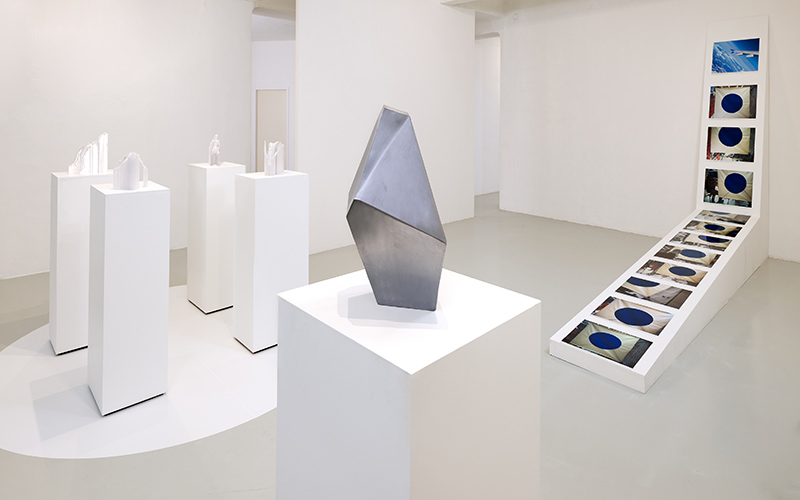
“Extraterrestrial art” therefore appears to be a heterogeneous whole, illustrated by the diversity of approaches and the very uneven quality of works produced in similar conditions. Of the eleven pieces in the exhibition, seven were produced as part of the “Zéro-G” (parabolic flight) residency. What do gestures as simple as Out of oneself (2024) by Stéphanie Solinas and Gap (2025, (see ill.]) by Alain Bublex, which testify to the impossibility of artistic creation in a state of weightlessness, and the work on matter which results Unspeakable bodies (2025) by Arthur Desmoulin? Bublex’s photographic installation documents his unsuccessful attempt to frame a target during the weightlessness phase, while Desmoulin’s organic glazed ceramic forms result from the twisting of latex sculptures subjected to weightlessness.
These proposals remain, all in all, quite classic: the artists are far from having explored all the potential of the means made available to them by the laboratory. For the moment, it is therefore premature to speak of an “extraterrestrial art” capable of opening a “new chapter in the history of art”, to use Azoulay’s words.