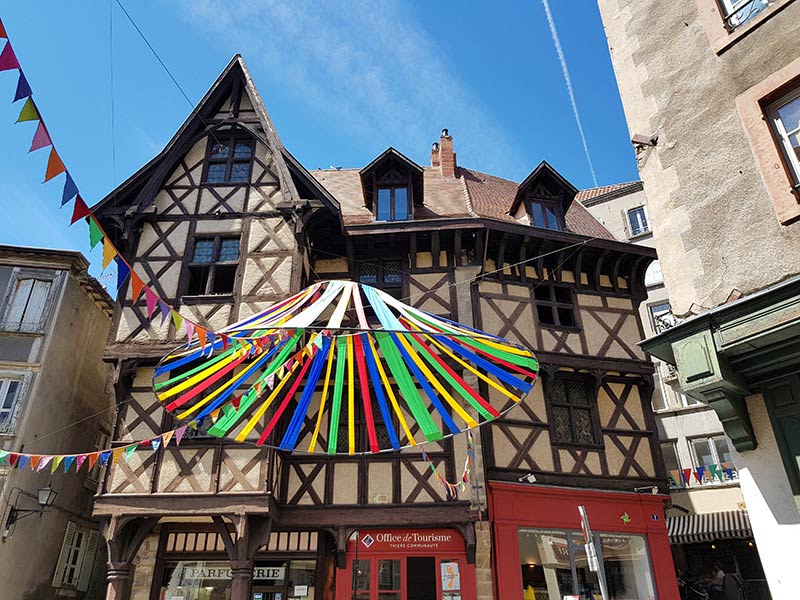
Security barriers now surround the Château du Pirou (15th century) in Thiers (Puy-de-Dôme). For several months, cracks observed in the structure of the building which houses the Livradois-Forez Tourism House have been monitored by the town of Thiers.
The city had commissioned a technical design office. Markers have been installed on the structure in order to monitor its evolution. The first measurements, carried out in December, showed only very limited movement at the level of the two pillars located at the entrance to the castle. The measurements taken on March 4, on the other hand, revealed more significant movements. The wooden frames, filled with rammed earth, and the thickness of the floors stiffen the structure, making deformations more visible under stress.
The Château or Maison du Pirou in Thiers (Puy-de-Dôme).
A security perimeter was therefore installed around the building, with modification of the direction of traffic in the surrounding area. The Tourist Office is temporarily rehoused. The administrative offices are transferred to other municipal premises in Barante, while the tourist information office is located at 8 rue du Pirou.
Built around 1410 by Louis II de Bourbon for his lords, the Château du Pirou then belonged to the Charriol family until the middle of the 20th century. Bought and restored by the city in the 1980s, it now hosts exhibitions and the Tourist Office. Located on Place du Pirou, in the heart of the medieval city, this half-timbered building is one of the symbols of Thiers’ ancient heritage. Classified as a historic monument in 1907, it is the third building in the city to benefit from this protection, after the Saint-Genès church and the Moutier abbey.
The building is distinguished by a corbelled gable resting on two wooden pillars. Two half-timbered floors dominate a masonry ground floor, formerly open to shops. The interior retains a spiral staircase, tiled floors and several medieval fireplaces. Vaulted cellars dug into the rock once communicated with ancient underground passages which are now condemned.