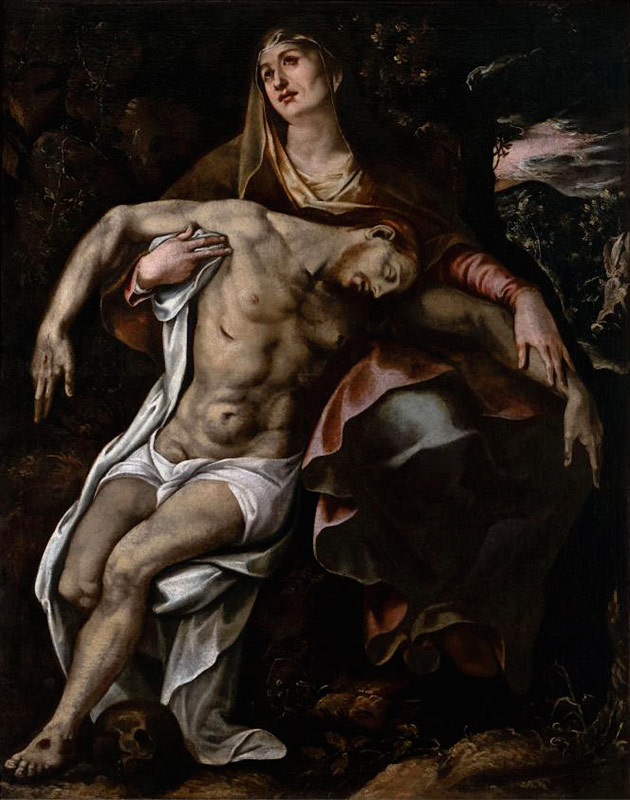
In 2020, an anonymous painting estimated at 3,000 euros went unnoticed in a sale in Genoa (Italy). Four years later, some suggest that it could be a rare painting by Michelangelo (1475-1564). The story thus begins at the Genoese auction house Wannenes. A 135 x 107 cm canvas, described as an anonymous work from the end of the 16th or beginning of the 17th century, is offered with a modest estimate, between 2,000 and 3,000 euros. But the work did not find a buyer.
Four years later, the same canvas was presented as a late painting by Michelangelo, entitled Pietà Spiritualiby Michel Draguet, honorary director of the Royal Museums of Fine Arts of Belgium. The hypothesis is based on technical analyzes carried out by the Royal Institute of Artistic Heritage (KIK-IRPA). On the canvas would appear monograms in the shape of an “M”, crossed by cracks, as well as a partially erased date, “154? “. Michel Draguet places the creation around 1542-1546, in the context of the religious circles of Spirituali linked to Vittoria Colonna and Cardinal Reginald Pole, close to Michelangelo.
In the meantime, the canvas has been restored by the Arcanes workshop in Paris. Leaving Italy in July 2024 with authorization from the Superintendency of Milan, it is still described as anonymous from the 17th century and estimated at 15,000 euros. It was finally acquired for 35,000 euros by two collectors residing in Belgium. After receiving the work, cleaned and restored, they claim to distinguish two barely visible monograms. They then asked Michel Draguet.
Scientific examinations have highlighted several elements deemed interesting. The art historian claims to have digitally superimposed, pixel by pixel, the convex thumb of Christ with that visible in a drawing by Michelangelo entitled The Dream of Human Life, preserved at the Courtauld Institute of Art. Pigment analyzes would also have revealed the presence of Native American cochineal, a dye that was still little distributed according to him at the time.
These clues hardly convince specialists. The consensus leans towards the work of a follower. The Florentine’s pictorial corpus is in fact extremely limited. Tradition only retains the Tondo Doni, in addition to the large frescoes of the Sistine Chapel and the Pauline Chapel. Michelangelo did little easel painting and even declared, according to Giorgio Vasari, that he hated painting.
David Ekserdjian, art historian specializing in the Italian Renaissance (University of Leicester), considers the attribution unrelated to the master’s style. The anatomical construction of the painting – unstructured torso, rigid arms, expression considered not very intense by the Virgin – rather evokes the Roman entourage of the master, in particular Guglielmo della Porta or Marcello Venusti, known for having produced copies or interpretations of the Vatican Pietà.
Michel Draguet, a specialist in surrealism rather than the Italian Renaissance, could have overinterpreted the scientific data. The carbon-14 dating of the painting indicates a very wide range, between 1520 and 1660, with a probability of 95.4%. Michelangelo died in 1564.
The authenticity of the monograms remains uncertain. The history of art has already known comparable cases, such as that of a Crucifixion by Saluzzo, a drawing attributed for a time to Michelangelo in the 1960s before finally being attributed to Marcello Venusti after the work of Roberto Longhi. The presence of cochineal of American origin, often presented as a decisive clue, does not constitute proof either. The pigment circulated in several Roman workshops from the 1550s.
Finally, no ancient source, neither from Giorgio Vasari nor from Ascanio Condivi, mentions such a painting, even though Michelangelo’s compositions were the subject of countless copies.