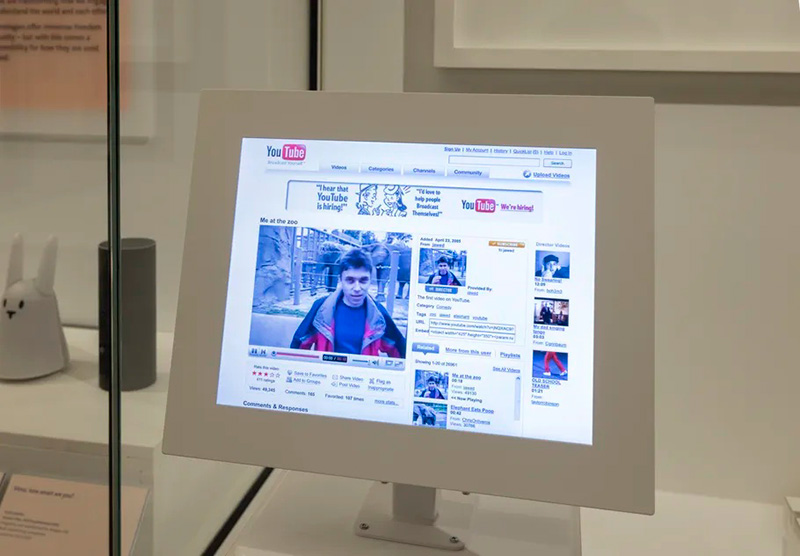
The first YouTube video becomes a museum object. The Victoria & Albert Museum (V&A) has announced the acquisition of Me at the zoo (April 24, 2005) – the first ever video posted on YouTube – along with the reconstructed original web page. This 19-second clip, where the co-founder of the platform Jawed Karim is ecstatic in front of elephants at the San Diego Zoo, has nearly 380 million views.
The clip is now on display in the V&A’s renovated ‘Design 1900-Now’ gallery, alongside a recreated web page as it looked in December 2006, when YouTube’s visual identity was stabilizing. This reconstruction, carried out over eighteen months, was carried out in collaboration with YouTube’s User Experience team and the interactive design studio OIO. This transition from a static web (Web 1.0) to a participatory web (Web 2.0) emerges from the screen to become a heritage object in its own right.
For museum curator Corinna Gardner, preserving this pioneering web page means recognizing the interface as a design object. Its refined aesthetic, but above all its interactions (note buttons, comments, suggested videos), are now part of the history of design. Because they are the first visible rules of Internet architecture.
“Me at the zoo” was the first video published on YouTube on April 24, 2005.
© Youtube
This acquisition is not an isolated gesture. The V&A took advantage of the reopening of its “Design 1900–Now” galleries to confront digital culture with other forms of contemporary creation. The 250 objects on display cover six themes (housing, identity, crisis, etc.) without strict chronological order. For example, we come across the green and black jersey of the Nigerian football team (2018 World Cup), a boom box from the 80s, or the remains of Edward Snowden’s computer. Likewise, the viral mobile game Flappy Bird (2014) and the Chinese app WeChat (2017) are now part of the V&A’s collections. Even more recently, the famous and much-maligned Labubu soft toy made its debut.
Several recent objects or symbols have entered museum collections, testifying to the accelerated patrimonialization of objects of our time. Among them, a fragment of the very first “gay pride flag” (3 meters by 8.5 meters) designed in 1978 by the American queer artist Gilbert Baker was found and presented as a museum piece. In June 2021, the GLBT Historical Society Museum in San Francisco unveiled this segment of the original and put it on display. This colorful fragment is now in the permanent collection of the San Francisco LGBT Museum.
The same year, the first message posted on Twitter (“just setting up my twttr” (“I’m setting up my Twitter”) on March 21, 2006 by Jack Dorsey, was put up for auction. Transformed into an NFT, it was sold for nearly 2.9 million dollars (2.5 million euros) and has since struggled to find a new buyer. In 2020, still in the United States, Cooper Hewitt captured the graphic production during the Covid-19 pandemic or the visual identity of social movements (digital poster Black Lives Matter/Defund the Police2020).