Sète (Hérault). Reading the general introduction to the Sète catalog, it seems obvious to exhibit place/musee-paul-valery-3141 (born in 1942) at the Paul-Valéry Museum. The artist, who has lived and worked in this city for around forty years, was already the subject of a presentation there in 2008. The recent event thus responds to the museum’s wish to offer him new visibility.
The explanation put forward by the two commissioners, Camille Bertrand-Hardy, director of the Sète museums center, and Stéphane Tarroux, associate scientific commissioner, however turns out to be more nuanced. According to them, it is a question of taking the opposite view of the image traditionally associated with the museum, “linked to the question of figuration, particularly through the Free Figuration movement…”and to show that “painting can free itself from the expected format of the painting: that it is not always an image, that it can turn away from representation to approach a form of construction”.
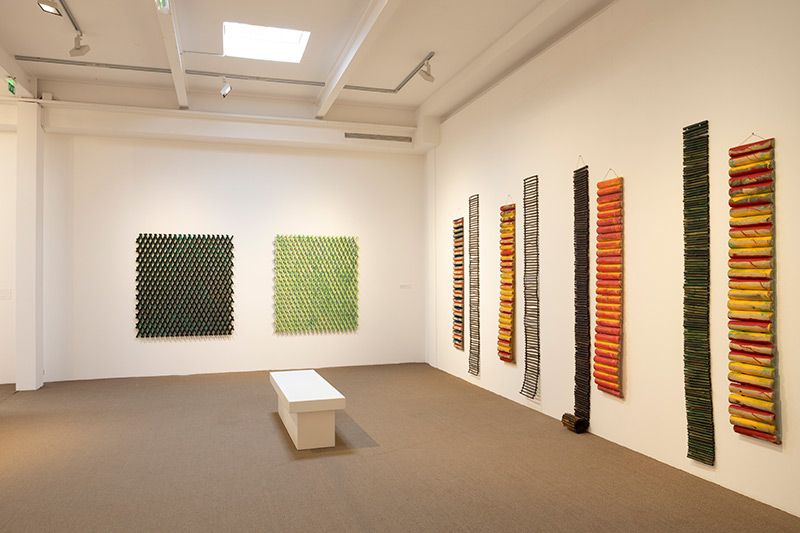
View of the exhibition “Dezeuze Daniel, Recent Works” at the Paul-Valéry Museum.
© Gilles Hutchinson
© Adagp Paris 2026
Remember Supports/Surfaces
In order to stand out from the Grenoble retrospective (2017-2018), the Sète presentation is limited to the plastic production of Dezeuze after 2000. A choice not without risks: the absence of historical works from the seventies, the Supports/Surfaces period, sometimes makes it difficult to understand the path of the man who was one of the founding members of this movement.
Thus, to fully understand Dezeuze’s evolution, it is important to keep in mind his emblematic works: paintings that have undergone a true ascetic stripping, reduced to their bare bones. It is on this condition that we can observe the way in which the artist continues his reflection around notions such as DIY, transparency or deconstruction. However, Dezeuze was able to free himself from the often too rigid nature of avant-garde ukases.
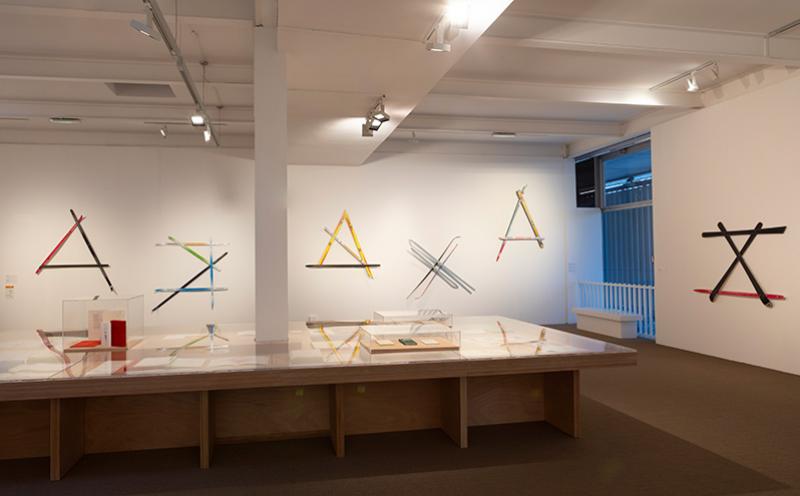
View of the exhibition “Dezeuze Daniel, Recent Works” at the Paul-Valéry Museum.
© Gilles Hutchinson
© Adagp Paris 2026
The works brought together here – and this is the main interest of the exhibition – make a big gap between the systematic analysis of the mechanisms of creation and the introduction of a subtle poetry. No doubt it’s the series Painting that pearls, Song of birds (see ill.), started in 2008, which immediately catches the visitor’s eye. Decorated with colored beads attached to the end of metal rods, these squares placed on the tip evoke, with a touch of humor, the last period of Mondrian, when the Dutch painter gradually abandoned black lines in favor of colored lines. Next comes Diptych, Two scrolls for Yang Fong (2021): flexible scales, hung on the wall and partially unfolded on the floor, distant memories of scrolls of Chinese poems, but above all the deployment of magnificent chromatic scales.
Throughout the journey, we are struck by Dezeuze’s curiosity, which draws inspiration from varied cultures: Shields from the medieval period to the Mayans with the Mesoamerican Breaths. Curiously, for a creator who swore only by materialist art, the work does not lack references to the religious domain – Icons Or Tzimtzuma term from Jewish mysticism. However, let us grant the right to contradict someone who seems to have invented an oxymoron: decorative minimalism.