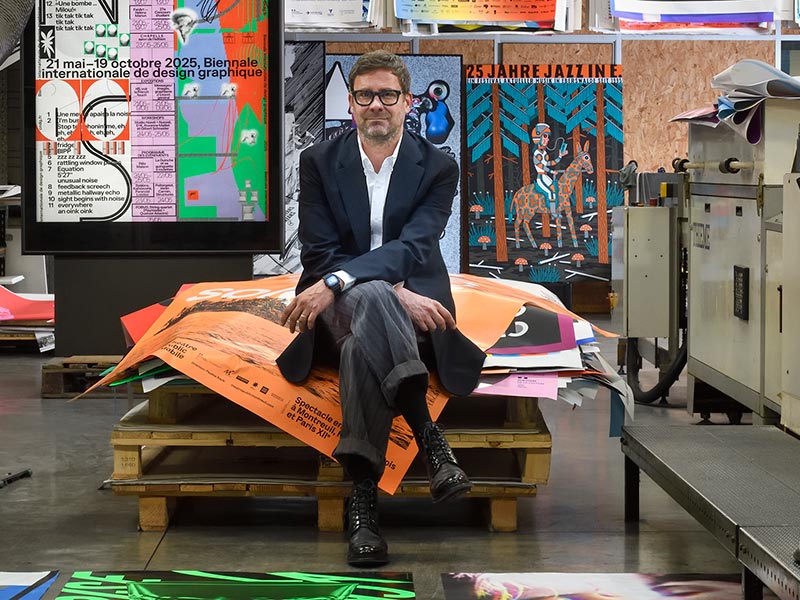
Still little known in the world of scenography and immersive, Frédéric Rose has set up in a few years a group based in Strasbourg under the Museum Manufactory brand, with proven expertise in the field of AI. He sets off to attack the Carrières des Lumières in Les Baux-de-Provence, whose delegation of service must be renewed, having formed around him a group of companies, each specialist in its field.
You are the designer of the scenographic route of the Maison Carrée in Nîmes. What philosophy guided him?
The intervention took place in two stages, the second being ongoing. The first phase took place as part of the change of public service delegate (DSP) in 2021-2022, with the transition from Culturespaces to Edeis. I decided to neutralize and strip the place. Culturespaces had installed a cinema room, partitions and air conditioning units which prevented the reading of the space and its perspectives. Our objective was to offer a total reading of the place. We freed up the central space and deployed the museography on the periphery, on the interior envelope of the Maison Carrée, thus freeing up the entire floor space. This approach was a very important element in winning over the delegation.
What is the nature of this museography? Is it immersive?
No, it’s not immersive at all. This is what I call “pure museography”, ultra light. Immersive is not suitable because it transforms and modifies the understanding of the place. The Maison Carrée was not made by the Romans for mapping video. The premise is to remove anything that could lead to misinterpretation, because there are very few traces of what was really happening there. The new museography allows us to understand the Maison Carrée in its urban environment, through models, audiovisuals with specialists, furniture and display cases.
Your contract with Edeis has not been renewed. What was your role in this DSP and why did the partnership end?
We were a service provider. We were mandated by Edeis, of which it was the first DSP, to be in direct contact with the City, the Regional Directorate of Cultural Affairs (Drac) and state services. This is our specificity at Museum Manufactory: we ensure the study, design, project management and monitoring of the work. The partnership was not renewed because Edeis was bought by Trévise Participations. With the change in strategy and the departure of the former leader, ties have weakened.
You are now positioning yourself on the Carrières des Lumières, this time with an immersive approach. How do you plan to differentiate yourself from Culturespaces’ current offering?
Indeed, we are agents of a group of companies, candidate for management of the Carrières des Baux-de-Provence site, and we have been selected to submit an offer. We have created a very competent team by bringing together experts, such as Marianne International, specialized in public reception and ticketing, or Arteum for the store. Culturespaces has done a good job as an operator, but they are using immersive for immersive’s sake with little content density. We are going to give more substance and body to the immersive, to develop the narrative and the content.
You plan to use artificial intelligence (AI) in the production of this content. How does AI help you?
We have already used AI to largely generate the mapping monumental of the ancient theater of Orange (5,000 to 6,000 m² of projected surface) (see ill.). AI helps speed up production and reduce production costs. If such a project traditionally costs between 800,000 and 1.2 million euros, the use of AI divides the costs by three or four.
Sound odyssey: mapping at the ancient theater of Orange.
© Museum Manufactory
What AI method do you use to ensure technical accuracy?
In addition to the classic use of neural networks (like ChatGPT or Midjourney), our specialty is fine tuning. We take a model open source and modify it with specific micro-training, creating technical databases. For example, to generate images of Greco-Roman sculptures, we train the neural network with real ancient collections, so that it is not based on the very muscular and caricatured characters from Marvel or Disney present in its original database. This makes it possible to “correct” the AI and obtain a representation more in line with historical reality.
How do you define the job of Museum Manufactory and what is your business model for the French market?
I define myself as a designer who leads a 360-degree project. Museum Manufactory is a superb toolbox for cultural projects. Our model, influenced by Anglo-Saxon and Germanic cultures, is that of “turnkey”. We take full responsibility, from design to engineering to financial to deployment, to save time and convenience for our customers.
This “all trades” model is unusual in the heritage operator market, renowned for its segmentation. Why does it persist?
The French market is indeed very fragmented, with each player remaining in their category (scenographer, engineer, architect, museographer). This strong segmentation is unique in the world and prevents the emergence of powerful French operators capable of competing with international players like Atelier Brückner, in Germany, which has hundreds of employees. However, the demand for global providers is increasing among private operators and is starting to emerge among the public.
What are the financial advantages of this “turnkey” model?
A “turnkey” project saves around 25% in time and budget compared to a traditional call for tender procedure. We negotiate directly with manufacturers, which eliminates the margins of resellers or distributors, which can represent 30 to 50% of the cost on certain equipment.
Which segment of museography are you mainly targeting?
We focus on places requiring strong mediation to occupy the space. We are comfortable in places where there are few or no collections. Our target market is between contemporary art museums which use little mediation and immersive museums where there is only sensory. This includes archaeological sites without visible remains, historical and scientific museums, or places like Quarries.