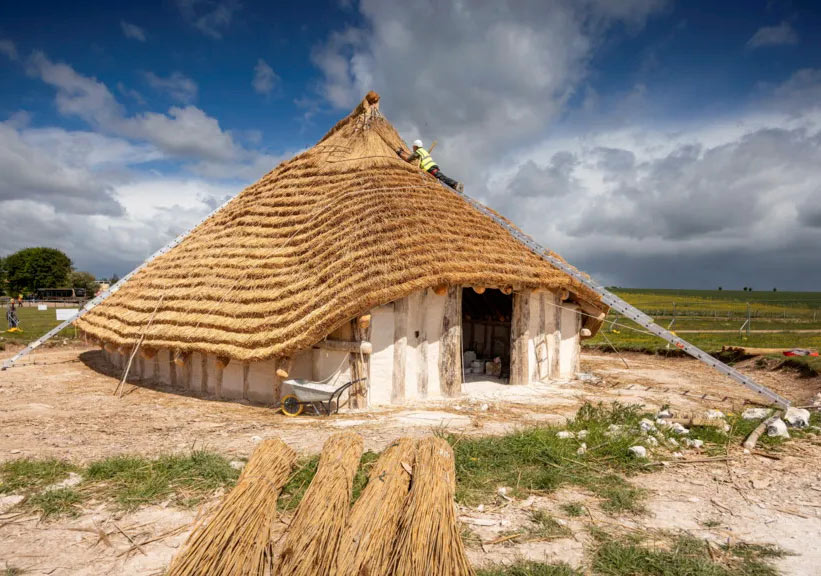
Three kilometers from Stonehenge, on Salisbury Plain in Wiltshire, the British heritage protection organization English Heritage inaugurated the Kusuma Neolithic Hall in May, the largest reconstruction of a prehistoric building ever undertaken in the United Kingdom. Seven meters high, this life-size construction recreates a Neolithic building dating from around 2,500 BC. BC Funded to the tune of one million pounds sterling by the British philanthropic foundation Kusuma Trust, it allows, according to The Guardian which reports the information, to experiment with the construction techniques and forms of collective organization of a community established in the immediate vicinity of Stonehenge 4,500 years ago.
This restitution is based on the remains of Durrington 68, discovered in the 1960s at Durrington Walls, a vast Neolithic habitat site located to the north-east of Stonehenge. Described by archaeologists as a “square within a circle” building, this building has no known equivalent in Britain. Its atypical plan intrigues researchers, who are still struggling to determine whether it was for domestic, ceremonial or community use.
Durrington Walls itself is an important Late Neolithic site. Archaeologists estimate that it could have accommodated up to 4,000 inhabitants, making it the largest known settlement in northern Europe at that time. Excavations carried out between 2004 and 2006 by the University of Sheffield revealed seven houses, suggesting the original existence of hundreds of dwellings. Thousands of pig and cattle bones as well as abundant Grooved Ware ceramics were also unearthed there, probably testifying to large seasonal gatherings organized during the winter.
Analyzes of organic residues provide more precise insight into the uses of the site. They show that dairy products were mainly consumed in ceremonial spaces, while meat preparation was concentrated in domestic areas, suggesting a clear separation between ritual activities and daily life.
The exact function of Durrington 68, however, remains unknown. Researchers alternately evoke a community hall, a ceremonial space, a funeral site or even a utility building. The traces of soils and hearths having disappeared under the effect of agricultural work, no hypothesis can be definitively confirmed. This uncertainty precisely motivated the reconstruction: to understand, through experimentation, the material and human constraints involved in the construction of such a building in the Neolithic.
Led by archaeologist Luke Winter with students from the universities of Exeter and Bournemouth, the project relied exclusively on materials and techniques compatible with the Neolithic period. The teams used flint axes to shape the frames, hazel wood from copses, a mortar made of chalk, water and straw for the walls, as well as a thatched roof. Each step was documented in order to study prehistoric working times and construction methods.
Carried out between October 2025 and May, the construction mobilized more than a hundred volunteers. A first phase of training introduced thirty-six participants to the handling of manual tools before using replicas of polished stone axes. According to Luke Winter, this collective dimension also makes it possible to renew the way we look at Neolithic societies, often considered theoretically rather than experimentally.
The Kusuma Neolithic Hall will open to the public during the summer before becoming, in September, an educational space intended for school groups. English Heritage is also planning the opening, in a separate building, of a learning center dedicated to megalithic construction techniques and hopes to eventually welcome almost 100,000 schoolchildren per year.
This reconstruction comes as Durrington Walls continue to reveal new clues about Stonehenge’s environment. In 2020, geophysical surveys revealed an immense circle composed of more than twenty monumental wells around the site. Research published in December 2025 by the universities of St Andrews and Bradford confirmed that these excavations, contemporary with Stonehenge, were carried out in a very short period of time.