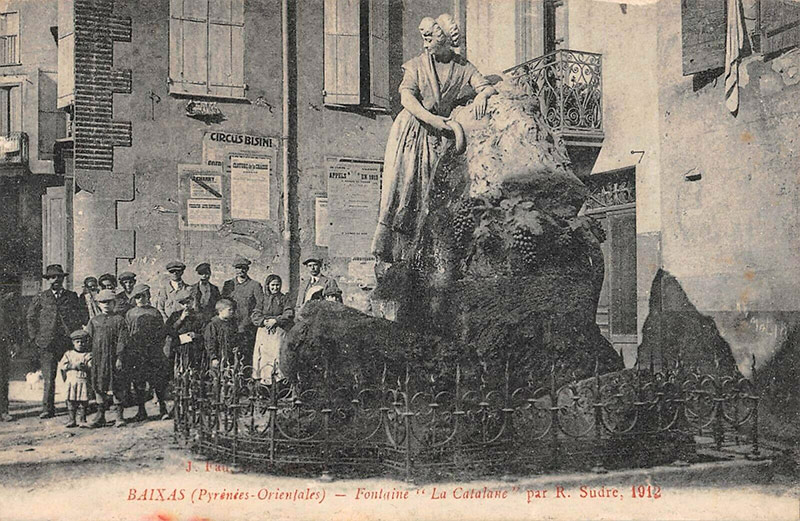
Baixas, 1909. Originally from the Pyrénées-Orientales, Raymond Sudre (1870-1962) was a student of the sculptors Alexandre Falguière and Antonin Mercié. Second Grand Prix de Rome in 1900 for his statue of David, Sudre was commissioned by the municipality of Baixas to create a monumental fountain intended to commemorate the happy completion of the water supply works in his native country. The sculptor designed the sculpture of a young girl, called “The Catalan”, who holds an amphora from which water flows into a basin while a trellis with beautiful fruits clings around the monument. The work which won the gold medal at the Salon des artistes français was inaugurated in 1909.
Very quickly, the fountain experiences the worst vicissitudes: the turbulent children make the fountain the object of their games and plow the most delicate sculptural motifs with their big shoes; the water is stopped and the pond becomes a garbage dump; on ball days, the fountain serves as a platform for spectators; on July 14, the municipality uses it to set off and set off fireworks which blacken the statue. Worse, on May 10, 1931, the head of the young Catalan gives way under the weight of a child perched on the statue. Fearing more serious accidents, the mayor has the fountain destroyed! Sudre discovers, with amazement, this latest humiliation, and concludes that the degradation and demolition of his monument were the consequence of faults on the part of the municipality which had thus violated his moral rights. The question is simple: can the sculptor obtain compensation for his damage from the municipality?
On December 26, 1932, the civil court of Perpignan declared itself incompetent because the acts of the municipality were of an administrative nature and could not be assessed by the judicial authority without violation of the rule of separation of powers. Sudre then referred the matter to the interdepartmental prefecture council of Montpellier (an institution abolished in 1953, constituting in some ways the ancestor of the administrative tribunal). On July 27, 1933, the latter decided to remove the case from the list due to his incompetence. Raymond Sudre then asked the mayor directly for compensation of 25,000 francs at the time (or approximately 25,000 euros today) to repair the damage linked to the mutilation and destruction of his sculpture. Faced with the municipality’s rejection, he brought the matter before the Council of State. The question of jurisdiction then resurfaces: does the infringement of an artist’s moral rights through the fault of the public service or through the non-maintenance or non-execution of a public work cause damage for which the artist is entitled to seek compensation before the administrative jurisdiction?
A founding judgment
On April 3, 1936, the Council of State responded in the affirmative in a much-noticed judgment which affirmed that “the dispute relates to the lack of maintenance of a public work and falls within the jurisdiction of the prefecture council”. This may seem simple, but the rules of jurisdiction at the time were much less so, and it was a bold motivation that the judges of the Palais-Royal adopted to avoid leading to a denial of justice! The case was therefore referred to the Montpellier Prefecture Council, which put an end to the dispute by ordering the municipality to compensate Raymond Sudre, on December 9, 1936. With this “Sudre” ruling, public persons who own a work of art are therefore bound for the first time to an obligation of conservation “as is” or at the very least “in good condition”. This vision was softened by an “Agopyan” ruling of September 11, 2006 by which the Council of State affirmed that moral rights are not intangible and that the public owner of a work can infringe the moral rights of the author, on the condition that the alteration – which can go as far as destruction – is made strictly necessary by a legitimate reason (aesthetic, technical or public security) derived from adaptation to new needs or arising from the evolution of public service.
However, the blacklisting of moral rights mainly targets architectural works, which must adapt to the new needs of owners because of their utilitarian function. On December 20, 2017, the Court of Cassation was able to validate the extension work carried out without the agreement of the architect Henri Ciriani (1936-2025) on the building of the Museum of Ancient Arles by the Department of Bouches-du-Rhône. Conversely, respect for moral rights remains alive for works of art: the town of Beaucaire (Gard) was condemned for allowing the fountain-sculpture of Roselyne Erutti to be destroyed; the City of Tourcoing (North) was for having initiated work on a sculpture without the agreement of its creator, Armand Debève, while the City of Hayange (Moselle) was for having repainted a fountain designed by Alain Mila in blue!
Regarding jurisdiction: the lawyer knows that the Conflicts Tribunal, following the law of May 17, 2011, confirmed the existence of a block of skills for the benefit of the judicial judge for the various intellectual property rights or literary and artistic property. In 2016, the deciding judge nevertheless considered that if the judicial judge is indeed the only one competent to rule on the question of the existence of harm resulting from an infringement of copyright, the administrative judge is, for his part, the only one competent to rule on the request for compensation in kind relating to a public work. Today, article L. 331-1 of the Intellectual Property Code expressly provides that “civil actions and claims relating to literary and artistic property, including when they also relate to a related question of unfair competition, are brought exclusively before judicial courts, determined by regulation”.