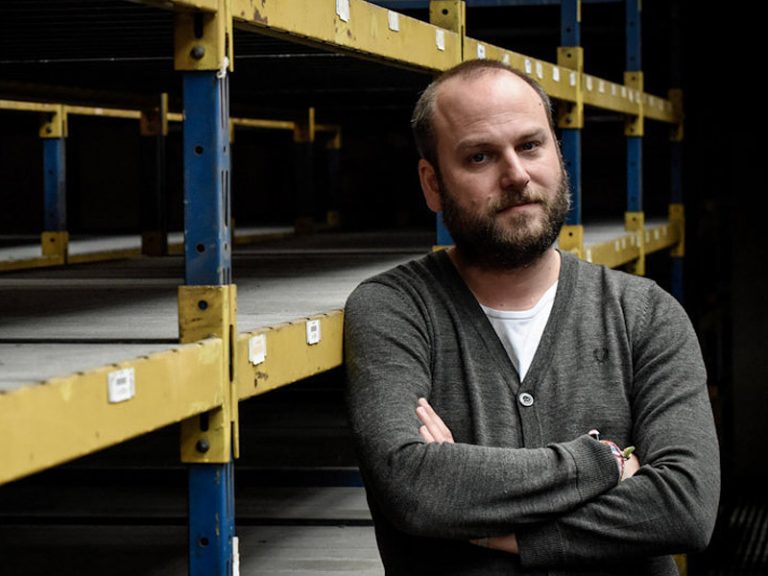
Nicolas Matyjasik (43 years old) has been running the “Fabrique de la Arrow” since March. This close friend of the mayor of Saint-Denis Mathieu Hanotin was his deputy chief of staff for a long time. They got to know each other during Benoît Hamon’s presidential campaign in 2017, both working in the candidate’s team. His doctoral thesis in political science defended in 2010 focused on the evaluation of public policies in a decentralized France. An ideal viaticum for rebuilding the arrow.
How do you describe the spire construction site?
It is both a reassembly since the tower and the spire were dismantled in 1847, but it is also a reconstruction, because we are identically recreating this whole as it was in the 19th century. But we are rebuilding it with today’s materials and tools. For simplicity we speak of “reconstruction”.
How is this “reconstruction” justified?
We are only continuing what was interrupted in the 19th century! At the time, the dismantling of the tower and spire was carefully documented, as reconstruction was to follow. But the debates on the modalities of reconstruction, the political and even more military context of the time (war of 1870, The Commune, reestablishment of the Republic, etc.) then the two world wars in the 20th century meant that the priorities were elsewhere. So yes, this is fully justified, especially since the basilica has long been invisible to history even though it is the first Gothic cathedral in the world and houses the tombs of the kings and queens of France. In the 1980s, the facade was horribly blackened. It regained all its glory thanks to the restoration campaign led by Jacques Moulin from 2012 to 2015.
The basilica of Saint-Denis without its spire and the 3D reconstruction with the spire.
© Follow the Arrow
What administrative authorizations have you obtained?
All of them, and they are numerous as you can imagine for a listed building so important in the history of France. On the political level, the project was officially relaunched in 2017 by the then president François Hollande and it is very supported today by Emmanuel Macron who was to come on March 14 to lay the first stone (the management of the war in Ukraine prevented this at the last moment). We have obtained authorization for work in 2022 which is being carried out under the supervision of Christophe Bottineau, chief architect of Historic Monuments. We have follow-up meetings with state services every six weeks and site meetings with all stakeholders take place every two weeks.
What sources do you use to reconstruct everything?
They are very numerous. We have drawings and even photographs from the period, but above all we can rely on the plans for the dismantling in 1837 and reassembly in 1838 of the spire by the architect François Debret. Debret’s very detailed surveys indicate in the smallest details the place of the stones, the elevations, the stairs, the pinnacles, the scales of the arrows, the metal shots, in wood… These plans allow us to know stone by stone the architecture of the whole. Furthermore, we commissioned Art Graphique et Patrimoine, a local company, to carry out 3D digital modeling which facilitates the work of architects.
Do you have original stones?
Yes, but we don’t use them. On the one hand, because there are too few of them, most of them have been “washed away” over the decades, and on the other hand, because those that remain are in poor condition. The 15,228 stones are therefore new. But I insist on the fact that it is an identical reconstruction, there is no interpretation on our part. This is the reason why, for example, we are reconstructing a single spire, despite the asymmetry, since that is how the whole thing existed at the time.
Some detractors accuse you of not respecting the Venice Charter?
It is a document that is starting to date (1964), with recommendations that may seem contradictory and which, according to experts, leave a lot of room for interpretation. According to Jacques Moulin who remains very involved on the subject and has worked extensively on the Venice Charter, we follow articles 10 to 13 which require respecting historical strata and clearly distinguishing between new and old elements. The Charter authorizes modern consolidation techniques. We also comply with the Nara Charter of 1994 which complements that of Venice.
Likewise, are you accused of “traumatizing” the existing structure through inappropriate interventions?
I would say it’s the opposite, we take care of it! The basilica has long been neglected by the public authorities and therefore the work of preventive excavations and probes at the foot of the north tower, which were carried out between 2022 and 2024 under state control, would undoubtedly not have been done without the reconstruction. This made it possible to carry out some consolidation work and great discoveries such as these nearly 200 burials currently being studied by Inrap, Drac and the archeology services of the department of Seine-Saint-Denis and the City. All this for a budget of around 4 million euros, financed by Follow the Flèche, which clearly demonstrates their importance. However, we were able to see that the structure is in good condition.
Voices have also been raised to say that the budget you have collected (€37 million) would be better used to restore monuments that need it?
I can only join those who are asking for more money to protect our heritage! Regarding the basilica, I remind you that there is not a euro of state money, the work is financed by local authorities and private patrons. But even more, it is not a “simple” restoration project, it is a vast cultural, tourist, urban, economic and social development project. There are nearly 140 journeymen and craftsmen here who will work on the site, some in areas accessible to the public in order to show their know-how, particularly to younger generations. It is a way of consolidating and promoting the entire arts and crafts sector. And to feminize it too, we have recruited several apprentice stonecutters who work in front of the public eye. It’s important to show young people that it’s not ChatGPT who cuts stones and that these are noble professions. The Arrow Factory has a strong artistic and cultural education dimension!
What do the Dionysians say about this reconstruction?
A lot has changed with the installation of the scaffolding, and this will accelerate when residents see the tower gradually rise. Today we are starting to see the fourth row of stones from the square. I said previously that the basilica has long been invisible. This is also somewhat true in the minds of the inhabitants. Since 2017 and the creation of the association, more and more people have become aware of the project, through educational workshops, mediation actions during city festivals or visits to the roof. The arrow factory is primarily intended for them. They were able to come for free on October 19 and there will be three other free days annually. Welcoming a major part of French history to the largest working-class suburb in France is no small thing!