Madrid,
A little over twenty years ago, in 2003, the Prado Museum began a triad of exhibitions dedicated to the great painting of the Venetian Renaissance by Tiziano’s hand; After the chapter dedicated to Tintoretto, in 2007, the Pinacoteca culminates now that cycle, which is actually completed with presentations of Bassano and Lotto, with which he was the youngest of the three geniuses: Veronés. Miguel Falomir has been the commissioner responsible for all the proposals, this time together with Enrico Maria Dal Pozzolo, professor at the University ofglo Studi di Verona.
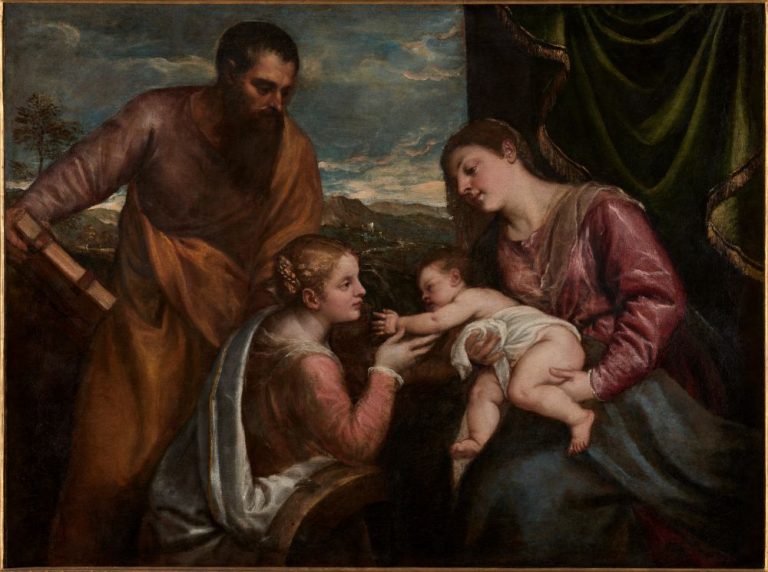
That is precisely the city where the artist was born and in which he could dive into a good number of Roman ruins that would leave a powerful imprint in his painting (Verona is also the Italian town with the greatest number of remains of antiquity after the capital). If Edward Hutton said that Prado’s father is TizianoVeronés is not far from being a close ancestor: among his fortnight of works in the museum are fundamental compositions, such as The dispute with doctors in the temple, Venus and Adonis either The Weddings of Cana.
Given the time between this exhibition and the previous two on the other two Venetian geniuses, there are inevitably differences in their approach and Falomir has explained today: currently a greater contextualization is sought so that the public can know better who preceded an author or took over in his paths, from there that in the sample of Tizian artists; And, unlike that exhibition centered on painting, this time other disciplines have also been incorporated, from the drawing to the sumptuous arts.
The great challenge that this project faced -which has managed to gather a hundred Essential pieces of Veronés from museums such as the Galleria Borghese, the Brera gate And it allows to know with all solvency the keys of its evolution and its work- it was to publicize its very relevant facet, as a frequency, for obvious reasons. If possible, it has been solved by bringing two creations to Madrid in this technique that were no longer in their original location and were transferred to canvas: the allegorical figures of justice and temperance from the church of Santa Maria Assunta and San Libele de Castelfranco Véneto.
Veronés has been associated in the popular imaginary for lavish and large format paintings (Dinner at Simón’s house It is the biggest canvas that has so far been part of an exhibition of the Prado), but this anthology gives us the opportunity to discover that it also brought its chromatic audacity and its elegance to smaller sizes. It also supposes some claim of a figure that enjoyed success in life, and uninterrupted until well into the twentieth century, but that in recent decades has been overshadowed; Perhaps, Falomir pointed out, for the absence of seizures – appropriate, of course – in its vital and artistic journey, those we like so much since romanticism. It seems that he enjoyed a happy marriage and that he did not maintain reviewable rivalries.
The Prado director has also referred to Veronés as one of the most complete painters in the history of Western art, by the extraordinary arsenal of resources he handled, the courage in his palette, his undone style and his obvious refinement, very personal. Their compositions transluce their own world and, in addition to providing aesthetic pleasure, invite the viewer to enter them, for their treatment of space, by the direct look of certain characters … and for their sensuality.
Precisely in that Dinner at Simón’s house that we quoted we await a detail related to the life of Verona: a clavo in one of the superb columns of classical influence. He refers to his family, modest, originally from the current Switzerland and formed by Picapedreros.

It was his teacher Antonio Badile, born also in Verona a decade before him; Veronés – in this he was not too original – would marry his daughter and then trained with Giovanni Caroto. In his first years and without leaving his city, a good number of stimuli and opportunities arrived: he admired the Assumption altarpiece of the Virgin In the cathedral and enjoyed the favors of the architect Michele Sanmicheli, who appreciated his talent and seems to love him as a son. For one of his palaces in Verona himself, Palazzo Canossa, carried out the painter some of his early works. Right there, as Pozzolo pointed out today, he could meet The Sagrada Familia with San Juanito Rafael, known as The pearlthat today treasures the meadow. Faced with this image, Veronese would have understood that he could try to synthesize in his fabrics the greatness of Urbino’s teacher and Tiziano’s.
A third relevant figure in its beginnings would be Girolamo Grimani, a relevant Venetian authority that made Veronés his reference artist. In any case, the painter would not take long to go to Rome, like so many, to observe firsthand what remained of the last Roman architecture; At this time, Verona was Mecca of many for the same reasons.

Upon his return, he opened the doors of the Ducal Palace and the decoration of the Church of San Sebastián was fully commission Cana weddings For the refectory of San Giorgio Maggiore, which some considered the most beautiful Venetian painting. He also worked alongside Palladio in Villa Barbaro, in Maser, with an extraordinary cycle in which he interspersed mythological scenes with the portrait of members of the Committee family.
Speaking of intelar, his conjunction was somewhat daring of the reason for the last dinner surrounded by children, animals, individuals who were contemporary … in the work Supper at Levi’s housewhich was commissioned by the Dominicans of the Basilica of San Juan and San Pablo in Venice. On account of this composition, he had one of his few frictions with the Inquisition: he responded to his misgivings remembering that the painters had enough to do with the poets and the crazy people and that, when they found a space, they filled it. This image is called that, and not according to its religious denomination, precisely because of this small conflict, which did not prevent him from continuing to develop his career as one of the senior painters of the serenísima.


Articulated under both thematic and chronological criteria, this fundamental retrospective demonstrates that the young Veronese was already very capable of gesturing sumptuous and conceptually free compositions, which mastery the treatments of the space inherited from Palladio, Daniele Barbaro, Serlio and Tintoretto; that demonstrated extraordinary intelligence in its creative processes, a huge ease at work from sketches and models; that he knew how to attract his clientele cultivated by the allegory and myth and that, in his last stage, he became an incredibly suggestive painter, not only through the sensuality of his figures, but of the light of his landscapes, antecedent of future baroque developments.
Precisely culminates the tour with Veronés fans; Among them were El Greco, Rubens, Alonso Cano (and later, also Delacroix, Cézanne, Otto Dix). Veronés is still a seducer.


“Paolo Veronese”
National Prado Museum
Paseo del Prado, s/n
Madrid
From May 27 to September 21, 2025