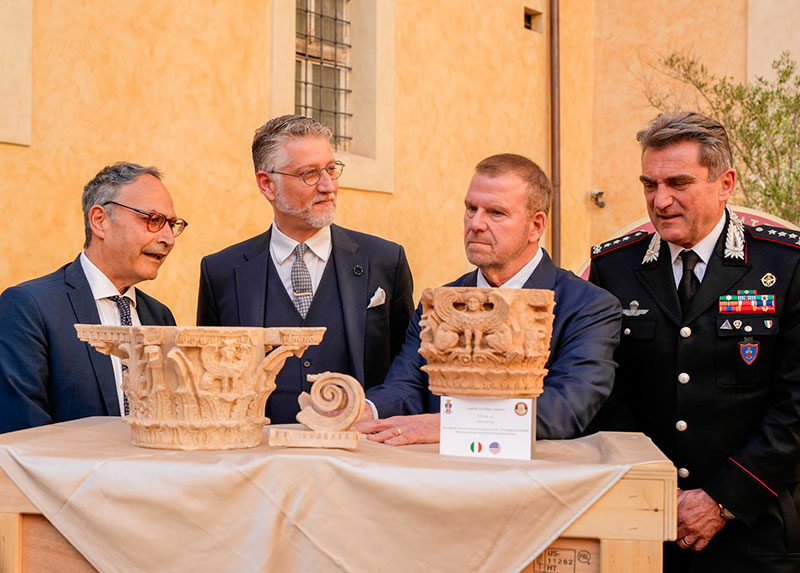
Italy presented at the Caserma “La Marmora”, in Rome, 337 cultural property repatriated from the United States after a series of operations carried out between December 2025 and April 2026. The whole is among the most important restitutions of recent years in terms of its volume, but above all because of what it reveals: cooperation now well established between the Italian and American authorities. The pieces returned mainly relate to archaeology, archives and the arts. Most come from clandestine excavations or were stolen from cultural institutions before being introduced onto the international market.
The collection covers a very broad period, from the 5th century BC to the 3rd century AD. It includes Roman sculptures, bronzes from the Iron Age to the Hellenistic period, terracottas, kraters (large Greek vases), Canosian vases (Italy, Hellenistic period), gold and silver objects, jewelry, Roman coins and architectural fragments from sites in the center and south of Italy. Certain objects stand out for their symbolic significance, such as a marble head attributed to Alexander the Great, dating from the 1st century AD and stolen from a Roman museum in 1960, as well as a bronze sculpture stolen from the site of Herculaneum.
The 337 objects were recovered in two stages. 221 were identified and seized thanks to the collaboration of the Manhattan District Attorney. The remaining 116 were returned in April following a coordinated action between the FBI, Homeland Security Investigations and the U.S. Attorney’s Office, with input from Christie’s New York.
Official presentation of the 337 art objects repatriated from the United States.
© Agnese Sbaffi / Ministero della Cultura
This operation is based on long-standing and well-established cooperation. Last December, Italy and the United States renewed their agreement on restrictions on the importation of Italian archaeological cultural property into the United States. Initially signed in January 2001, this agreement is today one of the oldest bilateral cultural property agreements in continental Europe; it has been renewed five times. Last January, the Italian Ambassador to the United States, Marco Peronaci, celebrated the 25th anniversary at Villa Firenze, recalling that this cooperation had enabled the return of more than 5,000 artifacts to Italy in 25 years.
Why have so many works been exported illegally? Because Italy concentrates a heritage of exceptional density and this has long remained insufficiently protected, particularly between the 1970s and 1990s, a period during which looting greatly intensified.
The 1939 law recognizes the State’s ownership of buried or submerged remains, but this rule has long been poorly applied, while monitoring resources remained weak. Funding for culture fell to 0.09% of GDP, reducing the capacity to protect sites. American demand played a decisive role. After the war, museums in the United States developed a marked taste for classical antiquities, without always seriously verifying their provenance. Before the UNESCO convention of 1970, and even after, controls of provenance remained very incomplete in the major auction houses.
Investigators and archaeologists estimate the number of pieces stolen in twenty years at 700,000. The looters sold the items for small sums; the art dealer Giacomo Medici transported them through Switzerland to restore and “whiten” them, before intermediaries such as the British antiques dealer Robin Symes or the American Robert Hecht, then auction houses such as Sotheby’s London, gave them a legal provenance. Convicted in 2004 for trafficking in stolen antiquities, Giacomo Medici led a network for nearly forty years which enabled the looting of thousands of pieces. His arrest in 1997 in Geneva led to the seizure of 10,000 artifacts, worth around 32 million euros.
Since 2022, restitutions have accelerated: 58 works returned in September 2022, 266 in August 2023, 600 in May 2024, then 337 additional. This dynamic is based on the Carabinieri TPC, the Italian command specializing in the protection of cultural heritage, and on the Antiquities Trafficking Unit, the Manhattan prosecutor’s unit responsible for antiquities trafficking. At the same time, American museums are increasingly encouraged to verify their collections. In 2023, the TPCs have recovered more than 105,000 cultural goods, estimated at 264 million euros.