Versailles (Yvelines). This is not the first time that the Palace of Versailles has restored or returned a royal bedroom, but the previous project dates from the mid-1970s, and concerned the queen’s bedroom. That of the king, in his private apartments located on the first floor, adjoins the Hall of Mirrors and the “official” bedroom where he received courtiers and staged his rising and going to bed. Its restoration was to follow that of the Queen’s bedroom in the 1980s.
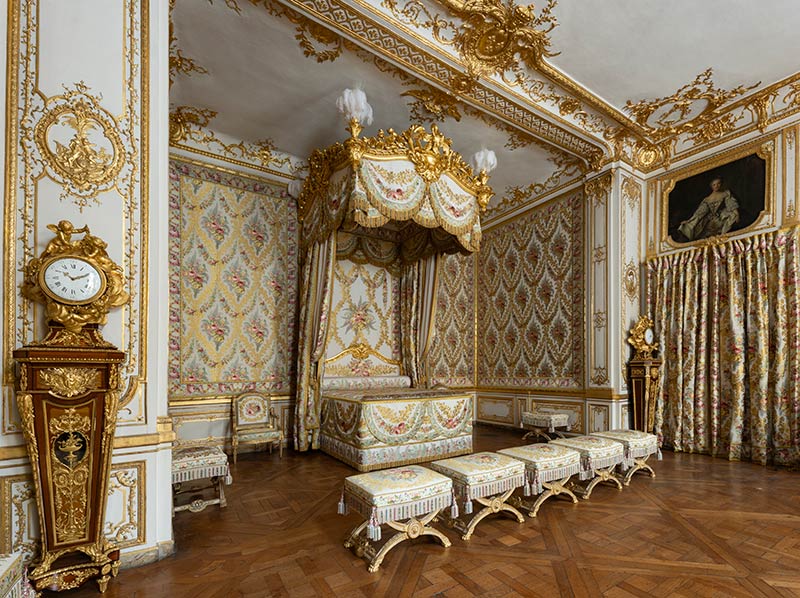
Initially intended for Louis XV, the king’s private bedroom was only completed in 1775 and was occupied by Louis XVI until October 6, 1789: “It is the state of the room on that date that we restored,” explains Benoît Delcourte, chief heritage curator. During the Revolution, the castle was pillaged and its furniture destroyed or stolen; the king’s bed was burned by the revolutionaries, and no trace of it remains in graphic sources. The room inaugurated in April therefore presents a completely “restored” bed in a restored decor, since the tapestries and woodwork had partially survived the Revolution.
To recreate the bed, the team of curators and sculptors had very few archives from the 18th century: “We only had the memoir of the sculptor Babel”indicates Benoît Delcourte. Quite a job “by interpretation of the text in images” was carried out, from beds from the same period in other French establishments linked to the monarchy. For bed textiles, “the Tassinari & Chatel house, heir to the Lyon silk factories, and in particular to Camille Pernon who delivered the silk, kept a sample of the bed hangings in its collections”. The weaving of the hangings began in the 1980s and lasted several years, further delaying the return of the bed. This bed has a 4 meter high imperial surmounted by a sculpture of a pelican, symbol of the king sacrificing himself for France as the pelican sacrifices itself for its young. The symbols displayed on the bed decorations are “less warlike than those in the bed of Louis XIV”notes the curator, who points out in particular the flowers and ferns decorating the drapes and the headboard. “For the decorations and furniture, we followed a principle of general harmony in terms of gilding”specifies Benoît Delcourte, a harmony also visible in the repeated patterns on the textiles.
The same principles of harmony and equivalence guided the restitution of the chest of drawers, since the original one of Louis XVI is at the Château de Chantilly (Oise): “A deposit was impossible so we worked from a chest of drawers from the Château de Compiègne from the same period and of equivalent status. » The gilding produced in the workshops of the Palace of Versailles contrasts with the cream and pastel tones of the textiles and seats (folding chairs and armchairs), for a relatively sober overall effect compared to the state salons. “This is undoubtedly the last major furniture restitution project in Versailles,” notes with regret Benoît Delcourte, who evokes the cost of such a project over several decades.