Marseilles. “Ferdinandea” was one of the names given to the volcanic island which emerged between Sicily and Tunisia in June 1831. The colonial powers then competed for control of the Mediterranean. The English are in Malta, the French occupy Algiers and the Kingdom of the Two Sicilies, an entity in southern Italy formed after the Congress of Vienna and of which King Ferdinand I took charge. Six months later, this island, a formation of igneous rocks, will gradually disappear under the sea, up to eight meters deep today. Writings, stories and fictions, maps, engravings, drawings and gouaches will bear witness to what it aroused in fears, curiosities, territorial claims, military and scientific expeditions.
Nearly two centuries later, Clément Cogitore (born in 1983) re-explores this story, the story of which he discovered a few years ago in a well-documented book, Dell’isola Ferdinandea and other things by Salvatore Mazzarella (Sellerio Editore, 1984), found in a second-hand bookstore in Palermo.
“I immediately felt that this story, mixing natural phenomena, scientific expeditions, imperialist propaganda and popular beliefs, I had to explore in my own way and imagine possible images,” explains the filmmaker, videographer and director, who once again invites us to take an interest in a place located at the heart of human interactions. After the Madre, Donnaregina contemporary art museum in Naples, setting for the first exhibition of “Ferdinandea” in 2022, the story unfolds at the Mucem under the general curatorship of art historian Kathryn Weir, and integrates other archives that the artist has cataloged during her investigation carried out in museums in Germany, France, England and Italy. The catalog of the Marseille exhibition (co-edition Atelier EXB/Mucem) is also enriched with a fiction by Tristan Garcia.
A hybrid, non-documentary narrative
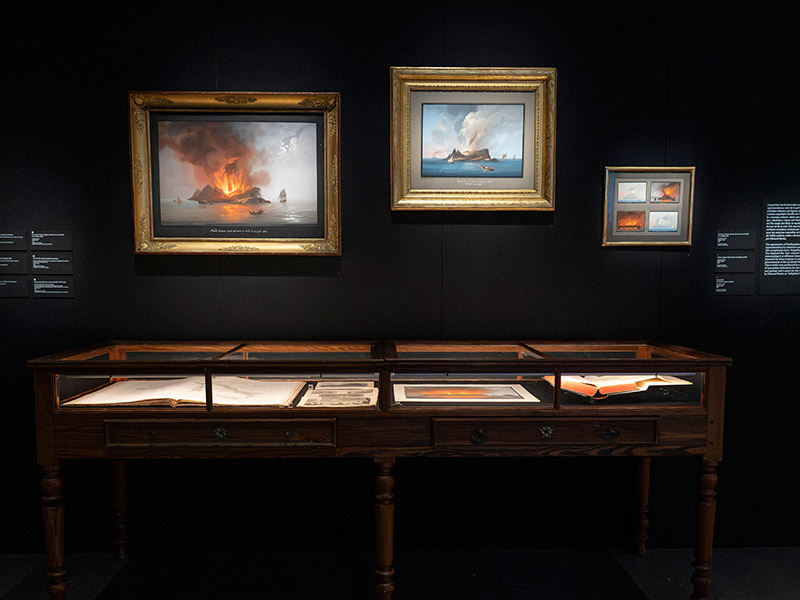
In the immense exhibition room of the Georges-Henri-Rivière building at Fort Saint-Jean, different types of narration coexist around the film Ferdinandea: uncertainties (duration 40 min), projected into a large black box. There we first find the representations, diplomatic correspondence, articles and fictions produced in France on Ferdinandea (called “Julia” by the French).
Through these documents clearly organized on the wall, explained and contextualized, Clément Cogitore extends the story to the contemporary period through three bodies of creations: photographs of marine currents and volcanic minerals taken in the 19th century on the island; a 16mm film, a collection of premonitory signs (seismic tremors, dead fish washed up on the beach, sulfur in the air), signs that he reinterprets; and a video of around fifteen minutes retracing a scientific dive in which he participated on the slopes of the underground volcano. Are snippets of stories that the film Ferdinandea: uncertainties multiplied in a non-documentary but hybrid narration. Corpora of heterogeneous images alternate between scientific images or images from other archives and images shot by Cogitore. After referring to the events of the 19th and 20th centuries, narrated in different Mediterranean languages, the film shifts towards a speculation on the reactions, consequences and interference that the emergence of a new land in the Mediterranean would cause. Ferdinandea is located “in a strategic zone of circulation of oil tankers, gas pipelines, submarine cables and passage of immigration and drugs”, recalls the artist. We find at Mucem this freedom from traditional narrative patterns that he has made his own since his first feature film Neither heaven nor earth (2015). As well as in the “Oscillations” exhibition at the Les Filles du Calvaire gallery in Paris, which is presenting until February 28 twelve videos by young artists from its workshop at the Beaux-Arts de Paris.