Florence,
The Palazzo Strozzi and the Di San Marco Museum host, since September 26, the great sample of Florentino fall and one of the most significant among those recently dedicated to the teachers of the Italian painting of the fifteenth century: “Blessed Angelico”. It examines the production, evolution and influence of Fra Angelico, as well as the kinships that can be established between his work and that of Renaissance painters and sculptors such as Lorenzo Monaco, Massaccio, Filippo Lippi, Lorenzo Ghiberti, Michelozzo and Luca Della Robbia.
Under the triple commissioner of Carl Brandon Strehlke, conservative emeritus of Philadelphia Museum of Art; Angelo Tartuferi, former director of the Di San Marco Museum; and Stefano Casciu, regional director of the National Museums of Toscana, this is the first major exhibition that Florence gives the artist since 1955 and has, between its two headquarters, with 140 works: paintings, drawings, sculptures and miniatures.
They come from the Louvre, the Gemäldegalerie, the Metropolitan Museum, the National Gallery of Washington, the Vatican Museums, the Alte Pinakothek of Munich or the Rijksmuseum of Amsterdam, as well as of Italian and international libraries and collections, churches and local institutions, and a number not less of those pieces have been restored for the occasion. The appointment has also allowed to gather dispersed compositions that, in some cases, integrated dismembered altarpieces two centuries ago.
The man who, inspired by the late Gothic strokes, contributed to lay the foundations of the incipient rebirth, was born with the name of Guido Di Piero around 1395, in the town of Vicchio Di Mugello, and died sixty years later in Rome. Always from a deep religious sense, from the meditation on the connection of the human being with divinity, he devised compositions characterized by his domain of perspective, his brilliant handling of light and the relationship between figures and space.
Fra Angelico entered the Dominicans around 1417 or 1418 and some testimonies suggest that he was painter even before. However, we do not have documents related to his artistic work until later: in 1430, the Dominicos de Fiesole commissioned him a table; In 1432, the servants of María de Brescia, a Annunciation; And, in 1433, the Linaioli (The Brotherhood of Los Lingerieos) A tabernacle of whose frame occupied Giberti. Domenico Veneziano, in 1438, was already cited as one of the best Florentine teachers and something before, in 1436, Cosme de Médicis commissioned two tables for the reconstruction of the observance, the convent of San Marco, as well as directing, cell to cell, its decoration.
His gradual fame as a painter ran a couple to his rise in the ecclesiastical career: Vasari account that in 1445 the Pope thought about turning him into a archbishop of Florence, but he, for humility, resigned in favor of the future San Antonino. Of course, he was called to paint in the Vatican, in the Niccholine chapel, and also made fresh, today lost, in the chapel of the sacrament; In addition, he decorated a Studiolo for Nicolás V.
In 1447 he was hired to decorate the chapel of San Brizio in the cathedral of Orvieto, a work that would complete Signorelli; In 1448, Pedro de Médicis entrusted him to decorate a closet for the silver objects of the Annunziata and, in the mid -fifties, Fra Angelico returned to Rome to work on the frescoes of the Minerva’s cloister. There he died, as we said, and his grave is found in Santa María Sopra Minerva.
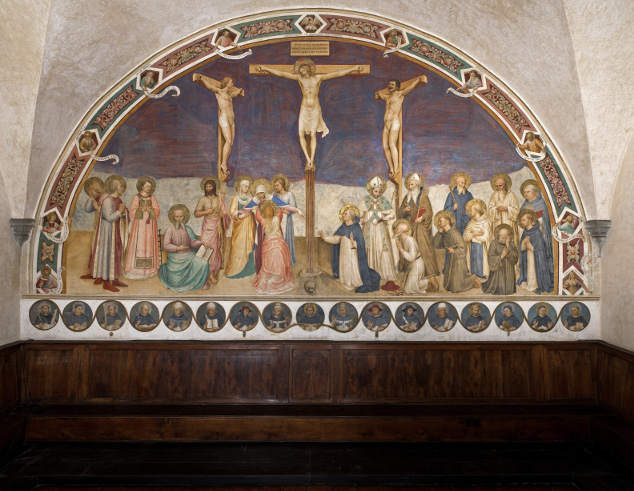
Of the popular ideas that circulate on this author the main person is Vasari. According to his biography, he was a saint and his painting could also be understood as such. Attending to his testimony, before painting he prayed and sobb, and we can consider his legacy as the reflection of those mystical outbursts, hence the beauty of his figures, the harmony of his colors and the grace of the shapes. He also said that he formed studying the frescoes of the Brancacci chapel of Masaccio (recognizing that he knew the painting of the quattrocento), but his work has – he explained – a naturalistic orientation, although for Fra Angelico painting nature, he was before a reason to admire the goodness of God that a field open to the investigation of his environment.
Referring to that influence of Masaccio in Florentino, Roberto Lonchi went further, stating that without that painting Angelico would not exist. We do not know his work prior to 1425 and that direct dependence can be discussed, but it is clear that the work of Fra Angelico was born by opposition or consolidation towards the currents that renewed the painting in Florence and was based on his own knowledge of the religious doctrine, hence his programmatic character and late beginning.
It has a gently emphatic tone: it seeks to attract naive souls with the visual evidence of the charm of their images, and also appeals to the learned through their allegories. There is much preaching in his work, hence the image he offers from God and the blessed is what can be offered to man, registering it in the field of sensory experience.
And, however, we are not only before a doctrine painter: as he participated in the religious discussions of his order, he took sides in artistic, pretending to demonstrate that modern painting did not necessarily have to be secular and that a religious painting can be without showing the life of Christ and the saints. Their efforts were aimed at giving religious painting an intellectual channel and a theoretical foundation.
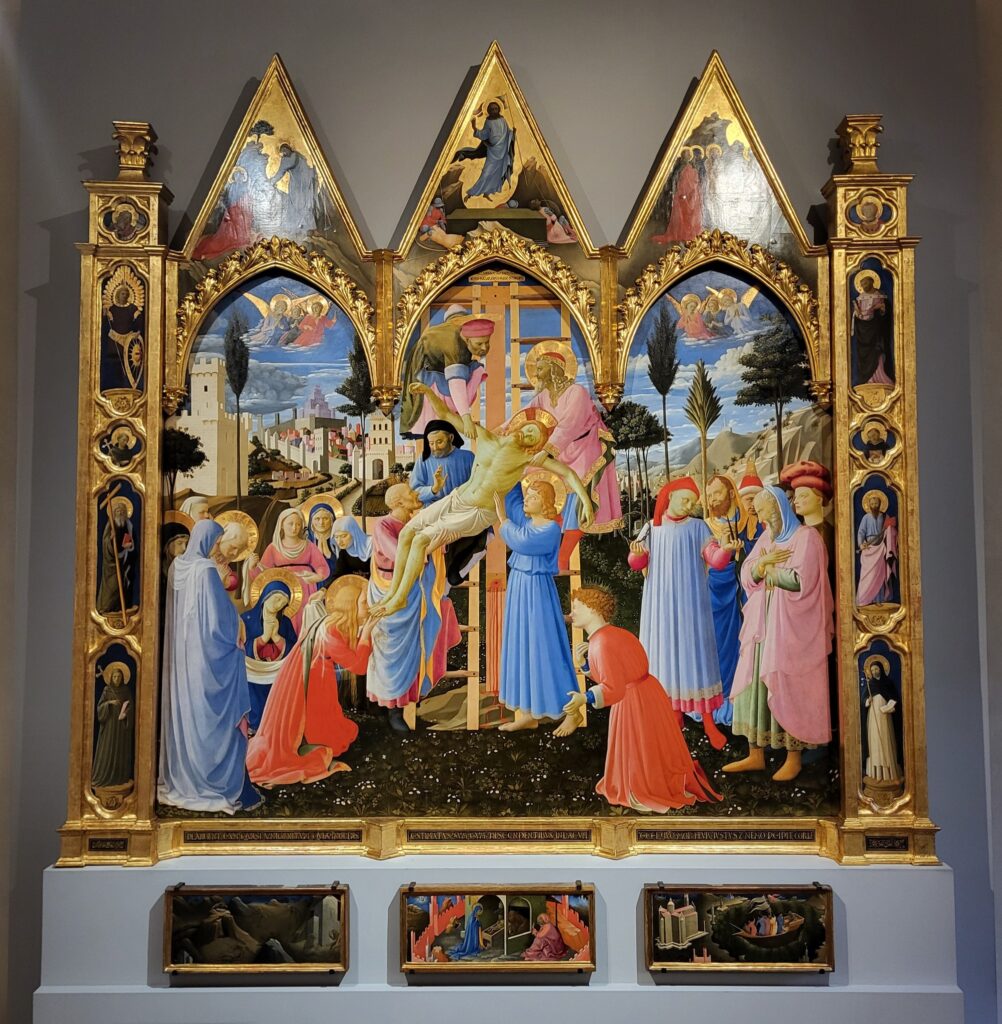
If, in Gothic painting, the ideal of beautiful resided in the harmony of proportions and in rhythmic continuity, Fra Angelico found that beauty in each of the things, which aspire to their own perfection (Debita Proportiowhat the view is pleased). But it is also true that, for him, the beauty is a value that is accessed through art and the concept of beauty is associated with the form, understanding as such the transformation of the matter reports into a perfect and different thing from the rest.
As a good connoisseur of the artists of his time, he was not Fra Angelico either outside the debates about the representation of space. He did not ignore the new rules of perspective, nor refused to apply them, but did not adopt them as a rational law from which to apprehend sensitive reality. He escaped to optical empiricism and understood space as a mere place, and perspective as a means to designate a perfect place for perfect things.
For example, in your Coronation From the Louvre, the staircase is seen in perspective from below, but that viewing angle simply responds to the need to hierarchically dispose of the orders of figures.
And, yet … he, who did not understand space as geometric abstraction, but as a populated place of figures, trees or buildings, was one of the first to conceive depth and distance as a landscape and to use the perspective to put each element in its place. He did it with a purpose: to produce an emotion through representations of the most pathetic moments of the divine drama, pointing through the landscapes deviations to the painful event, openings to meditation. Its nature is both scenario and comment, a beautiful and comforting invitation to reflection.
If we stop at their frescoes from the Nicolás V chapel in the Vatican, the spaces are widened by opening empty to express the feeling of remote time, of the historical distance of the evoked facts, and the perspective becomes a means to separate two successive times or two chapters from a story.
On the other hand, the light does have a real existence in Fra Angelico: it is not born of terrain origin, springs from the celestial bodies and lacks quantity, so it cannot be measured or spread. It influences, as will do in Piero Della Francesca, in the colors, which modulate from the light to dark, modifying them and transforming them into others.
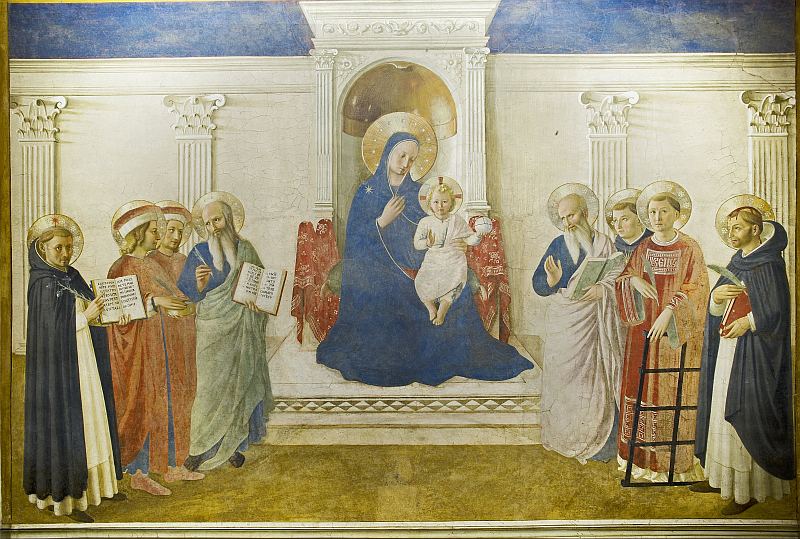
For the Florentine monk, the presence of light on Earth is due to a providential reason: it allows us to see nature while purifying our sensory experience, restoring things created its original perfection and restoring the harmony between the terrain and the celestial. That harmony is at the bottom of the whole of his work.
For him, the creation process served to eliminate false earthly appreciations of reality, sensuality: it is a process as intellectual as moral. Its beauty canon does not respond to proportional norms accepted a priori: It seeks purity, eliminating any sensual or sensory line and subjecting the paint to an inner decantation. Its ideal is that each of the elements represented encourage the desire of good.
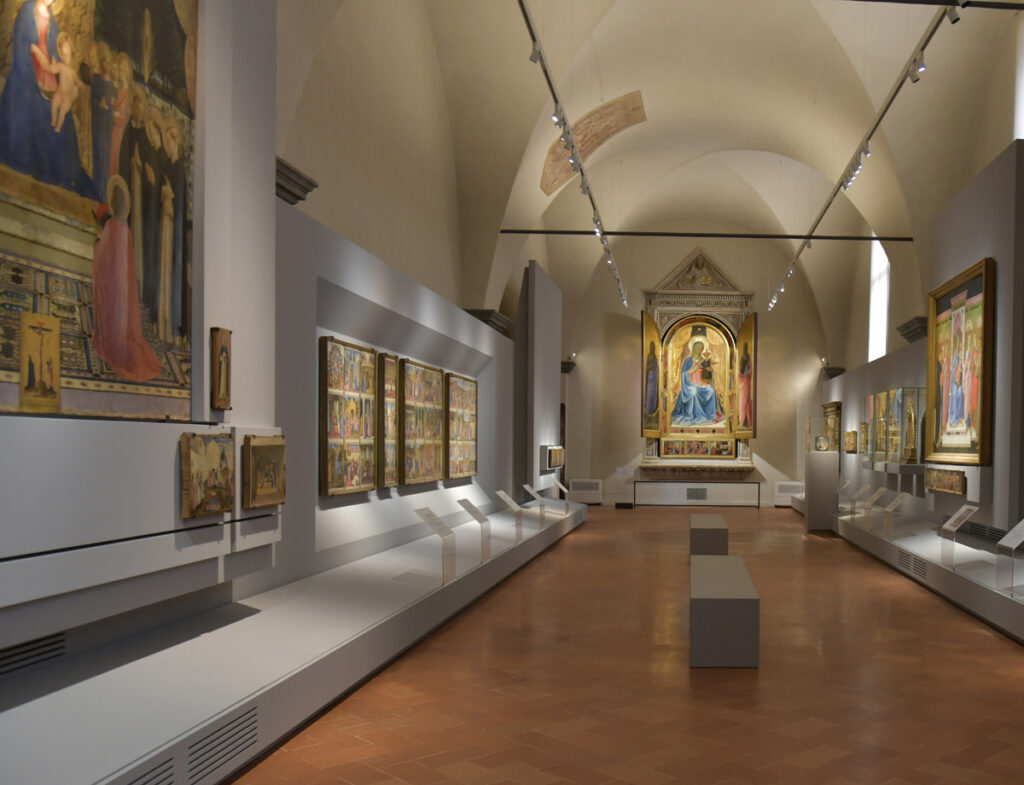
“Blessed Angelico”
From September 26, 2025 to January 25, 2026
PALAZZO STROZZI
Piazza Strozzi
Florence
Di San Marco Museum
Piazza San Marco, 3
Florence