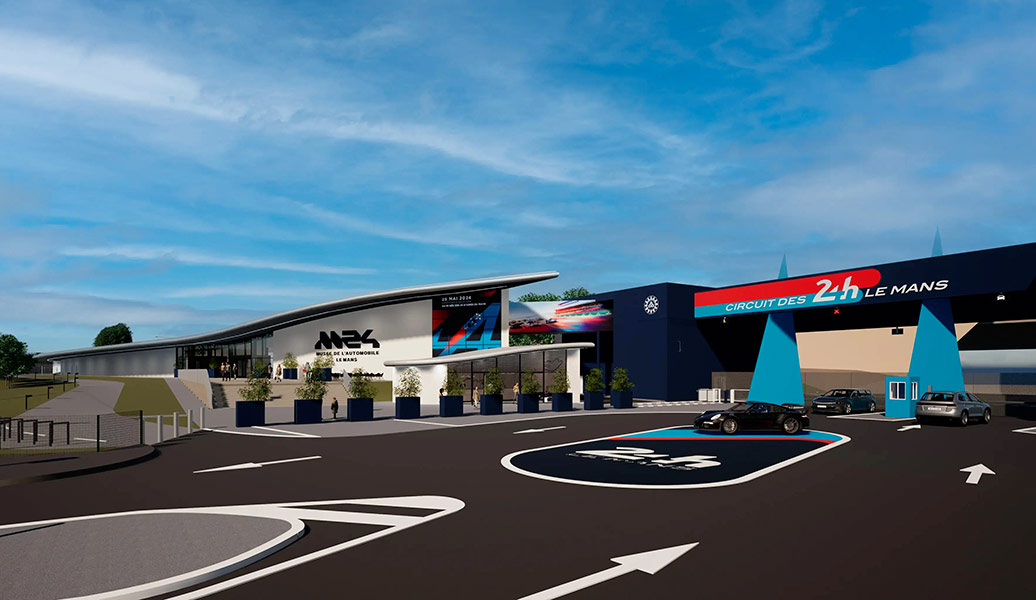
Le Mans. The legendary 24 Hours of Le Mans will soon have a new museum twice as large as the current one. With a total surface of 8,600 square meters, the M24 museum designed by the architect Frédéric Audevard should cost nearly 12 million euros according to Fabrice Bourrigaud, heritage and culture director at the Automobile Club of the West (ACO). This project is the culmination of a long process of museum of motorsport and the 24 hours of Le Mans. Fabrice Bourrigaud recalls that the idea of implanting a museum next to the circuit dates back to the 1960s, and that the first was created by the Automobile Club of the West, former owner of the circuit and organizer of car racing. In 1991, the Mayenne Departmental Council opened a more modern museum managed under management. In parallel, ACO opens a place intended to enhance its archives and heritage, and, in 2017, an agreement of transfer is signed between the department and ACO for the 24 -hour museum. The museum reopens in 2018 with a temporary exhibition policy to complete the collections (including many vehicles given by car manufacturers). During the work in 2025, the exhibitions are held in a temporary pavilion, while the circuit remains open to the visit. It is a company created in 2022 that manages the new museum project, MACO (Automobile Competition Museum), whose ACO and businessman Richard Mille are investors each at 50 %: the museum is therefore entirely funded in private funds.
A global museum ambition
The more than 200,000 visitors in 2024 prove according to Fabrice Bourrigaud that there is a growing interest in car sports and their history, themes in the heart of the future museum. The project aims to make it“The reference museum in the world for motorsport”with the model of the Indianapolis circuit museum in the United States (the museum has more than 150 vehicles on 7,500 square meters). France has several automotive museums (Peugeot Citroën in Sochaux, Michelin in Clermont-Ferrand), but no museum dedicated to mechanical sports. It remains to design a route that goes beyond the exhibition of cars and archive photographs. Because most of the collections are made up of vehicles that have participated in the 24 hours, and audiovisual archives that date back to the 1930s for the oldest. Fabrice Bourrigaud specifies that the museum team (a dozen people) has heritage curators and specialists in museography, according to him of a structured museum course and encompassing all mechanical sports (including Formula 1).
This course will favor “Immersion and audiovisual devices” To put in context the vehicles on display, part of which comes from donations from Richard Mille. The museum hopes to attract a large audience beyond enthusiasts of mechanical sports, in particular “Regular museum visitors”specifies Fabrice Bourrigaud, who ultimately aims for an attendance of 300,000 visitors per year, by betting on “The tourist potential of the Le Mans region, and the proximity of heritage sites such as the royal abbey and the Plantagenêt city”.