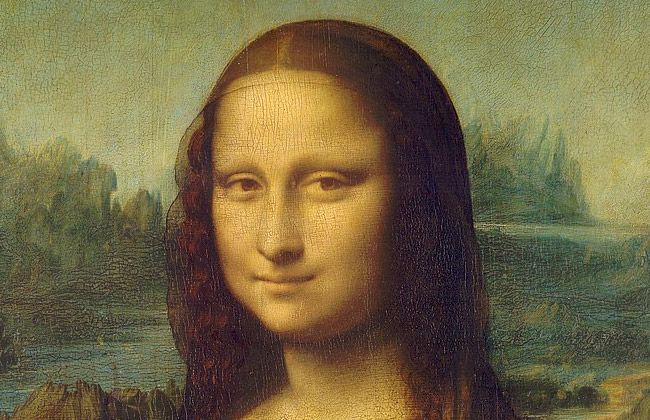
Five groups of architects, scenographers, and landscapers are working on the project pompously called “Louvre – New Renaissance”: remedying the deplorable exhibition conditions of The Mona Lisareview a tour of the museum that this venerated painting vampirizes by isolating it in a room in the basement of the Cour Carrée accessible via a new entrance. The winner of the competition should have been announced this month. But the spectacular burglary of the Apollon gallery now leads to questions about the budgetary priorities of the institution, while the Court of Auditors invites this project to be postponed, the cost of which, 667 million euros, appears to be unfunded.
Museums would therefore now be too dependent, even victims, of their flagship paintings. How are other major establishments handling this confrontation? In the discussion around “Louvre – New Renaissance”, this question was never raised. The Louvre is therefore considered a unique case – 9 million visitors – and the cannibalizing force of Leonardo’s painting is unrivaled. Yet in his latest work, Investigation of Les Ménines (Actes Sud), Jérémie Koering brings up an interesting comparison. The historian recalls the importance of the choices for hanging this painting (1656) by Velázquez, one of the flagships of the Prado (3.6 million visitors). Since 1819, when it entered the collections, museography has alternated between isolation or grouping, thus hesitating between two ways of considering the work. On the one hand, Las Meninas is integrated into the history of painting by being hung alongside other Spanish, or even European, canvases. On the other hand, this incredible representation of the Infanta Marguerite, her attendants, Velázquez himself and the royal couple appearing in a mirror is magnified, being isolated in a room specially dedicated to its contemplation. This option has been the most criticized, but yesterday’s Prado is not today’s Louvre.
Las Meninas by Diego Velázquez in room 12 of the Prado Museum in Madrid.
© Prado
Currently, bundling prevails, but differently. Las Meninas is surrounded by fourteen other portraits by Velázquez and that of Marguerite by Juan Bautista Martínez del Mazo, Velázquez’s son-in-law. Until March 8, the canvas faces a work by Juan Muñoz (1953-2001) whose retrospective “Art Stories” continues in the rooms devoted to temporary exhibitions. His sculpture, Sara with a pool table (1996) questions the act of looking, one of the key questions of Las Meninas. A relevant ancient/contemporary face-to-face. At the bottom of the 17th century masterpiece, a discreet barrier separates the viewer by 1.5 m: the large format painting (3.20 mx 2.79 m) without protective glass is then presented to him in all its splendor and its enigmas. What a contrast with the bunkering under glass of The Mona Lisathe distance of more than 4 m from this medium format. At the Prado, moreover, contemplation is calm, concentrated because photographs are prohibited. No raised smartphones or gesticulations for selfies like at the Louvre. To meditate.
The financing of “Louvre – Nouvelle Renaissance” is therefore contested but not its legitimacy. If it is necessary to isolate The Mona Lisa to save the museum and if it is necessary to save money, then why not exhibit it under the Pyramid, in the rooms dedicated to temporary exhibitions? These rarely convince. The Louvre could continue to organize file exhibitions in its rooms. For larger-scale projects, it would join the spaces renovated at great expense in the Grand Palais and would offer intellectual support to an Rmn which badly needs it for its programming. Entrance under the Pyramid would be reserved for visitors to the Mona Lisa, others entering via the Richelieu Passage or the Lions Gate. Thus, Monna Lisa would smile at the icon of the Grand Louvre. We couldn’t dream of better.
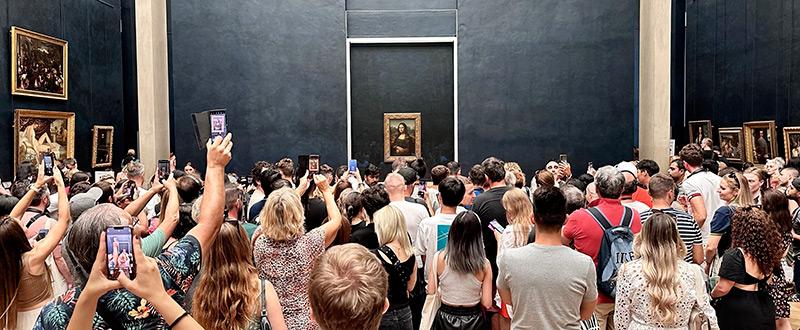
Visitors in front The Mona Lisa in September 2023.