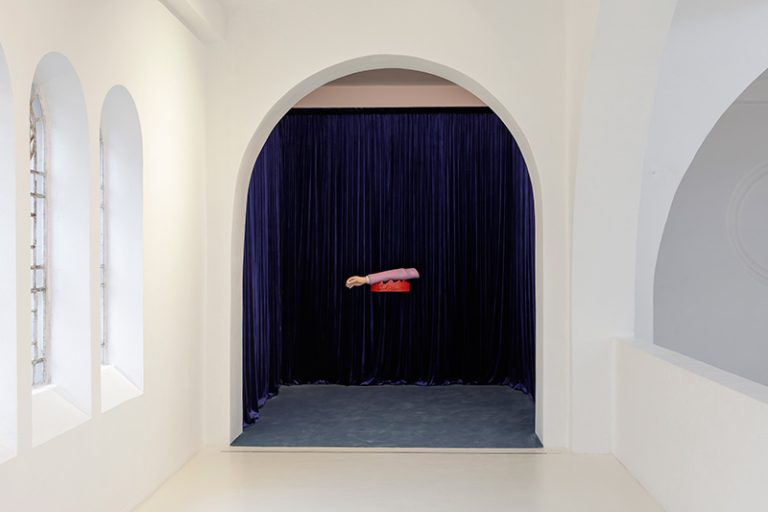
There are very few workshops that, internationally, continue to produce heliogravures according to their traditional technique, that is, using photosensitive gelatin, acids and aquatint resin to bite copper plates, instead of the more modern polymer plates – so few, that they even manufacture their own materials. There is a very small number in Europe and the United States – in Madrid, Ogami Press -, and in Mexico, where graphic creation has a well-established tradition, they are still carried out by centers such as Helio TM, which, for five years now and in the capital, has been responsible for preserving and disseminating these printing processes that emerged in the 19th century, in relation to the emergence of photography.
The mechanism consists – in general terms, because its feasible variations are numerous – in the transformation of a photographic image into a copper matrix to subsequently print it through engraving procedures, and is used, in that Mexican space, by artists of all disciplines, established and young, since it offers extraordinary expressive possibilities derived, precisely, from its artisanal nature.
Nineteen of them are now participating, at the Casa de México Foundation in Madrid, in the group exhibition “Our daily death: a contemporary view from the heliogravure”, curated by Pilar Goutas and Edgar Alejandro Hernández. It consists of around thirty works made specifically for the occasion, or taken from individual archives, so that they could be related to each other: they address the issue of death, so embedded in Mexican culture, but not necessarily literally, but rather linking it to memory, loss and mourning. Deep down, we will have the feeling that many of these compositions are populated by ghosts, like those that shelter the images compiled in another exhibition at this center, “Spectros. Enigmas of the gaze”, open until September 13.
Sometimes these are visions of detail, others almost metaphorical or allegorical constructions: the awareness of death underlies the solitary objects of Cristina Kahlo or Miguel G. Counahan; in the coiled and fragmented serpent of Maya Goded; the ray of light over the sea by Gerardo González; and, of course, in the portrait of a dead bride by Graciela Iturbide.

Our daily death: a contemporary view from heliogravure. Casa de México Foundation in Spain, 2026

Our daily death: a contemporary view from heliogravure. Casa de México Foundation in Spain, 2026

Our daily death: a contemporary view from heliogravure. Casa de México Foundation in Spain, 2026
Death, in this exhibition, becomes current and present in traces of blood and violence or in funerary rites, in scenes of migration or absences in rooms designed to be full (Mexican dramaYvonne Venegas). Other authors in Casa de México are Andrea Aspe, Ángela Arziniaga, Arturo Fuentes, Carmen Mendoza, Cristóbal Gracia, Fernanda de Icaza, Guillermo Espinosa, Héctor García, Martín Soto Climent, Piguame, Santgiago Borja and Pilar and Tamara Goutas.
In the montage we will also see plates and papers representative of different phases of the process, but also of the plastic power of these materials, theoretically subsidiary: inks and coppers, degrees of pressure and traces, the bases of this procedure, are excellent resources to suggest the fugitive, what remains of what is gone if you look twice.
Despite being manifestations of a method that is not especially primitive among those of engraving, these pieces commune with the Mexican graphic legacy due to that appeal to the mortuary that has been constant and that has also been used to critically review the living. In these works there is no mimesis, but rather mechanisms to confront loss and build memory and, therefore, the collective imagination.
The curator mentions in the text that accompanies the exhibition, exemplifying the deep relationship of Mexican engraving with death, José Guadalupe Posada, who in his workshop in Vanegas Arroyo gave shape to countless skulls that in his work refer to urban disorder, the social tensions of the time of Porfirio Díaz and popular stories that were only transmitted orally.
In these pieces, as in so many Mexican creations, death is not just an outcome or isolated event, but a present experience in daily life, capable of transforming it and modifying our bond with objects, affections and memories, sometimes hard as copper.

Our daily death: a contemporary view from heliogravure. Casa de México Foundation in Spain, 2026

Our daily death: a contemporary view from heliogravure. Casa de México Foundation in Spain, 2026

Our daily death: a contemporary view from heliogravure. Casa de México Foundation in Spain, 2026
«Our daily death: a contemporary view from the heliogravure»
CASA DE MÉXICO FOUNDATION IN SPAIN
C/ Alberto Aguilera, 20
Madrid
From September 9 to November 15, 2026