Paris. It is on the land of the late Mehryl Levisse, his long-term assistant who died in 2023, that the Moroccan artist Hassan Darsi (born in 1961) is today inaugurating his first French personal exhibition. This territory, from the thick Ardennes forests to the Champagne valleys, had already been surveyed by the visual artist, as part of a residency organized in 2014 by his dear friend in his hometown, Charleville-Mézières – the photograph of one of his sculptural interventions in the Carolomacerian public space had also been acquired immediately by the Frac Champagne-Ardenne. This time, Hassan Darsi takes up residence in Reims (but also in Mulhouse, which devotes a solo show simultaneous) to unveil some of its emblematic pieces as well as new works produced by the Frac.
Underlying political realities
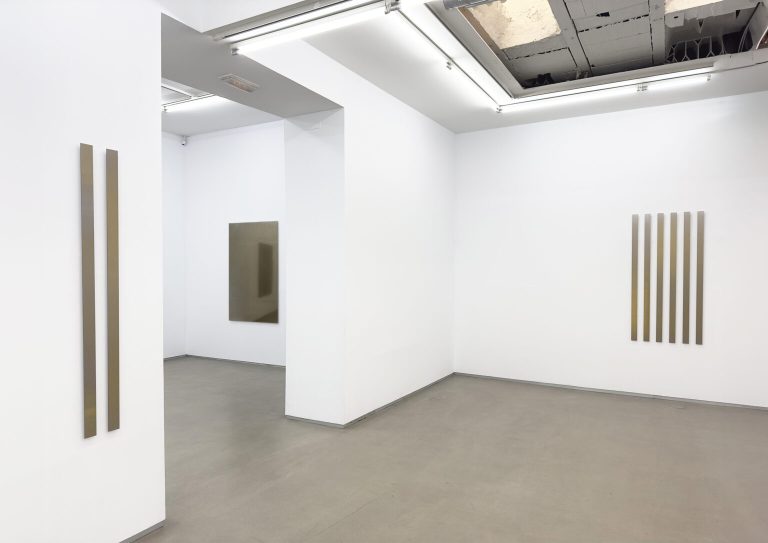
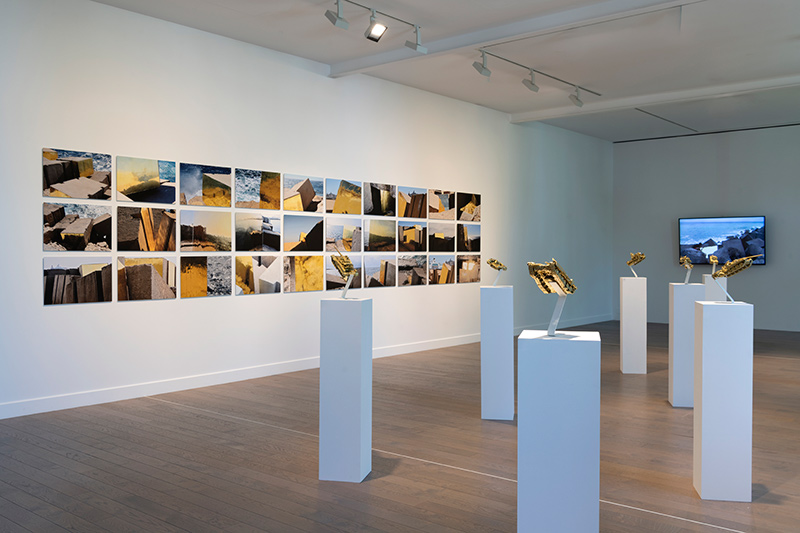
From Yves Klein to James Lee Byars, via Richard Wright, many contemporary artists have explored the aesthetic and symbolic potential of gold. Hassan Darsi is one of those creators who is interested in its irresistible power of seduction as well as the socio-political realities that lurk in its shadow, like the Ghanaian sculptor El Anatsui whose attractive golden tapestries are in reality made up of thousands of scrap metal. Hassan Darsi, for his part, develops a plastic vocabulary, based on covering with gilding, which he calls “gilding applications”. The Frac is screening a video documenting its site-specific intervention African Gold I (2008), showing the artist sticking golden adhesives on the concrete cubes of a sea wall in Tenerife, in the Canary Islands. Further on, a series of very beautiful photographs developed by the Reims institution in 2026 reports on the reactivation of Tenerife’s intervention on the sea wall of the port of Marseille in 2012, entitled African Gold II. A simple gesture which soberly evokes the migration issue and the gold rush in Africa. In the installation Drift Project V (2026), on the ground floor of the Frac, Hassan Darsi also attributes the characteristics of mirage to gold: the thin layer of gold deposited on the surface of the water in the pools gives the illusion of solid blocks and creates a landscape that looks like a swamp. Here again, splendor gives way to a less glamorous reality. Thanks to the keen eye of its trio of curators – Florence Renault-Darsi, co-founder, with her husband Hassan Darsi, of the La Source du lion association in Casablanca, Bérénice Saliou, the director of the Frac Champagne-Ardenne, and Sandrine Wymann, the director of the Kunsthalle de Mulhouse – the exhibition displays texts rich in information, which describe all aspects of the work.
With its tight corpus of around ten works, “Hassan Darsi. Persistances” however leaves the visitor a little unsatisfied. Most of the installations being extensions or reactivations of older works, it would have been interesting to push the discursive and visual correspondences further, as the curators did with African Gold (see ill.), even if it means going through archive display cases. This would have made it possible to give a little more historical consistency to the presentation of the creative process of a major artist on the Moroccan scene active for more than thirty years.