
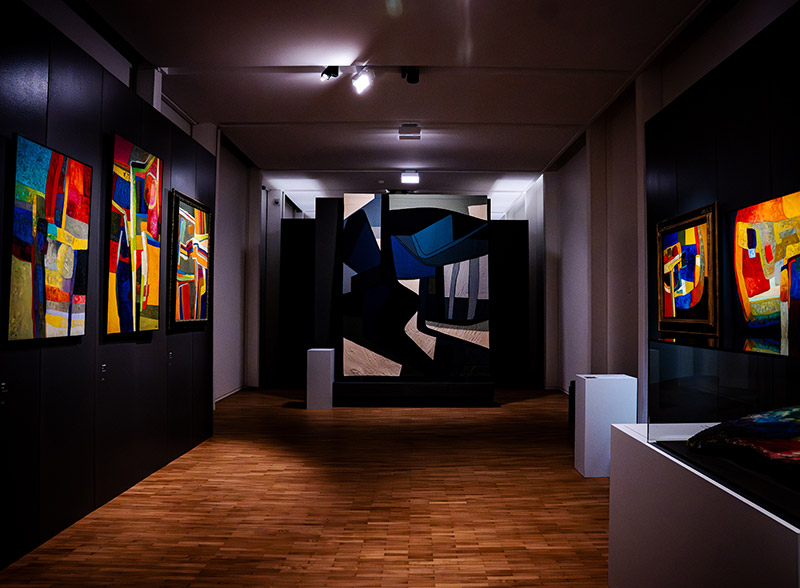
Bourges (dear). Located in the old town hall which dates from 1492, the Estève museum had not been redesigned since its opening in 1987 as its deputy director Anna Moirin specifies. Most of the collections come from the donation of the painter Maurice Estève (1904-2001) to the city of Bourges, and some more recent acquisitions. It was therefore necessary to renovate the building and rethink the route and the scenography: how to present abstract and colorful works in 15th century rooms with sculpted decorations?
The partial renovation (for an amount of 470,000 euros) has kept the elements of the period (monumental fireplace, beams, frames, toulttes on the ground) and discreetly integrated up the upgrades (electricity). Entry and spaces dedicated to mediation have been modified for more accessibility, “A condition set by the couple is from the creation of the museum”, According to Anna Moirin. If the majority of the route is held in the 15th century rooms, two large 5th century rooms upstairs offer renovated spaces with white walls, easier to scenograph.
In the scenography entrusted to Vasken Yéghiayan, the works coexist with the dark walls of the building, bringing large colored touches: Estève has indeed quickly chosen a palette of bright colors, under the influence of Matisse and Calder as Florent German, head of the conservation service and collections of the city of Bourges, recalls. The chronological journey shows both the abstract canvases that made Estève’s success from the 1950s and more confidential works.
View of the mediation space of the Estève museum.
© Benste / City of Bourges
Overall, the circulation is fluid because the canvases are hung on the sides or on removable picture rails placed in the main axis of the rooms. These picture rails become modules when the very detailed cartels are presented horizontally in front of the works, on supports“Up to PMRs”. In each room, some large canvases are presented on black metal supports “In the shape of a bridge, which dialogue with the stones of the walls as desired is”recalls Florent German. A slight problem of light brightness, however, the visit at certain times despite interior components, “ Due to the orientation of the windows to the south ”, concedes Florent German, who adds that a reflection is underway on the issue. In the 18th century rooms, the brightness is well managed and highlights a large tapestry from the 1970s as well as several graphic works that show another aspect of the artist’s work.
Bourges 2028 in perspective
The route therefore highlights the works of the collections, especially since several of them were restored during the closure of the museum. The restoration made it possible to find “Color subtlety” And to reveal the Estève painting technique which readily played overlays. “” Estève painted very slowly and in several layers ”, What the large exhibited canvases show well. The overhaul of the course and the renovation of rooms are only the first step in an ambitious project which includes the complete restoration of the building, in particular the roofs and the facades for which a diagnosis will be carried out soon. In addition, the project includes new shared reserves and a site for graphic arts collections.
The Estève museum is the first of the museums of Bourges to reopen, because the three other municipal museums have been closed since 2021 and 2023 for reasons of dilapidation or various risks. From the perspective of Bourges Capitale European 2028, renovation work should accelerate according to the municipality, especially since certain museums could change its identity: the former museum of decorative arts will become a center of interpretation of the heritage while the Museum of Berry (History and Archeology) is the subject of a reflection for the moment not successful.
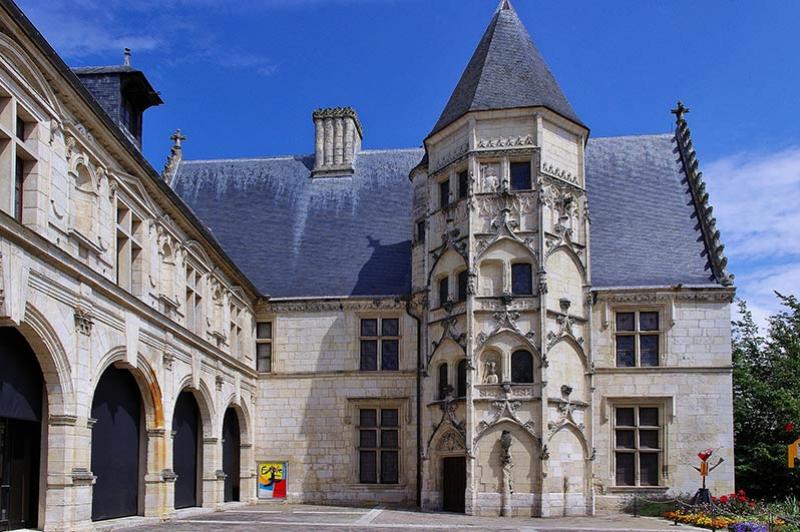
The Hôtel des Alderines in Bourges is home to the Estève museum.


