Valencia,
It is good to think that, beyond centenaries, there are reasons to delve deeper into the work of fundamental artists, focusing not on their most widespread works and stages, but on those that have been less widespread.
Three years after the commemoration of the century that has passed since the birth of Tàpies, the Bancaja Foundation reviews in Valencia, under the curator of Fernando Castro Flórez, the production of the last decade of his life, which approximately coincided with the first ten years of our century and the eighties of the Barcelona creator.
Given the chronology that he lived through, he experienced, right at the beginning of his adolescence, the Civil War and the post-war period, with the consequent isolation of Spain in the artistic and cultural field until, at least, the 1950s, circumstances that initially limited his projection. Despite this situation, and also overcoming a fragile health (he overcame a lung illness that kept him bedridden in 1942 and 1943), he managed to assert himself in his creative vocation and, after abandoning his law studies, he oriented himself towards the paths of the avant-garde.
Thus, delving into his concerns and searching through books and publications, the Catalan connected with other young people of similar inclinations and founded with them the group Dau al Set, one of the first platforms for creative renewal in post-war Spain, becoming partially a reflection of the cosmopolitan yearning in our country. The issues published by the collective’s trilingual magazine offer, in this sense, very relevant material: among its collaborators were Arnau Puig, Joan Brossa, Tharrats, Juan Eduardo Cirlot, Santos Torroella, Gaya Nuño, Antonio Saura, Ricardo Gullón…
In his autobiography personal memoryTàpies remembered those early years from his own perspective as a young painter who sought to carve out an intellectual training and connected with groups that were progressively developing, such as Els Vuits, with whom he would exhibit at the Blaus de Sarriá, and with the collaborators of the magazine Ariel. In parallel, he rediscovered the figures of the historical avant-garde, such as Picasso or Miró, then viewed with suspicion by officialdom, and he also interacted with Joan Brossa, Josep Vicenç Foix and Joan Prats.
In the purely pictorial, he was subjugated by Paul Klee, Kurt Schwitters, Duchamp…; in his words, All of this was like a stream of new ideas that were launched within me, although with a long delay, due to the years of closure in our country. If we had lived in a normal situation, perhaps I would have assimilated them sooner and with more positive results.. He intuitively sought a way out in the recovery of what was censored and in an evident desire for cosmopolitanism. We will appreciate similar motivations, at the end of the forties, in the Pórtico Group of Zaragoza or the Altamira School of Santander and that was also the time of the beginnings of Sempere, Millares or the aforementioned Saura.
Tàpies’ stay in Paris in 1950, from which he began to interact with Gallic informalism and the international avant-garde, was vital in the maturation of his language and in the expansion of his aesthetic horizons; In 1953 he would leave magical-surrealist figuration aside and, since then, he embarked on a personal career that would make him one of the most relevant authors of the second half of the century.
He soon surpassed the postulates of French abstraction, showing different concerns; For him, the influence of the critic Michel Tapié, author of the essay Another art (1952). Existentialism and his fascination with Eastern culture and thought also had an impact on the configuration of his own artistic world; By the mid-fifties, the painter had already opted for a very personal use of the material.
His style would mature, from that moment on, precisely in the coordinates of material informalism, which would lead him to experiment with sand, marble dust, resins or colored earths. On that physical support he simultaneously distilled his program of signs, which includes clearly symbolic ones (the cross, which coincides and is identified with the first letter of his last name), and, in addition, a personal way of influencing the matter. Comparing these signs or traces with his previous figurative repertoire, we detect a more interesting and effective austerity.
Analyzing his style over time, these works demonstrate a striking complexity and richness, because they refer to the best of the pictorial tradition of our country (to the sensitivity of the mystics of the 16th century), but also to contemporary art, since they interested Tàpies in more current ways than informalism and abstract expressionism: his images indicate an assimilation of spatialism, assemblage and other paths frequented by the Dadaists. Furthermore, the richness of the register that Catalan achieved in the fifties grew in the following years, when he also cultivated his harmony with povera and Joseph Beuys and experimented abundantly with the three dimensions.
During the eighties, Tàpies returned to the plane, but he did so, again, with originality, using large formats, a virtuoso use of varnishes and some figurative elements with erotic echoes.
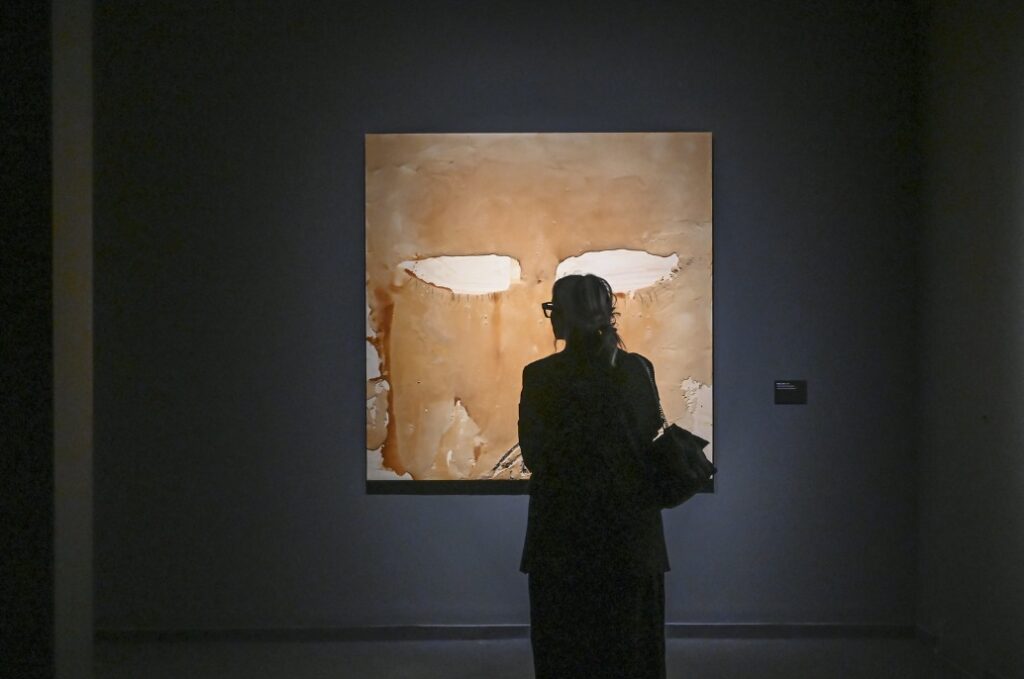
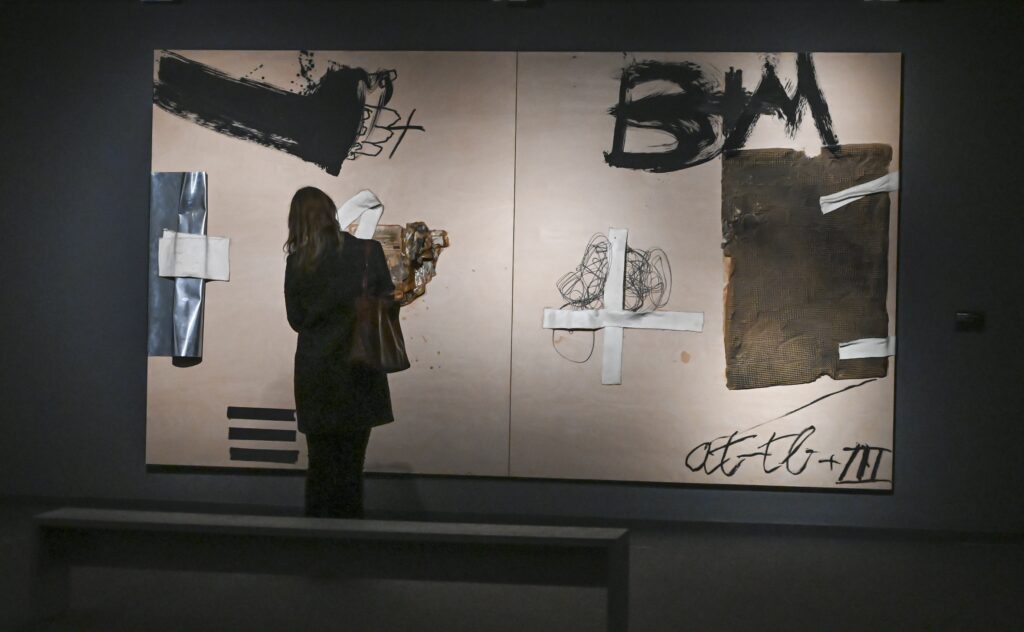
Where the canonical presentations end is where this latest exhibition by the Bancaja Foundation begins, which highlights how in those last years the artist did not shed his usual ideas and forms, but approached them in a more open and free way, following a cleaner aesthetic.
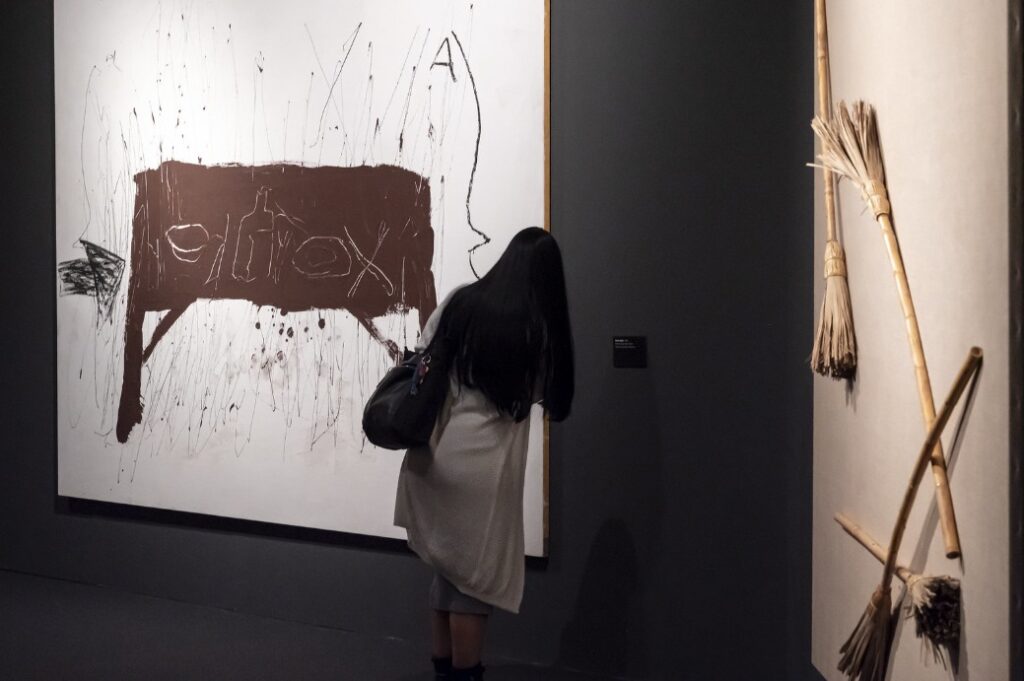
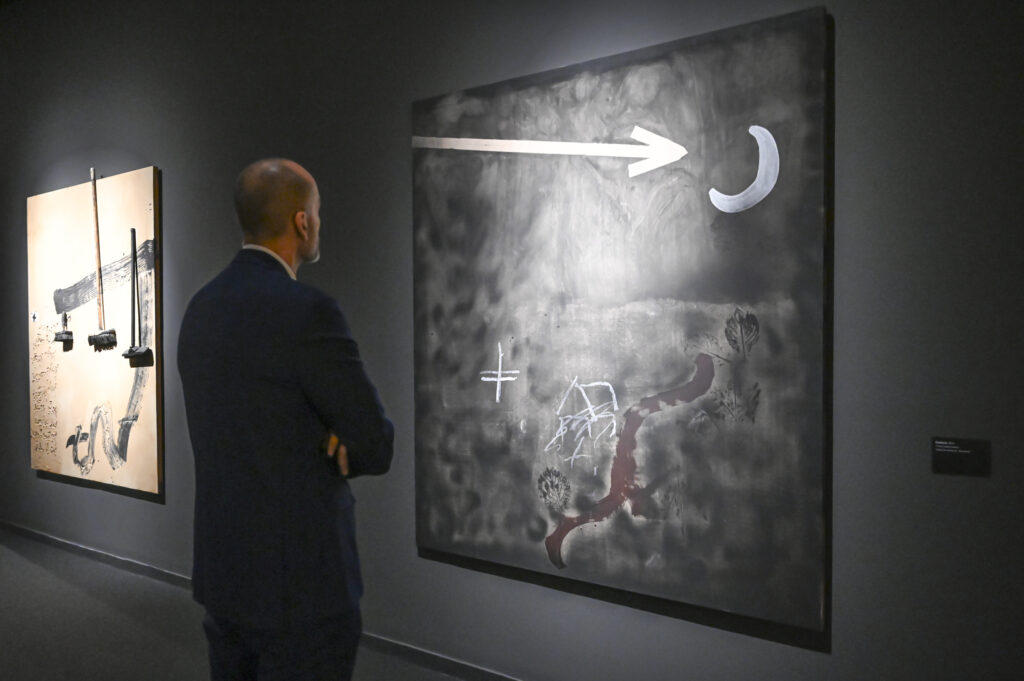
The route is made up of twenty large-format pieces and some unpublished, such as Morat (2005), a veritable (2006), Sis Signes (2009), Forests (2011) or Self-portrait (2011). Most of them come from the Tàpies family funds, with the exception of a = a (2005), which was incorporated into the collection of the Valencian foundation last year.
These works shelter symbols and matter, the latter in the form of everyday objects, wood, fabrics, ropes or fragments of furniture that bring life to their compositions, but from a containment and silence that is evident if we think about their previous career.
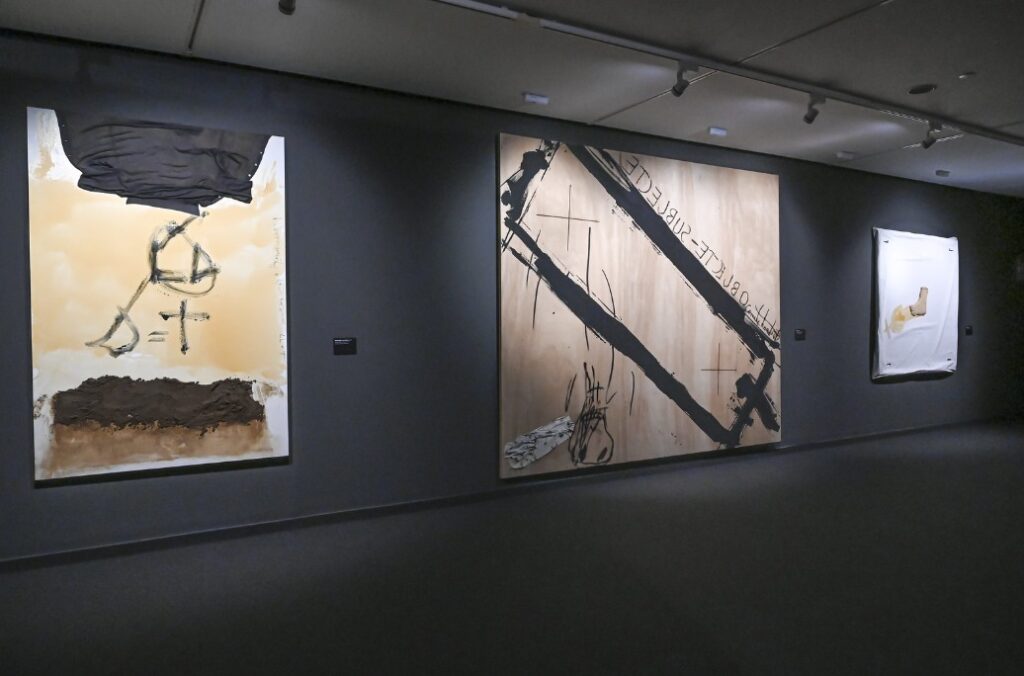
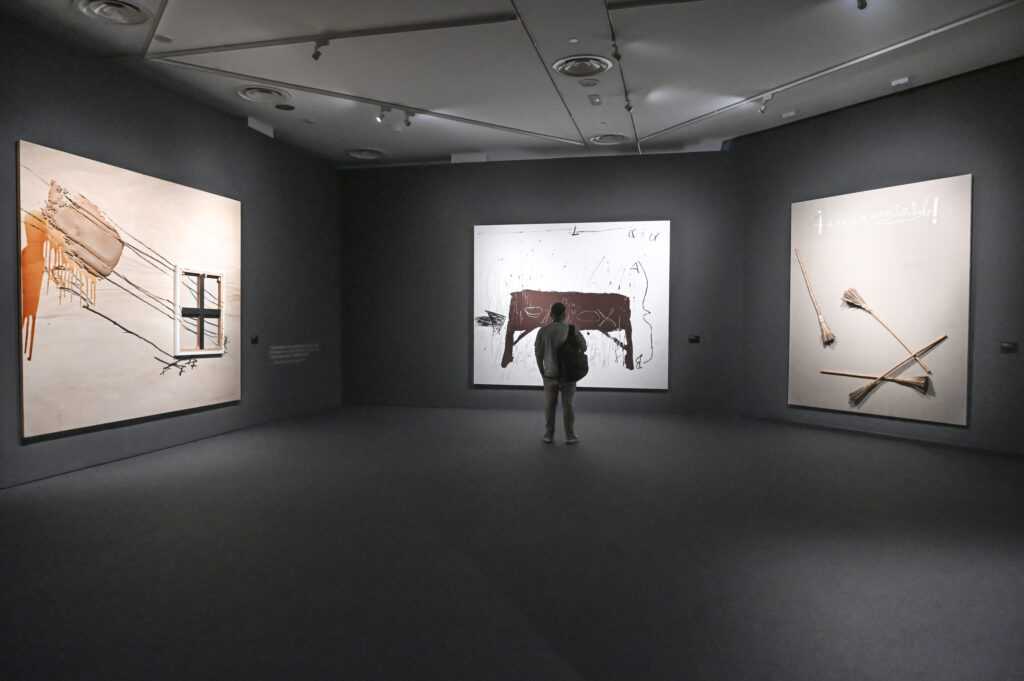
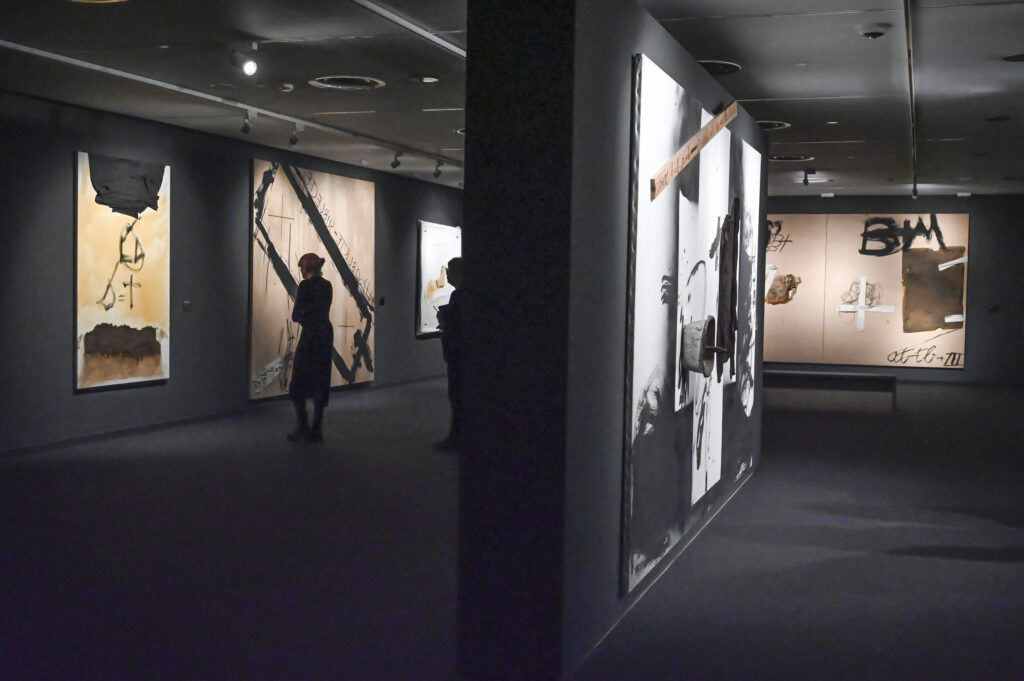
The montage highlights three axes of Tàpies’ production: the human body, which is alluded to through traces, references to limbs, torsos, mouths or eyes that enable the representation of the body’s vulnerability as memory; the symbols, because their vocabulary was always composed of crosses, letters and signs that do not fail to allude to concepts, ideas or reminders of a spiritual nature; and, of course, the objects, which for him were not accessories. He never stopped embedding real fragments into his fabrics, thus favoring the connection of the materials of our everyday life with the signs of the sacred.
The exhibition is completed with photographs of the artist’s house in Campins (Barcelona), with the aim of highlighting the influence of the light of that place in Montseny, and its calm, on those final works; and with the screening of the documentary Matter in the form of Tàpiesfrom the series Essentials of Spanish Television, broadcast as a result of its centenary.
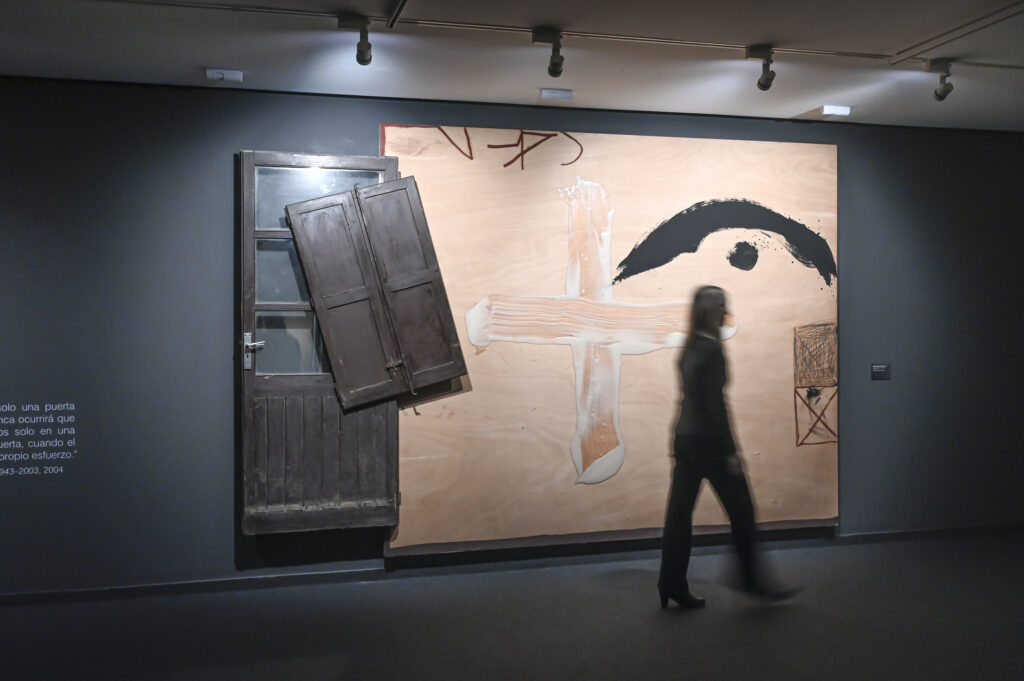
“Tàpies. Last decade (2002-2012)”
BANCAJA FOUNDATION
Plaza de Tetuán, 23
Valencia
From March 6 to August 30, 2026