
Rome (Italy). In 1956, the Palazzo Strozzi in Florence dedicated an exhibition to Pontormo, one of the greatest masters of Mannerism, on the occasion of the fourth centenary of his death. The exhibition which will be held until February 7 at the Scuderie del Quirinale does not respond to any anniversary celebration. Its curators present it as the first true monographic retrospective aimed at restoring the full historical and artistic place of one of the most unique creators of the Italian 16th century.
Jacopo Carucci, known as Le Pontormo (1494–1557), is in fact a contemporary of Leonardo da Vinci, Raphael and Michelangelo. Difficult for this artist to impose himself in the face of these tutelary figures of the Renaissance. However, this is the objective that Cristina Acidini has set for herself, at the origin of the exhibition of which she is the main curator alongside Elena Capretti, Philippe Costamagna, Bruce Edelstein and Carlo Falciani. “Pontormo must be appreciated for what he is, that is to say, not a follower of Michelangelo nor a Mannerist master in the pejorative sense, but a leading artistic personality,” she insists. Although the artist is famous in Tuscany, his native region, he has until now never benefited from a retrospective of this scale outside of Florence, thus allowing the international public to rediscover his work in its entirety.
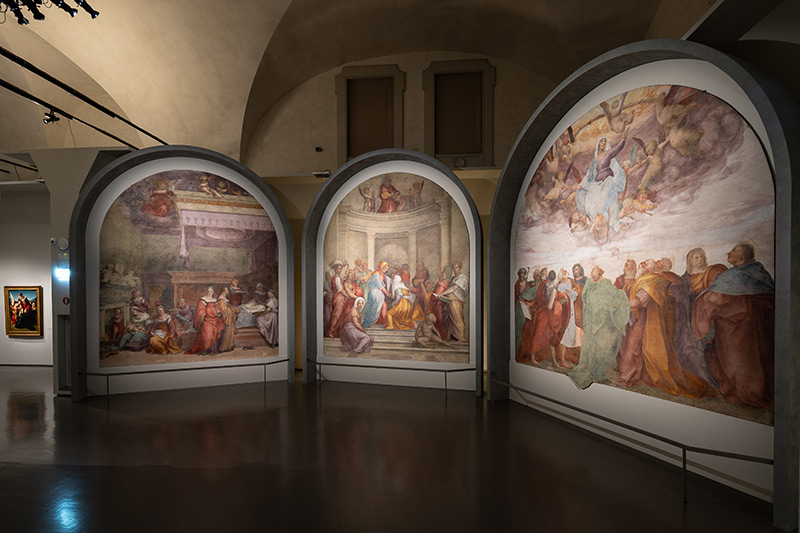
View of the Pontormo exhibition at the Scuderie del Quirinale in Rome.
© Alberto Novelli
The brevity of the exhibition title speaks volumes. Pontormo. Quite simply. The tour brings together more than 130 works (including 84 by Jacopo Carucci himself) from important private collections and prestigious international museums, such as the Louvre, the National Gallery in London, the Metropolitan Museum of Art in New York and the Getty Museum in Los Angeles. In addition to the Uffizi Gallery, essential for the success of such a monograph, the Accademia Gallery and the Bargello Museum in Florence, the Borghese Gallery and the Central Institute of Graphic Arts in Rome have also lent their most beautiful works.
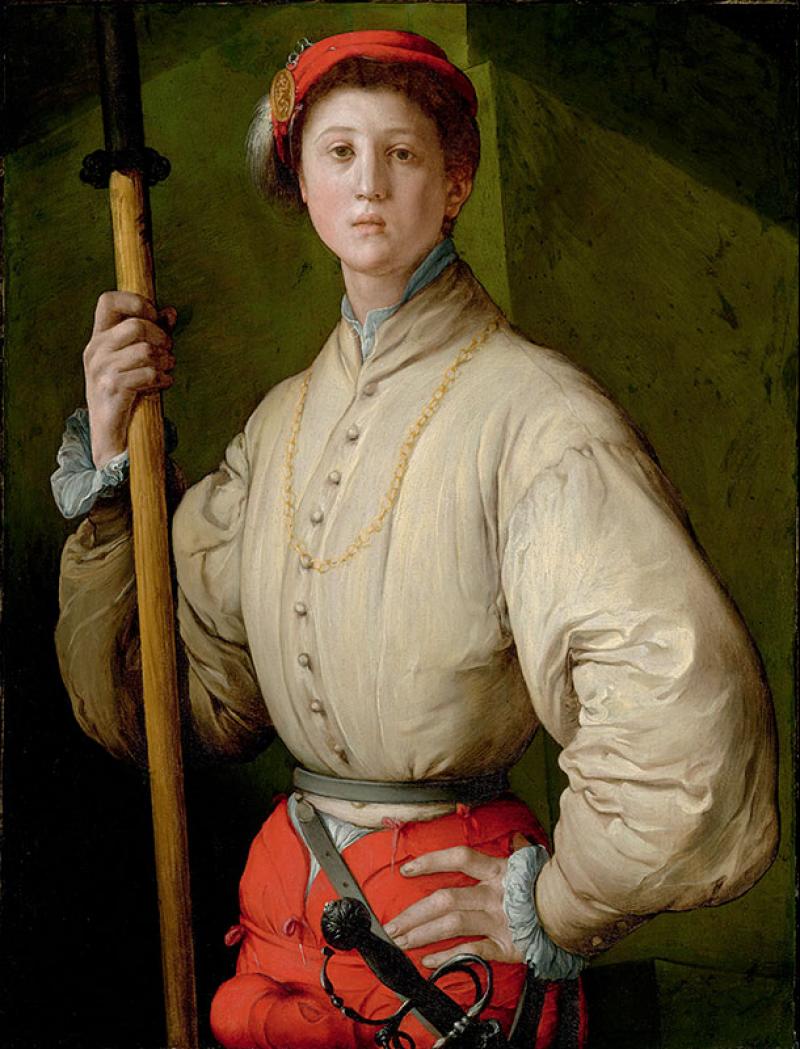
Pontormo (1494-1557), Portrait of a halberdiercirca 1529-1530, oil on canvas, 95 x 73 cm.
© J. Paul Getty Museum, Los Angeles
A bias towards scenographic sobriety
The churches of Florence and its surroundings are not left out. The famous Pieta (1525-1528) of the Santa Felicita church is exhibited alongside the four tondos of Evangelists painted by Pontormo and Bronzino, in a spatial arrangement that reproduces the original Capponi chapel. The route also allows you to admire the monumental frescoes of the Passion of Christmade in the early 1520s at the Chartreuse de Galluzzo in a style strongly inspired by the engravings of Albrecht Dürer. Weakened and altered by time, they have been the subject of large-scale restorations (in particular financed by the foundation Friends of Florence) before they can be moved and integrated into the exhibition.
The route opens with the first Visitation (1514-1516), a youthful fresco painted for the small cloister of the basilica of the Santissima Annunziata in Florence. This theme serves as a common thread for a visit which ends with the Visitation by Carmignano (1528-1532), a true icon of art history offered to the admiration of the public in the last room.
The feat of bringing together these works is coupled with an unusual scenographic success. Designing the hanging within the spaces of the Scuderie del Quirinale is a challenge that is not always successful due to the large rooms on the first floor, and the darker, low-ceilinged spaces on the second. The simple and refined choices here pay direct homage to the origins of the works and to Tuscan architecture. The use of gray tones for the walls explicitly refers to the pietra serenaa dark gray sandstone rock emblematic of Florentine monuments. This choice of sobriety highlights a chronological journey which leads the viewer from the first frescoes and the first drawings to the apogee of Pontormo’s work, embodied by large decorative ensembles such as that of the Capponi chapel. Upstairs, the tour highlights the rise of Florentine portraiture, a genre in which the artist distinguished himself. His famous portraits of a halberdier and Cosimo the Elder sit alongside works by contemporaries, such as Andrea del Sarto and Rosso Fiorentino.
For Simone Verde, director of the Uffizi Gallery, the strength of this museography lies in its ability to evoke the original context from which these works come while integrating into an aesthetic typical of modern exhibition spaces: “You enter with the impression of being in a cloister, then you find yourself in a museum room”. Beyond the rigorous art history lesson on the apogee of mannerism and the success of an elegant museography, the exhibition questions the contemporary resonance of Pontormo. A figure affected by the traumas of his time – notably the ravages of war and plague – the artist embodies the capacity of art to sublimate the crisis through aesthetics.
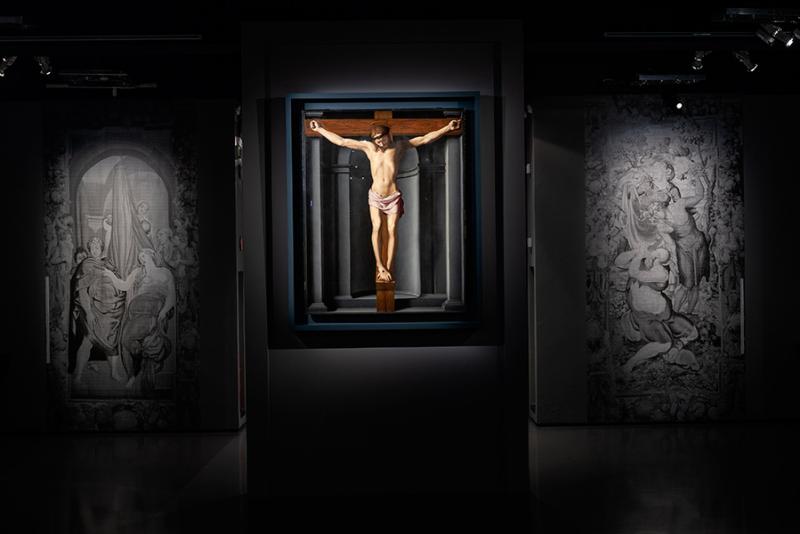
View of the Pontormo exhibition at the Scuderie del Quirinale in Rome.
© Alberto Novelli


