Antwerp (Belgium). “This is the last time you can take my mouth, this is the last time you can touch my breasts. » The litany, output from a small Sony monitor, continues, evoking the belly and sex, before ending with the words that give the work its title: “I am the last woman-object. » Created by Nicola L. in 1969, this television woman (see ill.) is one of the pieces in the retrospective devoted to her by the M-HKA in Antwerp.
Nicola L., I am the last woman-object1969.
© Nicola L. Collection & Archive and M HKA, Antwerp
Born in Morocco in 1932, Nicole Leuthe adopted the artist name Nicola L. Her artistic career led her to work between Paris, Brussels, New York, Ibiza, and Los Angeles where she died in 2018. She was married to Fred Lanzenberg, an influential Brussels gallery owner. The gallery contributed to the dissemination of pop art, New Realism then Narrative Figuration, and supported artists like Marcel Broodthaers.
If Nicola L.’s singular and nomadic career has developed from painting to sculpture and installation, from design to collective action and cinema, the relationship with the body and skin occupies a central place. It is also a work anchored in an era marked by political and cultural upheavals: feminism, the anti-war movement, collective intelligence and conceptual art.
The first surprise of the exhibition, focused on work from the late 1960s and 1970s, is to see that beyond the diversity of mediums and different periods of creation, the work maintains a real coherence throughout his artistic practice. Nicola L. also has a clarity of purpose. Thus, when she approaches design through elements of furniture, her “functional sculptures”, inspired by different parts of the body – sofa legs, eye lamps or woman-chest of drawers – combine a pop art aesthetic and at the same time a look at the objectification of the female body. The image carries a message, as in The ironing board woman on which is placed an iron in the shape of a phallus.
Enter the work
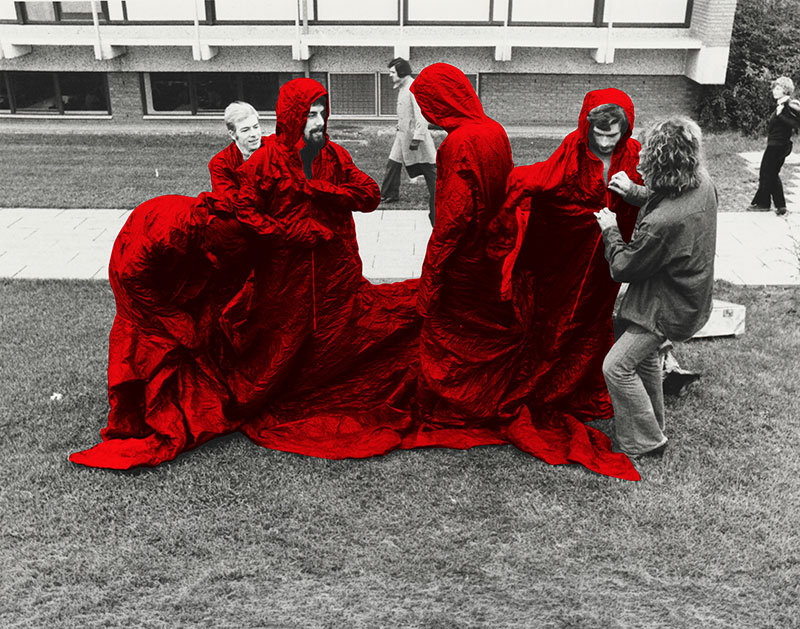
The Penetrables– the name she gave to costume sculptures similar to a second skin that she uses in compositions with ghostly bodies and in individual or collective performances – constitute one of the common threads of her work. Designed for the Isle of Wight Festival, Red Coat (1970) (see ill.), his emblematic work, is a red vinyl tarpaulin garment which will be worn in public places in different cities and continents by eleven participants, like a shared second skin.
The passage from performance, and even more from collective action, to a museum room may tend to dry up the subject, but in the case of Red Coatthe sculptural force of the piece allows it to go beyond the context of its staging. She also made her Penetrable portable and immersive sculptures where the boundary between the work of art and the spectator-participant blurs. The Fur Room is another expression: this imposing and enigmatic participatory installation in gray faux fur, which has been presented in different places in Europe, can be discovered by walking around, sliding your head, arms and legs inside or by entering just to look.
The route is also based on a major mediation effort: a very comprehensive visitor’s guide and a website put online for the occasion bringing together films and archive documents.
This exhibition is deserved recognition for a little-known artist who has found her place at the convergence of several disciplines. Imbued with utopia, Nicola L.’s vision, as radical as it is playful, speaks to the visitor today with intact freshness.