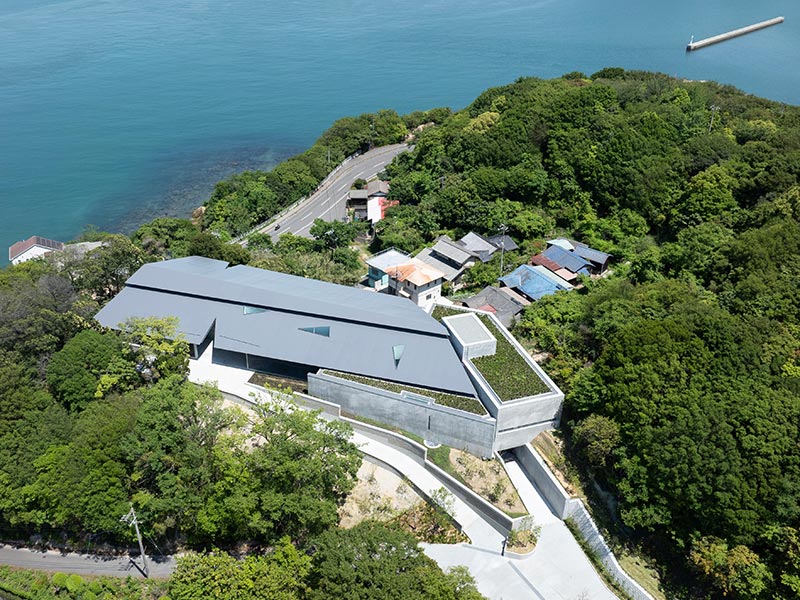
Naoshima, Kagawa (Japan). For the Naoshima New Museum of Art, inaugurated on May 31, the Fukutake Foundation took over the key elements of its other spaces, while adding unpublished aspects. She again called on her favorite architect, Tadao Ando, who thus signs her tenth realization on the island. We find his taste for concrete and geometric volumes, in a minimalist and angular bill but harmoniously integrated into the environment. Another common point: the particular attention paid to the experience of the visitor, designed as an art of living, with a restaurant with a panoramic terrace where a series of paintings specially made for the place by the Indian artist NS Harsha is presented, on the theme of marriage.
The new establishment also wishes to strengthen its links with the local population, like the Ando Museum, entirely devoted to the “Starchitect” and developed since 2013 in a traditional house in the heart of the same village of Honmura. This successful alliance, based on “Coexistence of nature, art and architecture”according to the terms of the foundation, is at the heart of “the Naoshima effect”, devoted by the inauguration of the Benesse House Museum in 1992. Intempt both a museum and a high -end hotel, this institution has given shape to the pioneer vision of the patron and entrepreneur Soichiro Fukutake. Illustrating the capacity of museums to regenerate a postindustrial declining ecosystem, this opening preceded by five years that of the Guggenheim of Bilbao, and was therefore prior to what was called “the Bilbao effect” in a similar perspective.
Naoshima New Museum of Art in Japan, designed by Tadao Andō.
© Gion
Even if the museum reaffirms the spiritual and contemplative dimension that characterizes the other art museums on the island, the latter-birth breathes a wind of novelty, as the adjective suggests “New”which opens the way to a continuous renewal.
Ryoji Kasahara, director general of the Fukutake Foundation, confirms this desire to adopt a more contemporary approach, centered on Asian scenes from the 21st century, while other museums reserve an important part of their spaces in Western art, like the Chichu Art Museum devoted to Claude Monet, Walter of Maria and James Turrell.
Its programming opens with the exhibition “From the Origin to the Future” (“From origins to the future”), designed in parallel to the Setouchi Triennale. The commissioner and director of the museum, Akiko Miki, brought together the works of a dozen artists from Asia in East, South and Southeast, for most orders. There is an assertive critical spirit, with sometimes subversive creations. Makoto Aida’s monumental sculpture, from his series “Monument for Nothing”, is emblematic in this regard. Taking up the form of toriitraditional Japanese portal symbolically separating the sacred space from the profane world, this national symbol is recreated by the artist in his most common vermilion red. However, it seems to be swaying, such as a play of medium-sized plastic, and covers itself with vignettes illustrating the main events, happy or tragic, which have marked the history of Japan since the 1990s. This intrusion of the contemporary in the old preserves all its ambiguity, oscillating between ex-vototo auspicious and symptoms of fungal diseases.
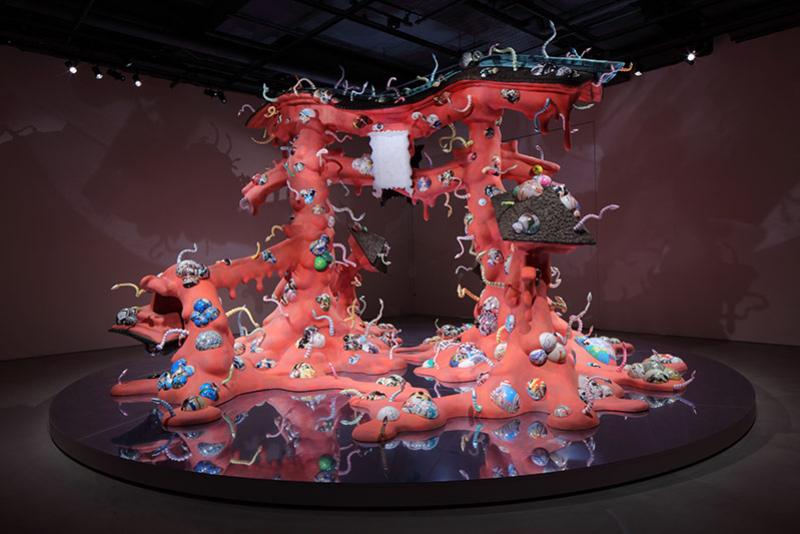
Makoto Aida, Red Torii Gate“Monument for Nothing” series, 2025.
© Kei Miyajima
The exhibition also offers historical contextualization enlightening the present. It presents in particular a large fresco by Takashi Murakami, which reinterprets the 18th century masterpiece attributed to Iwasa Matabei (1578-1650): Kyoto scenes and its surroundings (Rakuchu-rakugai-zu). Museum’s multimedia mediation presents Murakami as heir to Japanese painters “Eccentric”, in the wake of the work of the art historian Nobuo Tsuji. The latter contributed to the reassessment of the painters of the Edo period thanks to his reference work, Lineage of eccentricspublished in 1970 (not translated in French), where he is interested in artists developing an abundant imagination and populated by strange images, from Matabei to Utagawa Kuniyoshi (1798-1861).
The novelty finally lies in the visibility offered to artists of Southeast Asia. Among them, the Indonesian Heri Dono presents an imposing fresco featuring political figures of modern history in a surrealist universe. Thai Thai Pannaphan Yodmanee combines, on the other hand, and present through a wall installation made up of scenes painted according to the Siamese style and techniques on industrial ruins in reinforced concrete. This Panasiatic perspective undeniably contributes to enriching the island ecosystem of Naoshima, while giving a revitalizing impulse to the Japanese scene. The exhibition should continue until February 2026.