Paris. The recent retrospective of Lee Miller (1907-1977) was one of the Tate Britain’s biggest successes in terms of attendance, with more than 250,000 visitors. The one that has just opened at the Paris Museum of Modern Art (MAM) should also meet its audience. Initiated by Michal Goldschmidt, former assistant curator of modern British art at Tate Britain, it is organized with the MAM and the Art Institute of Chicago. The depth of the subject holds the attention from start to finish, served by very clear sequencing and airy scenography by Studio Matters. It is true that the work and different lives of this great photographer of the 20th century are fascinating. For around forty years, the photographer’s career has been the regular subject of exhibitions and books. Her years as a war reporter even inspired Ellen Kuras to make a film with Kate Winslet in the title role. The Lee Miller Archives, created in 1977 by Antony Penrose, Lee Miller’s son and his wife Suzanna after the photographer’s death, are particularly active in promoting the work. In France, the last retrospective nevertheless dates back to that organized by the Victoria and Albert Museum and presented by the Jeu de Paume in 2008-2009. It was particularly notable because it brought together for the first time original prints, nearly 150 – kept at the Lee Miller Archives, the V&A and in other public and private collections – supplemented by publications and a short extract from Jean Cocteau’s film, The Blood of a Poet (1932), in which Lee Miller plays one of the main roles.
A curatorial collaboration
Nearly twenty years later, the retrospective at the Museum of Modern Art in Paris has no equivalent, due to the scale of the collective research it generated and the loans from the Lee Miller Archives and various public and private collections. Nearly 250 prints are collected, including many vintage and unpublished. Fanny Schulmann, chief curator at the MAM in Paris, responsible for the photographic collections, participated in the new research, led by Hilary Floe, senior curator in modern and contemporary art at the Tate Britain, with whom she co-signed the retrospective in Paris. In particular, she delved into Lee Miller’s attachment to Paris – and the transformative dimension that the French capital played in his career – often reduced to his relationship with Man Ray, their artistic collaboration and the prism of surrealism. The Parisian exhibition expands this period by showing that the experiments with angles, framing, textures and subjects, carried out by the photographer, raise questions specific to her generation, crossed as much by surrealism as by expressionism, documentary reporting and political commitment. The collected period prints are particularly eloquent. Their quality and Lee Miller’s experiments in this area recall his great mastery of photographic techniques.
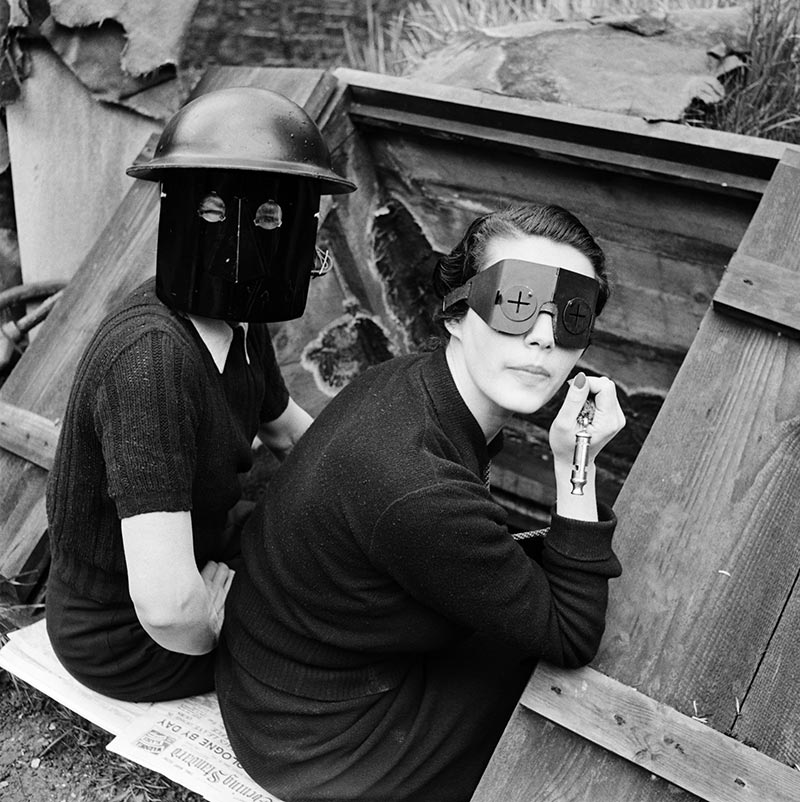
Lee Miller (1907-1977), Model Elizabeth Cowell wears a Digby Morton suitLondon, 1941.
© Lee Miller Archives
Importance of writing
Likewise, the section, dedicated to the liberation of the Dachau and Buchenwald concentration camps in April 1945, has more contact sheets and photographs than at Tate Britain. Unpublished in France – the Jeu de Paume exhibition was limited to publications in the press – they shed light on how the photographer positioned herself in the face of the horror she discovered. This part also allows you to read the typescript, partly reproduced in the article published in the Vogue English from June 1945. The importance of the written word in the work of Lee Miller is particularly highlighted at the MAM. Several cartels repeat sentences from his articles, and sound recordings produced by the Museum of Modern Art in Paris allow you to listen to some of his stories on the last struggles for Liberation, particularly in Alsace.
The illustrated timelines, which accompany each sequence of the journey, best contextualize each period with documentary photographs on Lee Miller, implicitly sketching his emotional and artistic universe. Contextualization found elsewhere in the exhibition in other forms. The three portraits together, which she produced during the years 1942-1943 of Martha Gellhorn, Margaret Bourke-White and Thérèse Bonney, recall their complicity.
The two distinct parts, those of the pre-war and the post-war devoted to friends, evoke, in touches, the links that Lee Miller forged with the artistic world on each side of the Atlantic. They highlight the permeation of surrealism in his work – including during the war and the Liberation –, perceptible in photographs of everyday details.
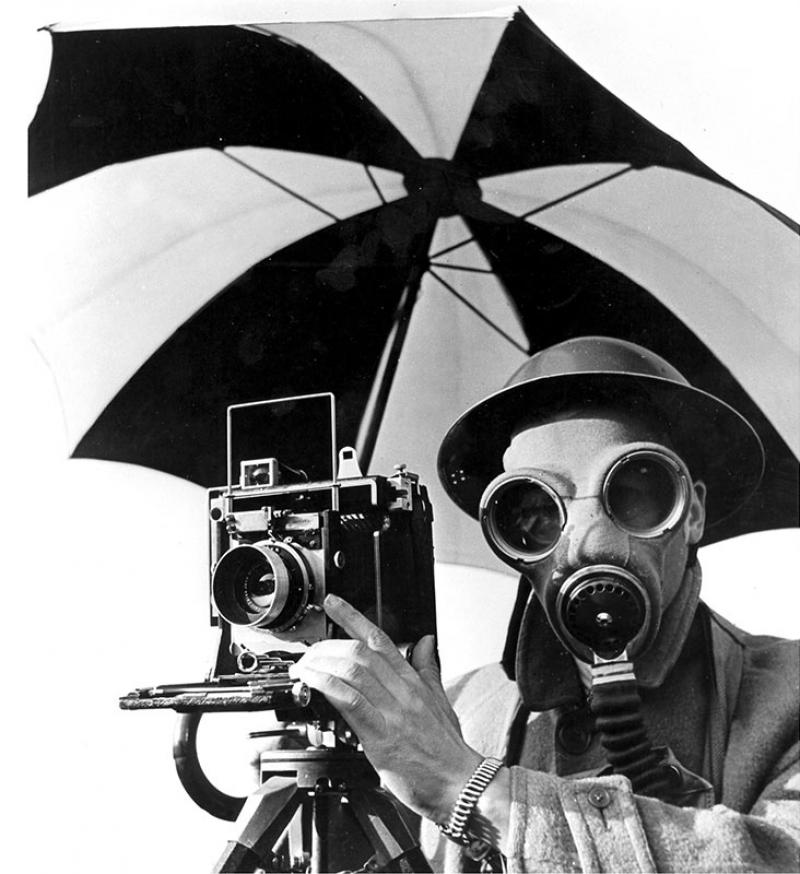
Lee Miller (1907-1977), David E. Scherman dressed for war1942.
© Lee Miller Archives, England 2025